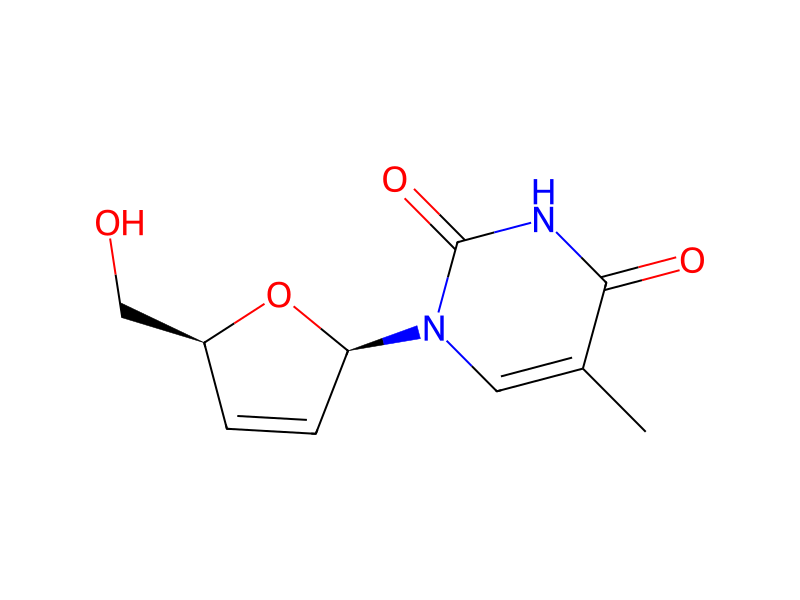
Basic information
- Standard SMILES
Cc1cn([C@H]2C=C[C@@H](CO)O2)c(=O)[nH]c1=O- InChIKey
XNKLLVCARDGLGL-JGVFFNPUSA-N- Molecular formula
- C10H12N2O4
- Average molar mass
- 224.21 g/mol
Overview
2',3'-didehydro-3'-deoxythymidine appears as white crystalline solid or powder. Odorless. (NTP, 1992)
Names & identifiers
- Preferred name
- Stavudine
- IUPAC
- 1-[(2R,5S)-5-(hydroxymethyl)-2,5-dihydrofuran-2-yl]-5-methylpyrimidine-2,4-dione
- English name
- Stavudine-α,α,α,6-d4
- Molecular formula
- C10H12N2O4
- Molecular weight
- 224.22
Names & synonyms
Show more names
Database identifiers
- CAS
1219803-67-4- ChEMBL
CHEMBL991- ChEBI
CHEBI:63581- UNII
- BO9LE4QFZF
- EC Number
- 641-374-0
- Nikkaji
- J83.276F
Properties
Computed structural properties
- XLogP
- -0.8
- Topological polar surface area
- 78.9 Ų
- Hydrogen bond donors
- 2
- Hydrogen bond acceptors
- 4
- Rotatable bonds
- 2
- Heavy atoms
- 16
- Formal charge
- 0
- Complexity
- 388
Experimental & physicochemical properties
LogP
log Kow = -0.72 at 37 °C
-0.8
Color/Form
White to off white crystalline solid
Colorless granular solid from ethanol/benzene
Solubility
50 to 100 mg/mL at 70 °F (NTP, 1992)
5-10 g/100 mL at 21 °C
30 mg/mL in propylene glycol at 23 °C
In water, 83 mg/mL at 23 °C
4.05e+01 g/L
Human Drugs
Breast Feeding; Lactation; Milk, Human; Anti-Infective Agents; Antiviral Agents; Anti-HIV Agents; Anti-Retroviral Agents; Reverse Transcriptase Inhibitors
FDA approved drugs -> Active ingredient
FDA approved drugs -> Active ingredient
Melting Point
318 to 320 °F (NTP, 1992)
159-160 °C
165-166 °C
159 - 160 °C
Physical Description
2',3'-didehydro-3'-deoxythymidine appears as white crystalline solid or powder. Odorless. (NTP, 1992)
Solid
Other Experimental Properties
Hydroxyl radical reaction rate constant = 1.21X10⁻¹⁰ cu cm/molec-sec at 25 °C /Estimated/
Ozone reaction rate constant = 2.1X10⁻¹⁶ cu cm/molec-sec at 25 °C /Estimated/
Safety & regulation
GHS classification
GHS Classification
Danger
H302 (66.7%): Harmful if swallowed [Warning Acute toxicity, oral]
P203, P260, P261, P263, P264, P264+P265, P270, P271, P280, P301+P317, P302+P352, P304+P340, P305+P351+P338, P318, P319, P321, P330, P332+P317, P337+P317, P362+P364, P403+P233, P405, and P501 (click each P-code to see the statement)
Aggregated GHS information provided per 3 reports by companies from 3 notifications to the ECHA C&L Inventory. Each notification may be associated with multiple companies.
Hazard information
FDA Requirements
The Approved Drug Products with Therapeutic Equivalence Evaluations List identifies currently marketed prescription drug products, incl stavudine, approved on the basis of safety and effectiveness by FDA under sections 505 of the Federal Food, Drug, and Cosmetic Act.
Safety & protection
First Aid
EYES: First check the victim for contact lenses and remove if present. Flush victim's eyes with water or normal saline solution for 20 to 30 minutes while simultaneously calling a hospital or poison control center. Do not put any ointments, oils, or medication in the victim's eyes without specific instructions from a physician. IMMEDIATELY transport the victim after flushing eyes to a hospital even if no symptoms (such as redness or irritation) develop.
Storage Conditions
Commercially available stavudine capsules should be stored in a tight container at a controlled room temperature of 15-30 °C. Stavudine powder for oral solution should be kept in a tight container at a controlled room temperature of 15-30 °C and protected from excessive moisture. Following reconstitution, the oral solution should be stored in a tight container at 2-8 °C.
Nonfire Spill Response
SMALL SPILLS AND LEAKAGE: If you spill this chemical, you should dampen the solid spill material with water, then transfer the dampened material to a suitable container. Use absorbent paper dampened with water to pick up any remaining material. Seal your contaminated clothing and the absorbent paper in a vapor-tight plastic bag for eventual disposal. Wash all contaminated surfaces with a soap and water solution. Do not reenter the contaminated area until the Safety Officer (or other responsible person) has verified that the area has been properly cleaned.
Disposal Methods
SRP: The most favorable course of action is to use an alternative chemical product with less inherent propensity for occupational exposure or environmental contamination. Recycle any unused portion of the material for its approved use or return it to the manufacturer or supplier. Ultimate disposal of the chemical must consider: the material's impact on air quality; potential migration in soil or water; effects on animal, aquatic, and plant life; and conformance with environmental and public health regulations.
Personal Protective Equipment (PPE)
RECOMMENDED RESPIRATOR: Where the neat test chemical is weighed and diluted, wear a NIOSH-approved half face respirator equipped with an organic vapor/acid gas cartridge (specific for organic vapors, HCl, acid gas and SO2) with a dust/mist filter. (NTP, 1992)
Toxicology
Interactions
These medications /didanosine or hydroxyurea/ in combination with stavudine may increase the risk of potentially fatal hepatotoxicity or pancreatitis.
Medications that cause neuropathy (e.g., ethambutol, isoniazid, phenytoin, vincristine) should be used cautiously in patients receiving stavudine. Regimens containing stavudine, didanosine, and/or hydroxyurea are associated with an increased risk for neuropathy. Zidovudine and stavudine should not be used concomitantly because zidovudine antagonizes the effect of stavudine.
In vitro studies detected an antagonistic antiviral effect between stavudine and zidovudine at a molar ratio of 20 to 1, respectively; concurrent use is not recommended until in vivo studies demonstrate that these medications are not antagonistic in their anti-HIV activity; zidovudine may competitively inhibit the intracellular phosphorylation of stavudine and so these two medications in combination are not recommended.
... If stavudine is used in conjunction with didanosine (with or without hydroxyurea), there is an increased risk of pancreatitis, peripheral neuropathy, and liver function abnormalities. In addition, fatal pancreatitis and hepatotoxicity may occur more frequently in patients treated with stavudine used in conjunction with didanosine and hydroxyurea. If stavudine is used concomitantly with didanosine, patients should be closely monitored.
Hepatotoxicity
Stavudine is a well known cause of liver injury and is regularly listed in case series of drug induced liver injury and acute liver failure. Mild and transient elevations in liver enzymes occur in up to half of patients on stavudine, but elevations above 5 times normal occur in only 5% to 13% of treated patients. Clinically apparent hepatotoxicity due to stavudine is well described and is usually marked by lactic acidosis, marked hepatic steatosis (microvesicular fat), and progressive hepatic synthetic dysfunction (LASH). This form of liver injury typically arises only after 2 to 6 months of therapy and is preceded by nonspecific prodromal symptoms of anorexia, nausea, vomiting, diarrhea, and weakness which is followed by dyspnea, jaundice and confusion. Lactic acidosis often accompanies the hepatic injury and may be the predominant clinical feature. Jaundice arises late and serum enzymes are unusually only mildly or moderated elevated, the pattern being mixed or actually cholestatic. Pancreatitis, myopathy and neuropathy may also occur. Lipodystrophy is frequently present. Liver histology during the early course of injury demonstrates marked microvesicular fat with little hepatocyte injury. Subsequently, cholestasis arises and the fatty change may evolve to a macrovesicular pattern. Late changes include ballooning cell degeneration, Mallory bodies and fibrosis. The hepatotoxicity associated with stavudine can be rapidly fatal, but is potentially reversable with intensive support and early withdrawal of therapy (Case 1). Monitoring of patients on stavudine demonstrates that asymptomatic elevations of serum lactate (hyperlactatemia) usually precedes the appearance of clinical symptoms and acidosis. Once lactic acidosis is present, however, the mortality rate is high (33% to 50%) (Case 2). Preexisting liver injury, female sex, older age, obesity, alcohol use and concurrent therapy with didanosine, ribavirin and tenofovir appear to increase the risk of this syndrome in patients taking stavudine.
Environmental Fate
TERRESTRIAL FATE: Based on a classification scheme(1), an estimated Koc value of 10(SRC), determined from a log Kow of -0.72(2) and a regression-derived equation(3), indicates that stavudine is expected to have very high mobility in soil(SRC). Volatilization of stavudine from moist soil surfaces is not expected to be an important fate process(SRC) given an estimated Henry's Law constant of 2.3X10⁻¹⁵ atm-cu m/mole(SRC), using a fragment constant estimation method(4). Stavudine is not expected to volatilize from dry soil surfaces(SRC) based upon an estimated vapor pressure of 9.5X10⁻¹² mm Hg(SRC), determined from a fragment constant method(5). Biodegradation data were not available(SRC, 2005).
AQUATIC FATE: Based on a classification scheme(1), an estimated Koc value of 10(SRC), determined from a log Kow of -0.72(2) and a regression-derived equation(3), indicates that stavudine is not expected to adsorb to suspended solids and sediment(SRC). Volatilization from water surfaces is not expected(3) based upon an estimated Henry's Law constant of 2.3X10⁻¹⁵ atm-cu m/mole(SRC), developed using a fragment constant estimation method(4). According to a classification scheme(5), an estimated BCF of 0.17(SRC), from its log Kow(2) and a regression-derived equation(6), suggests the potential for bioconcentration in aquatic organisms is low(SRC). Biodegradation data were not available(SRC, 2005).
ATMOSPHERIC FATE: According to a model of gas/particle partitioning of semivolatile organic compounds in the atmosphere(1), stavudine, which has an estimated vapor pressure of 9.5X10⁻¹² mm Hg at 25 °C(SRC), determined from a fragment constant method(2), is expected to exist solely in the particulate phase. Particulate-phase stavudine may be removed from the air by wet and dry deposition(SRC). Stavudine does not absorb light with wavelengths >290 nm(3) and is not expected to be susceptible to direct photolysis by sunlight(SRC).
Signs and Symptoms
Side effects include peripheral neuropathy tingling, burning, numbness, or pain in the hands or feet), fatal lactic acidosis has been reported in patients treated with stavudine (ZERIT) in combination with other antiretroviral agents, severe liver enlargement, inflammation (pain and swelling) of the liver, and liver failure.
Soil Adsorption/Mobility
The Koc of stavudine is estimated as 10 (SRC), using a log Kow of -0.72(1) and a regression-derived equation(2). According to a classification scheme(3), this estimated Koc value suggests that stavudine is expected to have very high mobility in soil.
Human Toxicity Excerpts
/SIGNS AND SYMPTOMS/ ... Complications of chronic overdosage include peripheral neuropathy and hepatic toxicity.
/SIGNS AND SYMPTOMS/ Lactic acidosis and severe hepatomegaly with steatosis, including some fatalities, have been reported in patients receiving stavudine and also have been reported in patients receiving other nucleoside reverse transcriptase inhibitors (NRTIs). Although relative rates of lactic acidosis have not been assessed in prospective well-controlled studies, longitudinal cohort and retrospective studies suggest that this adverse effect may occur more often with antiretroviral regimens that include stavudine. Female gender, obesity, and long-term therapy with NRTIs also may be risk factors. Fatal lactic acidosis has been reported in pregnant women who received antiretroviral regimens that included both stavudine and didanosine. In addition, deaths attributed to hepatotoxicity have occurred in patients who received antiretroviral regimens that included stavudine, didanosine, and hydroxyurea.
/SIGNS AND SYMPTOMS/ Rapidly ascending neuromuscular weakness, which has been fatal in some cases, has been reported rarely in patients receiving stavudine in conjunction with other antiretroviral agents. Most reported cases of motor weakness occurred in the setting of lactic acidosis or symptomatic elevations of serum lactate concentrations. The evolution of motor weakness may mimic the clinical presentation of Guillain-Barre syndrome (including respiratory failure), and symptoms may continue or worsen following discontinuance of antiretroviral therapy.
/CASE REPORTS/ Pancreatitis, which has been fatal in some cases, has occurred in patients receiving stavudine in conjunction with didanosine (with or without hydroxyurea) and has been reported in both treatment-naive and previously treated patients, regardless of degree of immunosuppression. In an early clinical study evaluating stavudine, pancreatitis was observed in less than 1% of adult patients receiving stavudine monotherapy. Patients receiving didanosine in conjunction with stavudine (with or without hydroxyurea) may be at increased risk of pancreatitis; there have been at least 2 fatalities related to pancreatitis in patients receiving didanosine concomitantly with stavudine, indinavir, and hydroxyurea. There also has been at least one death related to pancreatitis in a patient receiving didanosine in conjunction with stavudine and nelfinavir.
For more Human Toxicity Excerpts (Complete) data for STAVUDINE (8 total), please visit the HSDB record page.
Regulatory information
FDA Requirements
The Approved Drug Products with Therapeutic Equivalence Evaluations List identifies currently marketed prescription drug products, incl stavudine, approved on the basis of safety and effectiveness by FDA under sections 505 of the Federal Food, Drug, and Cosmetic Act.
Chemistry & industry
Pharmacology
ATC Code
J - Antiinfectives for systemic use
QJ - Antiinfectives for systemic use
Pharmacodynamics
Stavudine is a nucleoside reverse transcriptase inhibitor (NRTI) with activity against Human Immunodeficiency Virus Type 1 (HIV-1). Stavudine is phosphorylated to active metabolites that compete for incorporation into viral DNA. They inhibit the HIV reverse transcriptase enzyme competitively and act as a chain terminator of DNA synthesis. The lack of a 3'-OH group in the incorporated nucleoside analogue prevents the formation of the 5' to 3' phosphodiester linkage essential for DNA chain elongation, and therefore, the viral DNA growth is terminated.
Mechanism of Action
Stavudine inhibits the activity of HIV-1 reverse transcriptase (RT) both by competing with the natural substrate dGTP and by its incorporation into viral DNA.
Enzymatic conversion of stavudine to d4T-triphosphate appears to be complex, involving several steps and enzymes. Stavudine is first converted to dideoxydidehydrothymidine-5'-monophosphate (d4T-monophosphate) by thymidine kinase. Subsequently, d4T-monophosphate is converted to dideoxydidehydrothymidine-5'-diphosphate (d4T-diphosphate), and then to d4T-triphosphate, presumably by the same cellular kinases involved in the metabolism of zidovudine. ... d4T-Triphosphate is a structural analog of thymidine triphosphate, the natural substrate for viral RNA-directed DNA polymerase. ... d4T-triphosphate appears to compete with thymidine triphosphate for viral RNA-directed DNA polymerase and incorporation into viral DNA. Following incorporation of d4T-triphosphate into the viral DNA chain instead of thymidine triphosphate, synthesis is terminated prematurely because the absence of the 3'-hydroxy group on the drug prevents further 5' to 3' phosphodiester linkages.
Stavudine is phosphorylated by cellular kinases to the active metabolite stavudine triphosphate. Stavudine triphosphate inhibits the activity of HIV reverse transcriptase both by competing with the natural substrate deoxythymidine triphosphate (Ki =0.0083 to 0.032 uM), and by its incorporation into viral DNA causing a termination of DNA chain elongation because stavudine lacks the essential 3'-OH group. Stavudine triphosphate inhibits cellular DNA polymerase beta and gamma, and markedly reduces the synthesis of mitochondrial DNA.
d4T-Triphosphate can bind to and inhibit some mammalian cellular DNA polymerases, particularly beta- and gamma-polymerases, in vitro, and markedly reduce the synthesis of mitochondrial DNA. ...gamma-polymerase, an enzyme involved in mitochondrial DNA synthesis, is the polymerase most susceptible to inhibition. However, d4T-triphosphate and other dideoxynucleoside triphosphates appear to have much greater affinity for viral RNA-directed DNA polymerase than for mammalian DNA polymerases. ... Inhibition of beta- and gamma-polymerases by these drugs may account, to some extent, for the toxic effects associated with stavudine and other nucleosides in humans.
Biological Half-Life
0.8-1.5 hours (in adults)
Intracellular half life of stavudine triphosphate: Approximately 3.5 hours. /Stavudine triphosphate/
Normal renal function: Adults: 0.8 to 1.5 hours (intravenous); 1.14 to 1.74 hours (oral). Children (5 weeks to 15 years): 0.83 to 1/39 hours (intravenous); 0.7 to 1.22 hours (oral). Neonates (14 to 28 days) 1.3 to 1.88 (oral). Neonates (day of birth): 3.26 to 7.28 (oral). Renal function impairment (creatinine clearance 26 to 50 mL/min): Approximately 1 to 6 hours. Renal function impairment (creatinine clearance 9 to 25 mL/min): Approximately 3.7 to 5.5 hours. Renal function impairment (creatinine clearance > 50 mL/min): Approximately 1.3 to 2.1 hours. Renal function impairment (hemodialysis patients): Approximately 4.0 to 6.8 hours.
Twenty-two patients were studied after the first oral dose of 0.67, 1.33, 2.67, or 4 mg/kg of body weight; 17 of them underwent an additional steady-state pharmacokinetic evaluation after thrice-daily dosing of the above doses. ... The mean values for plasma elimination half-life ranged from 1 to 1.6 hr.
Metabolism/Metabolites
Phosphorylated intracellularly to stavudine triphosphate, the active substrate for HIV-reverse transcriptase.
The metabolic fate of stavudine has not been elucidated in humans. Intracellularly, in both virus-infected and uninfected cells, stavudine is converted to stavudine monophosphate by cellular thymidine kinase. The monophosphate is subsequently converted to stavudine diphosphate and then to stavudine triphosphate, presumably by the same cellular kinases involved in the metabolism of zidovudine. Intracellular (host cell) conversion of stavudine to the triphosphate derivative is necessary for the antiviral activity of the drug.
Phosphorylated intracellularly to stavudine triphosphate, the active substrate for HIV-reverse transcriptase. Half Life: 0.8-1.5 hours (in adults)
FDA Pharmacological Classification
BO9LE4QFZF
STAVUDINE
Established Pharmacologic Class [EPC] - Human Immunodeficiency Virus Nucleoside Analog Reverse Transcriptase Inhibitor
Nucleoside Analog [EXT]
Mechanisms of Action [MoA] - Nucleoside Reverse Transcriptase Inhibitors
Stavudine is a Human Immunodeficiency Virus Nucleoside Analog Reverse Transcriptase Inhibitor. The mechanism of action of stavudine is as a Nucleoside Reverse Transcriptase Inhibitor.
MeSH Pharmacological Classification
Drugs that are chemically similar to naturally occurring metabolites, but differ enough to interfere with normal metabolic pathways. (From AMA Drug Evaluations Annual, 1994, p2033)
Inhibitors of reverse transcriptase (RNA-DIRECTED DNA POLYMERASE), an enzyme that synthesizes DNA on an RNA template.
Agents used to treat AIDS and/or stop the spread of the HIV infection. These do not include drugs used to treat symptoms or opportunistic infections associated with AIDS.
Absorption, Distribution and Excretion
Following oral administration, stavudine is rapidly absorbed (bioavailability is 68-104%).
46 ± 21 L
Renal cl=272 mL/min [Healthy subjects receiving 80 mg PO]
Stavudine is rapidly absorbed following oral administration, and peak plasma concentrations of the drug are attained within 1 hour after the dose. Oral bioavailability of stavudine is reported to be about 86% in adults and 77% in pediatric patients 5 weeks to 15 years of age.
Data from single- and multiple-dose studies indicate that peak plasma concentrations and AUC of stavudine increase in proportion to dose over the dosage range 0.03 -4 mg/kg; there is no evidence that accumulation occurs following multiple doses.
Binding of stavudine to serum proteins is negligible over the concentration range of 0.01-11.4 ug/mL.
Uses & manufacturing
Uses
Antiviral
Medication
Use (kg; approx.) in Germany (2009): >10
For the treatment of human immunovirus (HIV) infections.
Formulations/Preparations
Zerit
Oral: Capsules: 15 mg Zerit (with parabens), (Bristol-Myers Squibb), 20 mg Zerit (with parabens), (Bristol-Myers Squibb) 30 mg Zerit (with parabens), (Bristol-Myers Squibb) 40 mg Zerit (with parabens), (Bristol-Myers Squibb); For solution: 1 mg/mL Zerit (with parabens), (Bristol-Myers Squibb).
General Manufacturing Information
While data specific to stavudine were not available(SRC, 2005), the literature suggests that some pharmaceutically active compounds originating from human and veterinary therapy are not eliminated completely in municipal sewage treatment plants and are therefore discharged into receiving waters(1). Wastewater treatment processes often were not designed to remove them from the effluent(2). Selected organic waste compounds may be degrading to new and more persistent compounds that may be released instead of or in addition to the parent compound(2). Studies have indicated that several polar pharmaceutically active compounds can leach through subsoils into aquifers(1).
Applications
UsesStavudine-alpha,alpha,alpha,6-d4 (CAS# 1219803-67-4) is a useful isotopically labeled research compound.
Suppliers9 total
Related reactions
No reaction records under the current filter.
Linked notes
Loading…