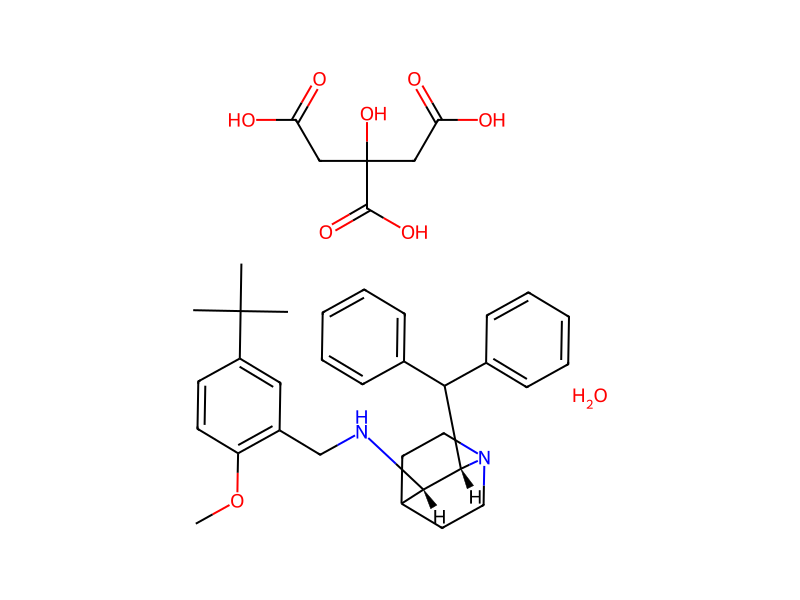
Basic information
- Standard SMILES
COc1ccc(C(C)(C)C)cc1CN[C@H]1C2CCN(CC2)[C@H]1C(c1ccccc1)c1ccccc1.O.O=C(O)CC(O)(CC(=O)O)C(=O)O- InChIKey
PGVSXRHFXJOMGW-YBZGWEFGSA-N- Molecular formula
- C38H50N2O9
- Average molar mass
- 678.8 g/mol
- Monoisotopic mass
- 678.35163118
Overview
Maropitant Citrate is a neurokinin receptor antagonist with antiemetic activity. This agent is approved for veterinary use only.
Names & identifiers
- Preferred name
- Maropitant Citrate
- IUPAC
- (2S,3S)-2-benzhydryl-N-[(5-tert-butyl-2-methoxyphenyl)methyl]-1-azabicyclo[2.2.2]octan-3-amine;2-hydroxypropane-1,2,3-tricarboxylic acid;hydrate
- English name
- Maropitant citrate hydrate
- Molecular formula
- C38H48N2O8
- Molecular weight
- 660.81
Names & synonyms
Show more names
Database identifiers
- CAS
359875-09-5- PubChem CID
- 204107
- DTXSID
DTXSID70957411- ChEMBL
CHEMBL2107353- UNII
- LXN6S3999X
- EC Number
- 837-630-8
Properties
Computed structural properties
- Topological polar surface area
- 158 Ų
- Hydrogen bond donors
- 6
- Hydrogen bond acceptors
- 11
- Rotatable bonds
- 13
- Heavy atoms
- 49
- Formal charge
- 0
- Complexity
- 848
Experimental & physicochemical properties
Animal Drugs
EMA approved medicines: Veterinary medicine
EMA approved medicines: Veterinary medicine
EMA approved medicines: Veterinary medicine
Physicochemical properties
- Melting point
- 153 · 153-159 °C(lit.)
- Flash point
- 100 °C · 100 °C
- storage temp.
- 2 · 2-8°C
- solubility
- 2 O: · H2O: 1 M at 20 °C, clear, colorless
- form
- white to off-white crystalline powder
- Water Solubility
- 3 mg/mL · Water: 3 mg/mL (4.42 mM)
- Major Application
- agricultureenvironmentalfood and beverages || microbiology
- InChIKey
- XDZPFSKCXRGRIO-OHTRWSNQNA-N
- SMILES
- C(O)(C(=O)O)(CC(=O)O)CC(=O)O.C(C1C=CC=CC=1)(C1C=CC=CC=1)[C@@H]1N2CCC(CC2)[C@@H]1NCC1C=C(C(C)(C)C)C=CC=1OC |&1:26,33,r|
- CAS DataBase Reference
- 359875 · 359875-09-5(CAS DataBase Reference)
- FDA UNII
- 6 S3999X · LXN6S3999X
- UNSPSC Code
- 41171614 · 41171614
- NACRES
- 85 · NA.85
- Symbol(GHS)
- 8 · GHS08,GHS09,GHS05
- Signal word
- Danger
- Hazard statements
- 400 · H400-H373-H318-H410
- Precautionary statements
- 273 · P273-P391-P501-P273-P391-P501-P260-P314-P501-P280-P305+P351+P338-P310
- PPE
- 2 · Eyeshields, Faceshields, Gloves, type P2 (EN 143) respirator cartridges
- Hazard Codes
- Xi,T
- Risk Statements
- 41 · 41-42/43-36/37/38-25
- Safety Statements
- 26 · 26-39-45-36/37-22
- RIDADR
- 3284 · UN 3284 6.1/PG 3
- WGK Germany
- 1 · 1
- RTECS
- 7350000 · GE7350000
- F
- 9 · 9
- Storage Class
- 6.1 C · 6.1C - Combustible acute toxic Cat.3toxic compounds or compounds which causing chronic effects
- Hazard Classifications
- 3 OralEye · Acute Tox. 3 OralEye Irrit. 2Skin Irrit. 2Skin Sens. 1
Safety & regulation
GHS classification
GHS Classification
Danger
H317 (50%): May cause an allergic skin reaction [Warning Sensitization, Skin]
P260, P261, P264+P265, P272, P273, P280, P302+P352, P305+P351+P338, P305+P354+P338, P317, P319, P321, P333+P317, P337+P317, P362+P364, P391, and P501 (click each P-code to see the statement)
Aggregated GHS information provided per 2 reports by companies from 2 notifications to the ECHA C&L Inventory. Each notification may be associated with multiple companies.
Hazard information
Safety data
- F
- 9
- PPE
- Eyeshields, Faceshields, Gloves, type P2 (EN 143) respirator cartridges
- wgk
- 1
- rtecs
- GE7350000
- ridadr
- UN 3284 6.1/PG 3
- risk_code
- 41-42/43-36/37/38-25
- Signal word
- Danger
- Symbol(GHS)
- GHS08,GHS09,GHS05
- hazard_code
- Xi,T
- safety_code
- 26-39-45-36/37-22
- Storage Class
- 6.1C - Combustible acute toxic Cat.3toxic compounds or compounds which causing chronic effects
- Hazard statements
- H400-H373-H318-H410
- Hazard Classifications
- Acute Tox. 3 OralEye Irrit. 2Skin Irrit. 2Skin Sens. 1
- Precautionary statements
- P273-P391-P501-P273-P391-P501-P260-P314-P501-P280-P305+P351+P338-P310
Chemistry & industry
Pharmacology
Applications
DescriptionMaropitant citrate hydrate is a specific neurokinin-1 (NK-1) receptor antagonist that selectively inhibits the production of substance P, a mediator involved in signalling vomiting. Maropitant citrate was therefore originally used to treat vomiting in dogs and cats. Currently, it is also used as an adjunct to visceral analgesia in dogs and cats, and in other species such as horses and birds.
UsesAnti-emetic.
Upstream & downstream products
Upstream raw materials
Suppliers50 total
Related reactions
No reaction records under the current filter.
Linked notes
Loading…