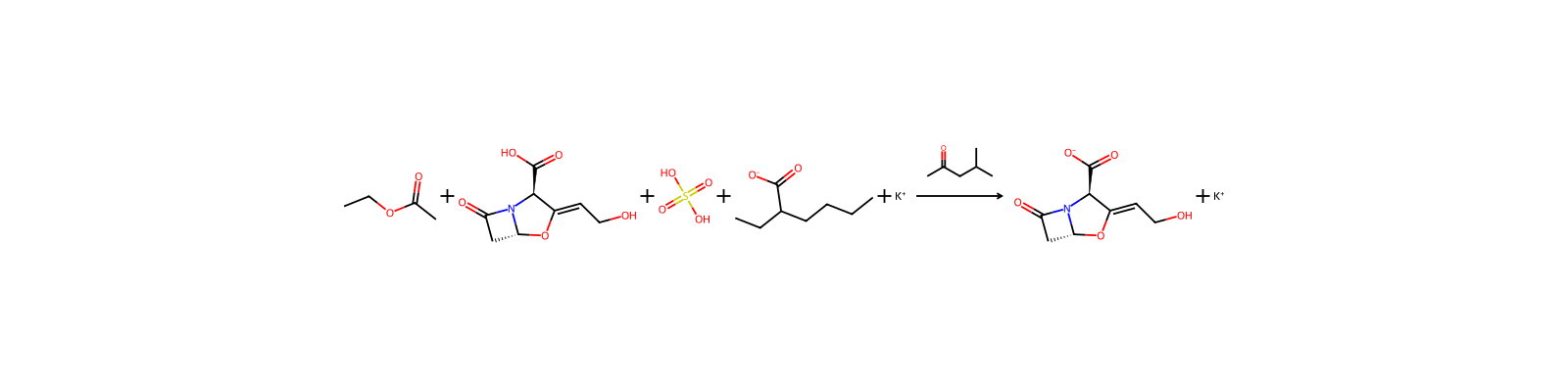
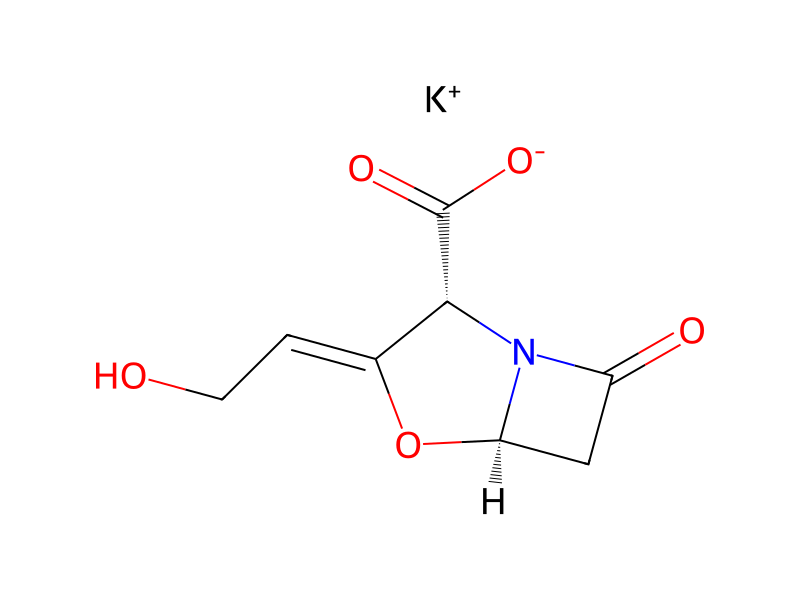
Basic information
- Standard SMILES
O=C([O-])[C@H]1/C(=C/CO)O[C@@H]2CC(=O)N21.[K+]- InChIKey
ABVRVIZBZKUTMK-JSYANWSFSA-M- Molecular formula
- C8H8KNO5
- Average molar mass
- 237.25 g/mol
- Monoisotopic mass
- 237.00395384
Names & identifiers
- Preferred name
- Potassium Clavulanate
- IUPAC
- potassium (2R,3Z,5R)-3-(2-hydroxyethylidene)-7-oxo-4-oxa-1-azabicyclo[3.2.0]heptane-2-carboxylate
Names & synonyms
Potassium clavulanate61177-45-5CLAVULANATE POTASSIUMAmonateBRL 14151KQ42OMW3AT8BRL-14151KCHEBI:85264DTXSID60210067AUGMENTIN COMPONENT CLAVULANATE POTASSIUM4-Oxa-1-azabicyclo(3.2.0)heptane-2-carboxylic acid, 3-(2-hydroxyethylidene)-7-oxo-, monopotassium salt, (2R-(2alpha,3Z,5alpha))-Clavulanic Acid, Monopotassium Salt
Show more names
Clavulanate, PotassiumPotassium, ClavulanateRefChem:56807DTXCID601325584-Oxa-1-azabicyclo(3.2.0)heptane-2-carboxylic acid, 3-(2-hydroxyethylidene)-7-oxo-, Monopotassium Salt,(2R-(2alpha,3Z,5alpha))-Monopotassium (2R,5R)-3-((1Z)-2-hydroxyethylidene)-7-oxo-4-oxa-1-azabicyclo(3.2.0)heptane-2-carboxylateClavulanic Acid Potassium SaltClavulanate (potassium)
Database identifiers
- CAS
61177-45-5- PubChem CID
- 23665591
- DTXSID
DTXSID60210067- ChEMBL
CHEMBL1003- ChEBI
CHEBI:85264- UNII
- Q42OMW3AT8
- EC Number
- 262-640-9、689-367-1
- Nikkaji
- J1.462.355H、J86.067K
Properties
Computed structural properties
- Topological polar surface area
- 89.9 Ų
- Hydrogen bond donors
- 1
- Hydrogen bond acceptors
- 5
- Rotatable bonds
- 2
- Heavy atoms
- 15
- Formal charge
- 0
- Complexity
- 329
Safety & regulation
GHS classification
GHS Classification
Danger
H228 (100%): Flammable solid [Danger Flammable solids];H252 (74.6%): Self-heating in large quantities; may catch fire [Warning Self-heating substances and mixtures];H317 (69.5%): May cause an allergic skin reaction [Warning Sensitization, Skin];H319 (23.7%): Causes serious eye irritation [Warning Serious eye damage/eye irritation];H334 (69.5%): May cause allergy or asthma symptoms or breathing difficulties if inhaled [Danger Sensitization, respiratory];H361 (13.6%): Suspected of damaging fertility or the unborn child [Warning Reproductive toxicity]
P203, P210, P233, P235, P240, P241, P260, P261, P264+P265, P271, P272, P280, P284, P302+P352, P304+P340, P305+P351+P338, P318, P321, P333+P317, P337+P317, P342+P316, P362+P364, P370+P378, P403, P405, P407, P410, P413, P420, and P501 (click each P-code to see the statement)
Aggregated GHS information provided per 59 reports by companies from 9 notifications to the ECHA C&L Inventory. Each notification may be associated with multiple companies.;Information may vary between notifications depending on impurities, additives, and other factors. The percentage value in parenthesis indicates the notified classification ratio from companies that provide hazard codes. Only hazard codes with percentage values above 10% are shown. For more detailed information, please visit ECHA C&L website.
Hazard information
Regulatory InformationPotassium clavulanate: Does not have an individual approval but may be used under an appropriate group standard
Hazard Classes and Categories
Flam. Sol. 1 (100%);Self-heat. 2 (74.6%);Skin Sens. 1 (69.5%);Eye Irrit. 2 (23.7%);Resp. Sens. 1 (69.5%);Repr. 2 (13.6%)
Flam. Sol. 2 (100%);Self-heat. 2 (100%);Eye Irrit. 2 (100%)
Regulatory information
Regulatory InformationPotassium clavulanate: Does not have an individual approval but may be used under an appropriate group standard
Chemistry & industry
Pharmacology
MeSH Pharmacological ClassificationEndogenous substances and drugs that inhibit or block the activity of BETA-LACTAMASES.
Uses & manufacturing
Use ClassificationAnimal Drugs -> FDA Approved Animal Drug Products (Green Book) -> Active Ingredients
Related reactions
22 records







Linked notes
Loading…