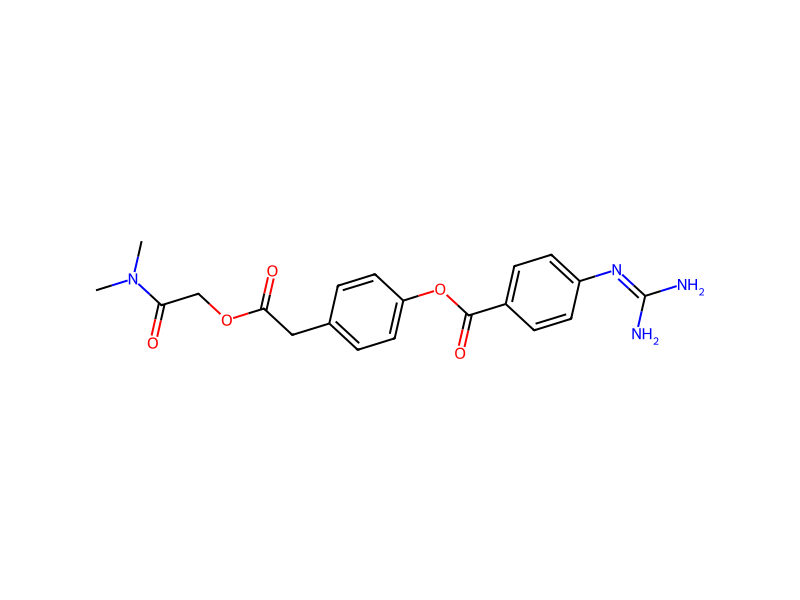
Basic information
- Standard SMILES
CN(C)C(=O)COC(=O)Cc1ccc(OC(=O)c2ccc(N=C(N)N)cc2)cc1- InChIKey
XASIMHXSUQUHLV-UHFFFAOYSA-N- Molecular formula
- C20H22N4O5
- Average molar mass
- 398.4 g/mol
- Monoisotopic mass
- 398.1590198
Overview
Camostat is a benzoate ester resulting from the formal condensation of the carboxy group of 4-guanidinobenzoic acid with the hydroxy group of 2-(dimethylamino)-2-oxoethyl (4-hydroxyphenyl)acetate. It is a potent inhibitor of the human transmembrane protease serine 2 (TMPRSS2) and its mesylate salt is currently under investigation for its effectiveness in COVID-19 patients. It has a role as an anticoronaviral agent, an antiviral agent, an antineoplastic agent, an antihypertensive agent, an antifibrinolytic drug, a serine protease inhibitor and an anti-inflammatory agent. It is a tertiary carboxamide, a member of guanidines, a carboxylic ester, a benzoate ester and a diester. It is functionally related to a 4-guanidinobenzoic acid. It is a conjugate base of a camostat(1+).
Names & identifiers
- Preferred name
- Camostat
- IUPAC
- [4-[2-[2-(dimethylamino)-2-oxoethoxy]-2-oxoethyl]phenyl] 4-(diaminomethylideneamino)benzoate
- English name
- Camostat
- Molecular formula
- C20H22N4O5
- Molecular weight
- 398.41
Names & synonyms
Show more names
Database identifiers
- CAS
59721-28-7- PubChem CID
- 2536
- DTXSID
DTXSID6044010- ChEMBL
CHEMBL590799- ChEBI
CHEBI:135632- UNII
- 0FD207WKDU
- Nikkaji
- J23.287D
Properties
Computed structural properties
- XLogP
- 1.1
- Topological polar surface area
- 137 Ų
- Hydrogen bond donors
- 2
- Hydrogen bond acceptors
- 6
- Rotatable bonds
- 9
- Heavy atoms
- 29
- Formal charge
- 0
- Complexity
- 602
Experimental & physicochemical properties
Physicochemical properties
- Boiling point
- 590.5 · 590.5±60.0 °C(Predicted)
- Density
- 1.28 · 1.28±0.1 g/cm3(Predicted)
- pka
- 10.17 · 10.17±0.10(Predicted)
- FDA UNII
- 0 FD207WKDU · 0FD207WKDU
- ATC code
- 2 AB04 · B02AB04
Chemistry & industry
Pharmacology
ATC Code
B - Blood and blood forming organs
QB - Blood and blood forming organs
Pharmacodynamics
Camostat mesylate is a protease inhibitor used to treat chronic pancreatitis. The duration of action is not long, as it is typically given in 3 divided doses daily. Patients should be counselled regarding the risk of anaphylaxis, thrombocytopenia, hepatic dysfunction, and hyperkalemia.
Mechanism of Action
In rats, oral camostat mesylate may increase pancreatic secretions and hypertrophy by increasing cholecystokinin release. Administration in rats has also lead to lower levels of IL-1beta, IL-6, TNF-alpha, TGF-beta, and PSC. Similar activity is seem after administration in humans, leading to reduced pain and inflammation as well as improve the function of the pancrease in chronic pancreatitis. In the case of SARS-CoV-2, camostat mesylate inhibits the action of the serine protease TMPRSS2, preventing the priming of the viral spike protein for attachment to ACE2, and entry into the cell.
MeSH Pharmacological Classification
Compounds which inhibit or antagonize biosynthesis or actions of proteases (ENDOPEPTIDASES).
Serine proteinase inhibitors which inhibit trypsin. They may be endogenous or exogenous compounds.
Absorption, Distribution and Excretion
A 200mg oral dose of camostat mesylate leads to the active metabolite reaching a Cmax of 87.1 ± 29.5 ng/mL, with a Tmax of 40 min, and an AUC of 10,400 ± 1,400 ng\*min/mL.
Camostat mesylate is 89.8-95.6% eliminated in the urine and 1.0-1.7% eliminated in the feces.
The volume of distribution at steady state of camostat mesylate is 0.34-1.31L/kg.
The clearance of camostat mesylate is 4.5-7.3mL/min/kg.
Applications
UsesCamostat is an orally active trypsin inhibitor. Camostat can reduce pancreatic fibrosis induced by repeated administration of superoxide dismutase inhibitors in rats, and decrease the proliferation and activation of pancreatic stellate cells (PSCs)[1].
Upstream & downstream products
Upstream raw materials
Suppliers34 total
Additional notes
DefinitionChEBI: Camostat is a benzoate ester resulting from the formal condensation of the carboxy group of 4-guanidinobenzoic acid with the hydroxy group of 2-(dimethylamino)-2-oxoethyl (4-hydroxyphenyl)acetate. It is a potent inhibitor of the human transmembrane protease serine 2 (TMPRSS2) and its mesylate salt is currently under investigation for its effectiveness in COVID-19 patients. It has a role as an anticoronaviral agent, a serine protease inhibitor, an antifibrinolytic drug, an anti-inflammatory agent, an antiviral agent, an antihypertensive agent and an antineoplastic agent. It is a tertiary carboxamide, a carboxylic ester, a diester, a member of guanidines and a benzoate ester. It is functionally related to a 4-guanidinobenzoic acid. It is a conjugate base of a camostat(1+).
Related reactions
No reaction records under the current filter.
Linked notes
Loading…