
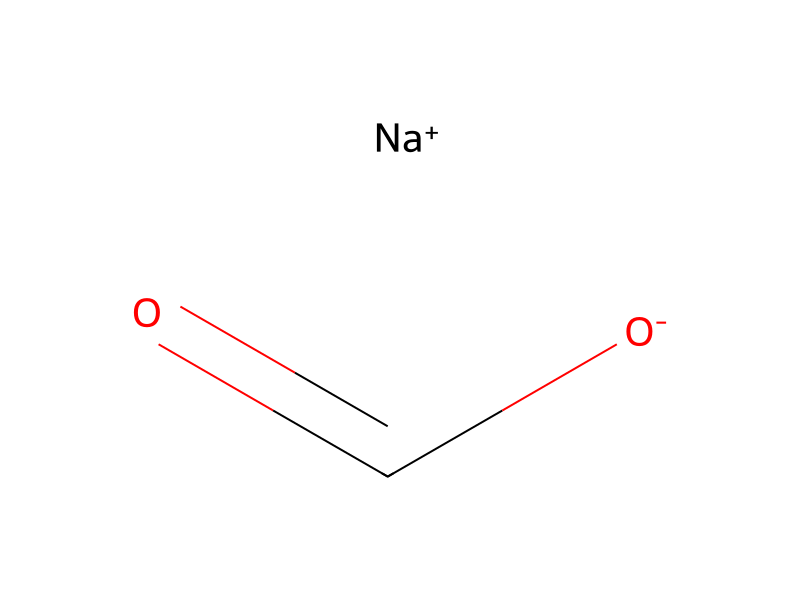
Basic information
- Standard SMILES
O=C[O-].[Na+]- InChIKey
HLBBKKJFGFRGMU-UHFFFAOYSA-M- Molecular formula
- HCOONa
- Average molar mass
- 68.007 g/mol
- Monoisotopic mass
- 67.98742355
Overview
Sodium formate is an organic sodium salt which is the monosodium salt of formic acid. It has a role as a buffer and an astringent. It contains a formate.
Names & identifiers
- Preferred name
- Sodium Formate
- IUPAC
- sodium formate
Names & synonyms
SODIUM FORMATE141-53-7Formic acid, sodium saltSalachlorFormic acid, sodium salt (1:1)Mravencan sodnyFORMIC ACID, NA SALTSodium formate, refinedFormic acid sodium salt (1:1)387AD98770DTXSID2027090CHEBI:62965
Show more names
NSC-77457RefChem:183890DTXCID407090205-488-0690-860-9Formic acid sodium saltsodium;formateCHNaO2
Database identifiers
- CAS
141-53-7- PubChem CID
- 2723810
- DTXSID
DTXSID2027090- ChEMBL
CHEMBL183491- ChEBI
CHEBI:62965- UNII
- 387AD98770
- EC Number
- 205-488-0、690-860-9
- Nikkaji
- J43.162A
Properties
Computed structural properties
- Topological polar surface area
- 40.1 Ų
- Hydrogen bond donors
- 0
- Hydrogen bond acceptors
- 2
- Rotatable bonds
- 0
- Heavy atoms
- 4
- Formal charge
- 0
- Complexity
- 13.5
Experimental & physicochemical properties
Chemical ClassesMetals -> Organic Acids, Metal Salts
Cosmetics
Cosmetic ingredients (Sodium Formate) -> CIR (Cosmetic Ingredient Review)
Buffering; Preservative
Food AdditivesPROCESSING AID -> FDA Substance added to food
Density
1.92 @ 20 °C
1.9 g/cm³
1.92 @25 °C
Color/Form
COLORLESS MONOCLINIC CRYSTALS
WHITE GRANULES OR CRYSTALLINE POWDER
Solubility
SLIGHTLY SOLUBLE IN ALCOHOL, INSOL IN ETHER
SOLUBLE IN GLYCEROL
SOLUBILITY IN WATER: 97.2 G/100 CC @ 20 °C
SOLUBILITY IN WATER: 160 G/100 CC @ 100 °C
Solubility in water, g/100ml at 20 °C: 97
Boiling PointBOILING POINT: DECOMPOSES; DELIQUESCENT
Melting Point
253 °C
253 °C
257 °C
Food Contact SubstancesFCS -> FDA Inventory of Food Contact Substances Listed in 21 CFR
Physical Description
Dry Powder; CBI; Large Crystals; Liquid
White deliquescent solid; [Merck Index] White powder; [MSDSonline]
HYGROSCOPIC WHITE GRANULES OR CRYSTALLINE POWDER.
Other Experimental Properties
AT TEMP HIGHER THAN 253 °C, IT DECOMP INTO SODIUM OXALATE & HYDROGEN, THEN INTO SODIUM CARBONATE
AQ SOLN IS NEUTRAL; PH IS ABOUT 7; HAS BUFFERING ACTION
SOLUBILIZES TRIVALENT METAL IONS IN SOLN BY FORMING COMPLEX ION; HAS SLIGHT ODOR OF FORMIC ACID
SLIGHTLY HYGROSCOPIC
Safety & regulation
GHS classification
GHS Classification
This chemical does not meet GHS hazard criteria for 97.1% (2698 of 2778) of all reports.
Not Classified
Aggregated GHS information provided per 2778 reports by companies from 10 notifications to the ECHA C&L Inventory.
Hazard information
Regulatory Information
Chemical: Formic acid, sodium salt
Regulation (EC) No 1831/2003 (amended)
Formic acid, sodium salt (1:1) is listed on the EPA's Chemical Data Reporting (CDR) system. Manufacturers and importers of Formic acid, sodium salt (1:1) are required to report information about their production and use of this chemical to the EPA under the Toxic Substances Control Act (TSCA). (40 eCFR Part 711)
Status: Active Update: 25-05-2022 https://echa.europa.eu/registration-dossier/-/registered-dossier/14849
Sodium formate: Non hazardous
Other Safety InformationIMAP assessments - Formic acid, sodium salt: Environment tier I assessment
Fire HazardsCombustible under specific conditions. Finely dispersed particles form explosive mixtures in air.
Fire PotentialFIRE HAZARD: SLIGHT.
Hazards Summary
After ingestion of 3-4 gm/day, albuminuria and hematuria may occur; Also may cause cardiac depression and methemoglobinemia at high doses; [HSDB] Decomposed by heating forming carbon monoxide and hydrogen; An eye and respiratory tract irritant; [ICSC] High concentrations may cause respiratory tract irritation; Solutions may cause skin and eye irritation; [CHEMINFO] An irritant; [MSDSonline]
EPA Safer ChemicalChemical: Sodium formate
Chemical DangersDecomposes on heating. This produces carbon monoxide (see ICSC 0023) and hydrogen (see ICSC 0001). This generates fire and explosion hazard. Decomposes on contact with acids. This produces formic acid vapours (see ICSC 0485).
Physical DangersDust explosion possible if in powder or granular form, mixed with air.
Hazard Classes and CategoriesNot Classified
CSL Reaction Information
CSL00194
Nitrous oxide + Nitric oxide + Sodium + Hydrogen + Sodium formate + Toluene
"A safety letter from Merck & Co. chemists titled “Nitric Oxide at High Pressure” (C&EN, Jan. 30, page 6) described two explosions during depressurization of a reaction between NO and methanol under basic conditions. The products in a model system with sodium methoxide were described as nitrous oxide and formic acid, presumably as sodium formate. A potential danger in this system should be pointed out: Sodium formate undergoes thermal decomposition to give hydrogen gas (J. Am. Chem. Soc.,DOI: 10.1021/ja02245a004), which explodes spontaneously in the presence of nitrous oxide above critical limits (J. Am. Chem. Soc., DOI: 10.1021/ja01179a036), even in the absence of a catalyst or source of ignition. The presence of hydrogen and nitrous oxide above a reaction mixture was undoubtedly the cause of an explosion and fire in my laboratory in 1981 during workup of a reaction between sodium and nitric oxide. The major product of the reaction is cis-sodium hyponitrite, which decomposes immediately in water to form sodium hydroxide and nitrous oxide. The employee, a biology major who was badly burned, had carried out the reaction a number of times without incident. This time he tried twice and failed to disperse about 30 g of sodium in toluene and, without consulting me, decided to continue the reaction. The explosion occurred as he was attempting to destroy the unreacted sodium, a lump too large to remove from the flask, by dropwise addition of water. Most of the sodium had reacted at the time of the explosion, and there was no indication of mechanical failure. At the time, I was unaware of the extreme incompatibility of the two gases, and the accident was extremely puzzling. The reaction mixture was close to room temperature and was stirred rapidly while the headspace was flushed with a stream of nitrogen. When I arrived at the laboratory a few minutes after the accident, nitrogen was still flowing from the burned-off end of the plastic tubing. Since that time, I noticed a reference to the “hydrogen explosion” in the ancient chemical literature as a way to identify nitrous oxide." (reprint of the full-text)
Explosive
Medium (up to 100g)
10.1021/cen-09013-letters
Safety & protection
Fire FightingIn case of fire in the surroundings, use appropriate extinguishing media.
First Aid Measures
Fresh air, rest.
Remove contaminated clothes. Rinse skin with plenty of water or shower.
First rinse with plenty of water for several minutes (remove contact lenses if easily possible), then refer for medical attention.
Rinse mouth.
Safe StorageSeparated from strong acids. Dry. Well closed.
Spillage DisposalSweep spilled substance into covered containers. Wash away remainder with plenty of water.
Eye PreventionWear safety goggles.
Inhalation RiskEvaporation at 20 °C is negligible; a nuisance-causing concentration of airborne particles can, however, be reached quickly.
Skin PreventionProtective gloves.
Exposure PreventionPREVENT DISPERSION OF DUST!
Ingestion PreventionDo not eat, drink, or smoke during work.
Inhalation PreventionUse ventilation, local exhaust or breathing protection.
Effects of Short Term ExposureThe substance is irritating to the eyes and respiratory tract.
Protective Action Criteria (PAC)
3.0 [mg/m3]
25 [mg/m3]
250 [mg/m3]
Toxicology
Adverse EffectsMethemoglobinemia - The presence of increased methemoglobin in the blood; the compound is classified as secondary toxic effect
Exposure RoutesThe substance can be absorbed into the body by inhalation of its aerosol.
Toxicity Summary
The CIR Expert Panel concluded that formic acid and sodium formate are safe in the present practices of use and concentration in cosmetics, as described in this safety assessment, when formulated to be non-irritating.
Safe for use in cosmetics, with qualifications
Signs and Symptoms
Cough. Sore throat.
Redness. Pain.
Human Toxicity Excerpts...APPEARS TO HAVE A LOW TOXICITY (10 G BY MOUTH WITHOUT ILL EFFECTS IN MAN).
Non-Human Toxicity Excerpts
FORMATE ION IS EXTENSIVELY OXIDIZED IN VIVO, BUT IT MAY HAVE DIRECT ACTIONS ON BRAIN (CAUSE OF CONVULSIONS IN POISONED ANIMALS?).
FORMATE, USUALLY AS SODIUM FORMATE, HAS BEEN FED TO VARIOUS ANIMALS & ADMIN PARENTERALLY WITHOUT OCULAR DISTURBANCE.
FORMATE IS...INHIBITOR OF CERTAIN ENZYMES, EG, CATALASE, & HAS BEEN INVESTIGATED FOR POTENTIAL INJURIOUSNESS TO RETINA & OPTIC NERVE. HOWEVER, NO EVIDENCE HAS BEEN OBTAINED OF SUCH RETINAL TOXICITY IN EXPERIMENTAL ANIMALS, & 0.02 MOLAR FORMATE HAS NOT BEEN FOUND TO AFFECT METAB OF RETINA IN VITRO. /FORMATE/
Antidote and Emergency TreatmentFORMATES CAN BE METABOLIZED TO FORMIC ACID, HENCE TREATMENT AS FOR METHANOL SHOULD BE CONSIDERED.
Chemistry & industry
Pharmacology
Metabolism/Metabolites
FORMATE ION IS EXTENSIVELY OXIDIZED IN VIVO...
GIVEN ORALLY TO NORMAL HUMAN, ABOUT 2.1% WAS ELIMINATED AS FORMIC ACID IN URINE IN 24 HR AFTER 2.96 & 4.4 G OF NA FORMATE.
Uses & manufacturing
Uses
CIR ingredient: Sodium Formate
Used in analytical chemistry as precipitant for noble metals, to buffer strong mineral acids to higher pH, for dyeing and printing fabrics, for tanning leather, and to make other organic chemicals; Also used as an electroplating agent, an acidulant in the textile industry, a reducing agent, a mordant, a complexing agent, and a therapeutic caustic and astringent; [HSDB] Used in photographic fixing baths; [CHEMINFO]
Electroplating [Category: Plate]
IN ANALYTICAL CHEM AS PRECIPITANT FOR NOBLE METALS; BUFFERING OF STRONG MINERAL ACIDS TO HIGHER PH
MEDICATION: CAUSTIC, ASTRINGENT AGENT; DYEING & PRINTING FABRICS
CHEM INT FOR FORMIC ACID, OXALIC ACID; ELECTROPLATING AGENT; ACIDULANT IN TEXTILE INDUSTRY, LEATHER TANNING
U.S. Exports
(1972) No Data
(1975) No Data
(1986) No Data
U.S. Imports
(1972) No Data
(1975) No Data
(1984) 1.68X10+9 g
U.S. Production
2023: 10,000,000 - <50,000,000 lb
(1972) 1.45X10+10 GRAMS (TECHNICAL GRADE)
(1975) 1.5X10+10 GRAMS (TECHNICAL GRADE)
(1986) No Data
Consumption Patterns(FORMIC ACID) 48% IN DYEING & FINISHING TEXTILES; 15% IN LEATHER TANNING; 25% AS A CHEM INT; 12% IN OTHER APPLICATIONS (1973)
Consumer UsesNot Known or Reasonably Ascertainable
Industry UsesNot Known or Reasonably Ascertainable
Methods of Manufacturing
REACTION OF SODIUM HYDROXIDE & CARBON MONOXIDE
CARBON MONOXIDE & SODIUM HYDROXIDE ARE HEATED UNDER PRESSURE, ALSO FROM PENTAERYTHRITOL MANUFACTURE.
Formulations/Preparations
GRADES: TECHNICAL; CP.
/Available as/ ACS, purified & technical grades
Household ProductsInformation on 135 consumer products that contain Sodium Formate in the following categories is provided:
Use Classification
EPA Safer Chemical Functional Use Classes -> Enzymes and Enzyme Stabilizers;Processing Aids and Additives
Safer Chemical Classes -> Green circle - The chemical has been verified to be of low concern
Cosmetics -> Buffering; Preservative
General Manufacturing Information
Not Known or Reasonably Ascertainable
Formic acid, sodium salt (1:1): ACTIVE
NA FORMATE (0.5 MMOLE) INHIBITED ACCUMULATION OF METHEMOGLOBIN AND ERYTHROCYTE LYSIS CAUSED BY 2.6 & 3.3 MMOLE PRIMAQUINE.
Sodium formate appears in sodium methylate at 0.3%
Related reactions
399 records


Linked notes
Loading…