
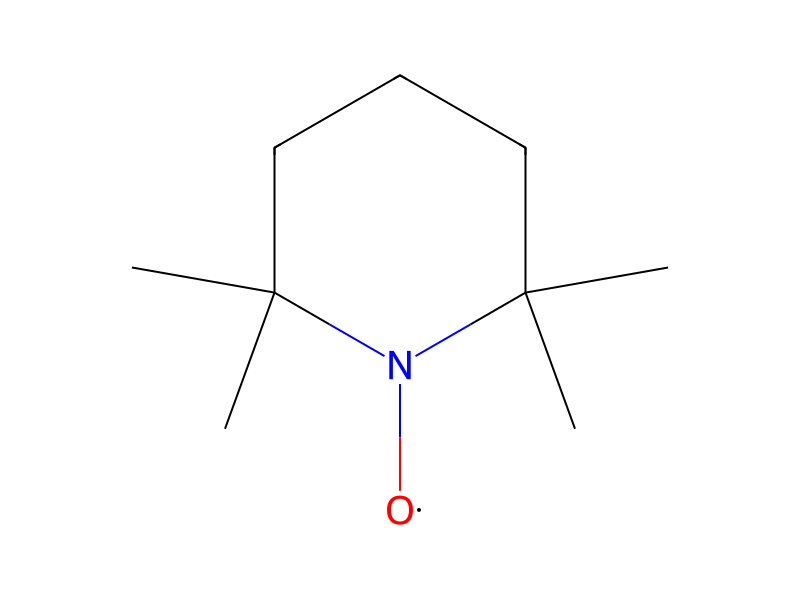
Basic information
- Standard SMILES
CC1(C)CCCC(C)(C)N1[O]- InChIKey
QYTDEUPAUMOIOP-UHFFFAOYSA-N- Molecular formula
- C9H18NO
- Average molar mass
- 156.25 g/mol
- Monoisotopic mass
- 156.1388392
Overview
TEMPO is a member of the class of aminoxyls that is piperidine that carries an oxidanediyl group at position 1 and methyl groups at positions 2, 2, 6, and 6, respectively. It has a role as a ferroptosis inhibitor, a catalyst and a radical scavenger. It is a member of piperidines and a member of aminoxyls.
Names & identifiers
- Preferred name
- Tempo
- IUPAC
- (2,2,6,6-Tetramethylpiperidin-1-yl)oxidanyl
- English name
- TEMPO
- Molecular formula
- C9H18NO*
- Molecular weight
- 156.25
Names & synonyms
TEMPOTananeTanan2,2,6,6-Tetramethyl-1-piperidinyloxy2,2,6,6-Tetramethylpiperidine-1-oxylTetramethylpiperidinooxyVQN7359ICQTetramethylpiperidine nitroxideDTXSID20733001-Piperidinyloxy, 2,2,6,6-tetramethyl-CHEBI:328492,2,6,6-tetramethyl-4-piperidine-N-oxide
Show more names
TEPOTMEPO2,2,6,6-Tetramethylpiperidin-1-oxyl2,2,6,6-TETRAMETHYLPIPERIDINE-N-OXYL(2,2,6,6-Tetramethylpiperidin-1-yl)oxyl2,2,6,6-Tetramethylpiperidoxyl
RefChem:187806DTXCID7037345219-888-82564-83-22,2,6,6-Tetramethylpiperidinooxy2,2,6,6-Tetramethylpiperidine 1-oxyl(2,2,6,6-tetramethylpiperidin-1-yl)oxidanylMFCD00009599
Database identifiers
- CAS
2564-83-2- PubChem CID
- 2724126
- DTXSID
DTXSID2073300- ChEMBL
CHEMBL606971- ChEBI
CHEBI:32849- UNII
- VQN7359ICQ
- EC Number
- 219-888-8
- Nikkaji
- J1.968.655H、J100.807B、J2.763.954B
Properties
Computed structural properties
- XLogP
- 1.4
- Topological polar surface area
- 4.2 Ų
- Hydrogen bond donors
- 0
- Hydrogen bond acceptors
- 1
- Rotatable bonds
- 0
- Heavy atoms
- 11
- Formal charge
- 0
- Complexity
- 136
Experimental & physicochemical properties
Chemical ClassesNitrogen Compounds -> Amine Oxides
Vapor Pressure0.000006 [mmHg]
Physical DescriptionDark red solid; [Merck Index] Red crystalline solid; mp = 32-37 deg C; [Alfa Aesar MSDS]
Physicochemical properties
- Melting point
- 36 · 36-38 °C(lit.)
- Boiling point
- 193 °C · 193°C
- Density
- 1 g/cm3 · 1 g/cm3
- vapor pressure
- 0.4 hPa · 0.4 hPa (20 °C)
- refractive index
- 1.435 · 1.4350 (estimate)
- Flash point
- 154 °F · 154 °F
- storage temp.
- 30 °C · Store below +30°C.
- solubility
- 9.7 g/l · 9.7g/l
- form
- Powder
- color
- Yellow to green
- PH
- 8.3 · 8.3 (9g/l, H2O, 20℃)
- Water Solubility
- Soluble in all organic solvents. Insoluble in water.
- Merck
- 14 · 14,9140
- BRN
- 1422418 · 1422418
- Stability
- Stable. Incompatible with strong acids, strong oxidizing agents. Refrigerate.
- InChI
- 1S/C9H18NO/c1-8(2)6-5-7-9(3,4)10(8)11/h5-7H2,1-4H3
- InChIKey
- RVWUHFFPEOKYLB-UHFFFAOYSA-N
- SMILES
- CC1(C)CCCC(C)(C)N1[O]
- CAS DataBase Reference
- 2564 · 2564-83-2(CAS DataBase Reference)
- EWG's Food Scores
- 1 · 1
- FDA UNII
- 7359 ICQ · VQN7359ICQ
- NIST Chemistry Reference
- 1 · 1-Piperidinyloxy, 2,2,6,6-tetramethyl-(2564-83-2)
- EPA Substance Registry System
- 1 · 1-Piperidinyloxy, 2,2,6,6-tetramethyl- (2564-83-2)
- UNSPSC Code
- 12352119 · 12352119
- NACRES
- 22 · NA.22
- Symbol(GHS)
- 5 · GHS05
- Signal word
- Danger
- Hazard statements
- 314 · H314-H412
- Precautionary statements
- 260 · P260-P273-P280-P303+P361+P353-P304+P340+P310-P305+P351+P338
- PPE
- 3 · Eyeshields, Faceshields, Gloves, type P3 (EN 143) respirator cartridges
- Hazard Codes
- C,Xi
- Risk Statements
- 34 · 34-36/37/38
- Safety Statements
- 26 · 26-36/37/39-45-24/25
- RIDADR
- 3263 · UN 3263 8/PG 2
- WGK Germany
- 3 · 3
- RTECS
- 8991900 · TN8991900
- Autoignition Temperature
- 275 °C · 275 °C
- TSCA
- TSCA listed
- HazardClass
- 8 · 8
- PackingGroup
- III
- HS Code
- 29333999 · 29333999
- Storage Class
- 8 A · 8A - Combustible corrosive hazardous materials
- Hazard Classifications
- 3 Eye · Aquatic Chronic 3Eye Dam. 1Skin Corr. 1C
- REACH Registrations
- Active
- Limited Quantities
- 1 Kg · 1 Kg (2.2 lbs) (solid)
- Excepted Quantities
- Max Inner Pack (30g or 30ml) and Max Outer Pack (500g or 500ml)
Safety & regulation
GHS classification
GHS Classification
This chemical does not meet GHS hazard criteria for 1.2% (5 of 403) of reports.
Danger
H314 (93.1%): Causes severe skin burns and eye damage [Danger Skin corrosion/irritation]
P260, P264, P264+P265, P273, P280, P301+P330+P331, P302+P361+P354, P304+P340, P305+P354+P338, P316, P317, P321, P363, P405, and P501 (click each P-code to see the statement)
Aggregated GHS information provided per 403 reports by companies from 12 notifications to the ECHA C&L Inventory. Each notification may be associated with multiple companies.
Hazard information
Regulatory Information
PMN - indicates a commenced PMN (Pre-Manufacture Notices) substance.
Status: Active Update: 15-11-2019 https://echa.europa.eu/registration-dossier/-/registered-dossier/24636
2,2,6,6-Tetramethylpiperidine-1-oxyl: Does not have an individual approval but may be used under an appropriate group standard
Hazards SummaryA severe skin and eye irritant; Causes somnolence in dermal lethal-dose studies of rabbits; [RTECS] Causes burns; [Alfa Aesar MSDS]
Hazard Classes and CategoriesSkin Corr. 1B (93.1%)
Toxicology
Adverse EffectsDermatotoxin - Skin burns.
Toxicity DataLCLo (rat) = 4,500 mg/m3/2hr
Safety data
- PPE
- Eyeshields, Faceshields, Gloves, type P3 (EN 143) respirator cartridges
- wgk
- 3
- tsca
- TSCA listed
- rtecs
- TN8991900
- ridadr
- UN 3263 8/PG 2
- hs_code
- 29333999
- risk_code
- 34-36/37/38
- Signal word
- Danger
- Symbol(GHS)
- GHS05
- hazard_code
- C,Xi
- safety_code
- 26-36/37/39-45-24/25
- hazard_class
- 8
- Storage Class
- 8A - Combustible corrosive hazardous materials
- packing_group
- III
- Hazard statements
- H314-H412
- Limited Quantities
- 1 Kg (2.2 lbs) (solid)
- Excepted Quantities
- Max Inner Pack (30g or 30ml) and Max Outer Pack (500g or 500ml)
- REACH Registrations
- Active
- Hazard Classifications
- Aquatic Chronic 3Eye Dam. 1Skin Corr. 1C
- Autoignition Temperature
- 275 °C
- Precautionary statements
- P260-P273-P280-P303+P361+P353-P304+P340+P310-P305+P351+P338
Chemistry & industry
Pharmacology
MeSH Pharmacological ClassificationNaturally occurring or synthetic substances that inhibit or retard oxidation reactions. They counteract the damaging effects of oxidation in animal tissues.
Uses & manufacturing
UsesUsed in organic chemistry (radical trap, catalyst, and polymerization mediator); [Merck Index] Used as a spin label in MRI; [REPROTOX]
General Manufacturing Information1-Piperidinyloxy, 2,2,6,6-tetramethyl-: ACTIVE
Applications
Description2,2,6,6-Tetramethylpiperidine is a product that is used for the most diverse purposes because of its strong basicity, for example, as a light stabilizer for polyolefins, as a cocatalyst in olefin polymerizations (Ziegler catalysts), as a building block for the synthesis of pharmaceuticals and crop protection products, as a cocatalyst in the synthesis of dichloroacetyl chloride. The 4-unsubstituted 2.2.6,6-tetramethylpiperidine is generally prepared from the corresponding 4-oxo compound. It is known that triacetonamine can be converted by hydrazine to the hydrazone, which is then cleaved in the presence of alkali into 2,26,6-tetramethylpiperidine and nitrogen.
UsesTEMPO(2,2,6,6-Tetramethylpiperidinooxy) is a stable radical prepared through the oxidation of 2,2,6,6-tetramethylpiperidine. TEMPO has a wide range of applications including use as a free radical scavenger, a reagent in organic synthe sis and as a structural probe in electron spin resonance spectroscopy. TEMPO can also be used as a mediator in free radical polymerization.
UsesIn organic chemistry as a radical trap, 2,2,6,6-Tetramethylpiperidinooxy can be used as a catalyst and in polymerization mediation.
UsesTEMPO can be used:As a catalytic oxidant for copper-catalyzed, greener oxidation of alcohols under aerobic conditions.As a catalytic oxidant in the iodobenzene diacetae oxidation of nerol to neral.For trapping the styrenyl radical generated from benzoyl peroxide during nitroxide-mediated radical polymerization of styrene. In the carboxylation of water-resistant nanofibrillated cellulose (NFC) films.Copper(I)/TEMPO-catalyzed aerobic oxidation of primary alcohols to aldehydes with ambient air
General DescriptionFor a synthetic protocol using NMP initiators, contributed by Prof. Karen Wooley, please visit our technology spotlight.
Upstream & downstream products
Upstream raw materials
Downstream products
Suppliers50 total
国药集团化学试剂有限公司86-21-63210123 · [email protected]
梯希爱(上海)化成工业发展有限公司021-67121386 · [email protected]
上海阿拉丁生化科技股份有限公司400-6206333 13167063860 · [email protected]
INTATRADE GmbH+49 3493/605464 · [email protected]
T&W GROUP021-61551611 13296011611 · [email protected]
爱斯特(成都)生物制药股份有限公司+86-28-85122536 85324413 · [email protected]
南京利盛康合生物科技有限公司025-52110956 13814852963 · [email protected]
韶远科技(上海)有限公司021-50795510 4000665055 · [email protected]
科瑞迪化学400-821-5857 021-64326257 · [email protected]
上海将来实业股份有限公司400-0066400 13621662912 · [email protected]
上海迈瑞尔生化科技有限公司4006356688 18621169109 · [email protected]
阿法埃莎(中国)化学有限公司400-6106006 · [email protected]
太原市瑞和丰科贸有限公司+86 351 7031519 · [email protected]
上海德默医药科技有限公司400-021-7337 2355568890 · [email protected]
安耐吉化学&3A(安徽泽升科技股份有限公司)400-0056266 · [email protected]
武汉凯威斯科技有限公司86-027-67849912 · [email protected]
苏州泽厚生物科技有限公司0512-68716880 19984816880 · [email protected]
上海瀚鸿科技股份有限公司021-54306202 13764082696 · [email protected]
上海柯维化学技术有限公司021-64609169 18901607656 · [email protected]
上海相辉医药科技有限公司13761987713 · [email protected]
上海景颜化工科技有限公司13817811078 · [email protected]
嘉兴市艾森化工有限公司0573-85285100 18627885956 · [email protected]
池州捷峰生物科技有限公司0566-8928158 · [email protected]
武汉丰泰威远科技有限公司027-87465837 19945049750 · [email protected]
孝感深远化工有限公司15527621225; 15527621225 · [email protected]
山东西亚化学有限公司13355009207 13355009207 · [email protected]
玛雅试剂+86 (573) 82222445 (0)18006601000 452520369 · [email protected]
四川库利南科技有限公司400-1166-196 18981987031 · [email protected]
天津希恩思生化科技有限公司400 638 7771 · [email protected]
湖南汇百侍生物科技有限公司0731-85526065 13308475853 · [email protected]
南京维奥化工有限公司Please Send Email 18652950785 · [email protected]
Connect Chemicals GmbH+49 2102 2077 19 · [email protected]
河南多贝化工有限公司0370-2785118 17550508557 · [email protected]
斯百全化学(上海)有限公司021-021-021-67601398-809-809-809 15221380277 · [email protected]
上海源叶生物科技有限公司13636370518 · [email protected]
深圳法默科技有限公司0755-86648230 · [email protected]
上海思域化工科技有限公司86-21-34053660 · [email protected]
赛默飞世尔科技(中国)有限公司800-810-5118 · [email protected]
北京伊诺凯科技有限公司400-810-7969 010-59572699 · [email protected]
徐州景禾科技有限公司15152068369 · [email protected]
上海遐瑞医药科技有限公司+86 21 61551611
江苏艾康生物医药研发有限公司025-66113011 13913916777 · [email protected]
上海健超生物科技有限公司150-2103-5486 18017383231 · [email protected]
TOKYO CHEMICAL INDUSTRY CO., LTD.03-36680489 · [email protected]
上海贤鼎生物科技有限公司4009209199 · [email protected]
深圳振强药物研发有限公司0755-66853366 13670046396 · [email protected]
上海卓锐化工有限公司021-69180038
越林试剂021-62960152 · [email protected]
南京杜莱生物技术有限公司025-84699383-8003;025-846993838003-8003 18013301590 · [email protected]
无锡中坤生化科技有限公司+86 0510-85629785
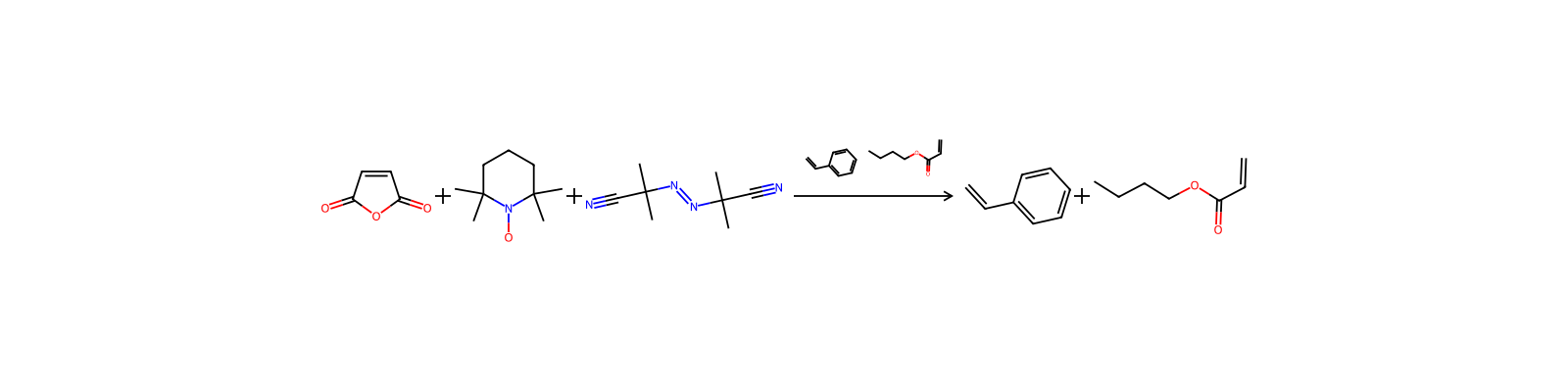
Related reactions
442 records




Linked notes
Loading…