
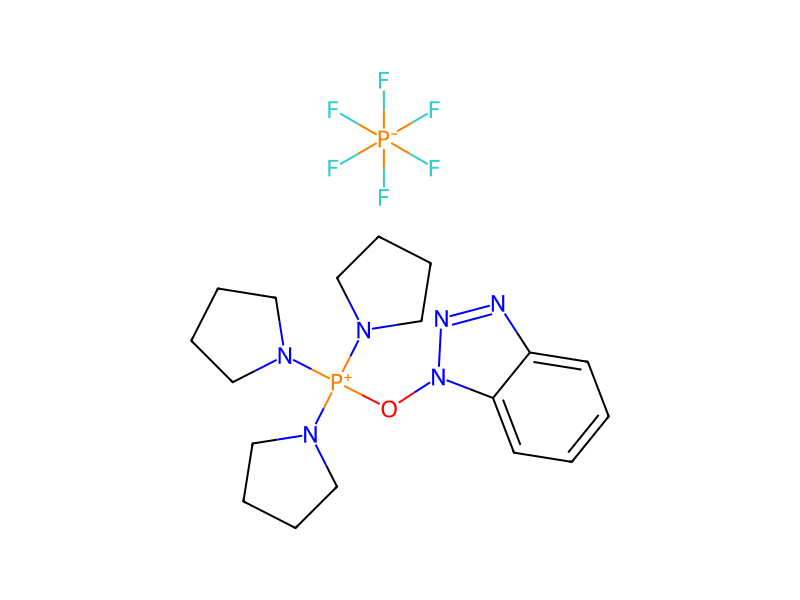
Basic information
- Standard SMILES
F[P-](F)(F)(F)(F)F.c1ccc2c(c1)nnn2O[P+](N1CCCC1)(N1CCCC1)N1CCCC1- InChIKey
VIAFLMPQBHAMLI-UHFFFAOYSA-N- Molecular formula
- C18H28F6N6OP2
- Average molar mass
- 520.4 g/mol
- Monoisotopic mass
- 520.17040251
Names & identifiers
- Preferred name
- PyBOP
- IUPAC
- benzotriazol-1-yloxy(tripyrrolidin-1-yl)phosphanium hexafluorophosphate
- English name
- PyBOP
- Molecular formula
- C18H28F6N6OP2
- Molecular weight
- 520.39
Names & synonyms
PyBOP128625-52-5DTXSID40369209RefChem:177361DTXCID50320245(Benzotriazol-1-yloxy)tripyrrolidinophosphonium hexafluorophosphate((1H-Benzo[d][1,2,3]triazol-1-yl)oxy)tri(pyrrolidin-1-yl)phosphonium hexafluorophosphate(V)MFCD00077411Benzotriazole-1-yl-oxytripyrrolidinophosphonium hexafluorophosphatebopp1H-Benzotriazol-1-yloxytripyrrolidinophosphonium HexafluorophosphateBenzotriazol-1-yl-oxytripyrrolidinophosphonium hexafluorophosphate
Show more names
N-[(dimethylamino)-3-oxo-1H-1,2,3-triazolo[4,5-b]pyridin-1-yl-methylene]-N-methylmethanaminium hexafluorophosphateBOP REAGENTBYPOPBENZOTRIAZOLE-1-YL-OXY-TRIS-PYRROLIDINO-PHOSPHONIUM HEXAFLUOROPHOSPHATEBENZOTRIAZOL-1-YLOXYTRIS(PYRROLIDINO)PHOSPHONIUM HEXAFLUOROPHOSPHATE
benzotriazol-1-yl-oxytripyrrolidinphosphonium hexafluorophosphate1-Benzotriazolyloxytripyrrolidinylphosphonium hexafluorophosphateBenzotriazol-1-yloxytripyrrolidinophosphonium hexafluorophosphate(Benzotriazol-1-yloxy)tripyrrolidinophosphonium (hexafluorophosphate)benzotriazol-1-yloxy(tripyrrolidin-1-yl)phosphanium;hexafluorophosphate132701-58-7Benzotriazole-1-yl-Y6KQR4GY6T
Database identifiers
- CAS
128625-52-5- PubChem CID
- 2724699
- DTXSID
DTXSID40369209- UNII
- Y6KQR4GY6T
- EC Number
- 603-290-2
Properties
Computed structural properties
- Topological polar surface area
- 49.7 Ų
- Hydrogen bond donors
- 0
- Hydrogen bond acceptors
- 13
- Rotatable bonds
- 5
- Heavy atoms
- 33
- Formal charge
- 0
- Complexity
- 500
Physicochemical properties
- Melting point
- 154 · 154-156 °C (dec.)(lit.)
- Density
- 1.438 at · 1.438 at 20℃
- vapor pressure
- 0 · 0-0Pa at 20-50℃
- storage temp.
- 2 · 2-8°C
- solubility
- 25 mg/mL, · methanol: 25 mg/mL, clear
- form
- Fine Crystalline Powder
- color
- White to off-white
- Sensitive
- Moisture Sensitive
- BRN
- 3584612 · 3584612
- Major Application
- peptide synthesis
- InChI
- InChI=1S/C18H28N6OP.F6P/c1-2-10-18-17(9-1)19-20-24(18)25-26(21-11-3-4-12-21,22-13-5-6-14-22)23-15-7-8-16-23;1-7(2,3,4,5)6/h1-2,9-10H,3-8,11-16H2;/q+1;-1
- InChIKey
- BYCLGHOAELJLOF-UHFFFAOYSA-M
- SMILES
- [P+](ON1N=NC2C=CC=CC1=2)(N1CCCC1)(N1CCCC1)N1CCCC1.[P-](F)(F)(F)(F)(F)F
- LogP
- -0.3 at · -0.3 at 26℃ and pH3.5-3.7
- CAS DataBase Reference
- 128625 · 128625-52-5(CAS DataBase Reference)
- UNSPSC Code
- 12352107 · 12352107
- NACRES
- 22 · NA.22
- Symbol(GHS)
- 7 · GHS07,GHS09
- Signal word
- Warning
- Hazard statements
- 302 · H302-H317-H410
- Precautionary statements
- 261 · P261-P264-P273-P280-P301+P312-P302+P352
- PPE
- 95 · dust mask type N95 (US), Eyeshields, Gloves
- Hazard Codes
- Xi
- Risk Statements
- 37 · 37/38-44-36/37/38
- Safety Statements
- 26 · 26-36-24/25-37/39
- RIDADR
- 1325 · UN 1325 4.1/PG 2
- WGK Germany
- 3 · 3
- F
- 8 · 8-10-21
- Hazard Note
- Irritant
- HS Code
- 29339980 · 29339980
- Storage Class
- 11 · 11 - Combustible Solids
- Hazard Classifications
- 4 OralAquatic · Acute Tox. 4 OralAquatic Acute 1Aquatic Chronic 1Skin Sens. 1
- REACH Registrations
- Active
Safety & regulation
GHS classification
GHS Classification
Warning
H302 (14.9%): Harmful if swallowed [Warning Acute toxicity, oral];H315 (87.8%): Causes skin irritation [Warning Skin corrosion/irritation];H317 (12.2%): May cause an allergic skin reaction [Warning Sensitization, Skin];H319 (87.8%): Causes serious eye irritation [Warning Serious eye damage/eye irritation];H335 (86.5%): May cause respiratory irritation [Warning Specific target organ toxicity, single exposure; Respiratory tract irritation];H410 (12.2%): Very toxic to aquatic life with long lasting effects [Warning Hazardous to the aquatic environment, long-term hazard]
P261, P264, P264+P265, P270, P271, P272, P273, P280, P301+P317, P302+P352, P304+P340, P305+P351+P338, P319, P321, P330, P332+P317, P333+P317, P337+P317, P362+P364, P391, P403+P233, P405, and P501 (click each P-code to see the statement)
Aggregated GHS information provided per 74 reports by companies from 13 notifications to the ECHA C&L Inventory. Each notification may be associated with multiple companies.;Information may vary between notifications depending on impurities, additives, and other factors. The percentage value in parenthesis indicates the notified classification ratio from companies that provide hazard codes. Only hazard codes with percentage values above 10% are shown. For more detailed information, please visit ECHA C&L website.
Hazard information
Regulatory InformationStatus: Active Update: 24-05-2021 https://echa.europa.eu/registration-dossier/-/registered-dossier/30080;Status: Active Update: 07-12-2018 https://echa.europa.eu/registration-dossier/-/registered-dossier/27481
Hazard Classes and CategoriesAcute Tox. 4 (14.9%);Skin Irrit. 2 (87.8%);Skin Sens. 1 (12.2%);Eye Irrit. 2 (87.8%);STOT SE 3 (86.5%);Aquatic Chronic 1 (12.2%)
Regulatory information
Regulatory InformationStatus: Active Update: 24-05-2021 https://echa.europa.eu/registration-dossier/-/registered-dossier/30080;Status: Active Update: 07-12-2018 https://echa.europa.eu/registration-dossier/-/registered-dossier/27481
Safety data
- F
- 8-10-21
- PPE
- dust mask type N95 (US), Eyeshields, Gloves
- wgk
- 3
- ridadr
- UN 1325 4.1/PG 2
- hs_code
- 29339980
- risk_code
- 37/38-44-36/37/38
- Signal word
- Warning
- Symbol(GHS)
- GHS07,GHS09
- hazard_code
- Xi
- hazard_note
- Irritant
- safety_code
- 26-36-24/25-37/39
- Storage Class
- 11 - Combustible Solids
- Hazard statements
- H302-H317-H410
- REACH Registrations
- Active
- Hazard Classifications
- Acute Tox. 4 OralAquatic Acute 1Aquatic Chronic 1Skin Sens. 1
- Precautionary statements
- P261-P264-P273-P280-P301+P312-P302+P352
Chemistry & industry
Applications
UsesOne of the most convenient coupling reagents for peptide synthesis without carcinogenic by-products. It replaces BOP reagent. This is especially suitable for solid-phase peptide synthesis, avoids racemization.
Uses1H-Benzotriazol-1-yloxytri(1-pyrrolidinyl) phosphonium hexafluorophosphate (PyBOP) is a peptide coupling reagent utilized in solid phase peptide synthesis. It is also used as a substitute for the (benzotriazol-1-yloxy)tris(dimethylamino)phosphonium hexafluorophosphate (BOP) reagent.
UsesPyBOP is a reagent for: Synthesis of single labeled oligonucleotides that fluoresce upon matched hybridization Generation of endocrine disruptor chemical binders Cycloaddition to template-assembled multivalent peptide conjugates
General Description(Benzotriazol-1-yloxy)tripyrrolidinophosphonium hexafluorophosphate (PyBOP) is an activator of carboxyl group commonly used in peptide synthesis. It also participates in the carboxylic acid esterification. It shows characteristics similar to benzotriazol-1-yloxy)tris(dimethylamino)phosphonium hexafluorophosphate (BOP) and can be utilized as an alternative to BOP in peptide bond formation.
Suppliers50 total
国药集团化学试剂有限公司86-21-63210123 · [email protected]
北京华美互利生物化工010-56205725 · [email protected]
梯希爱(上海)化成工业发展有限公司021-67121386 · [email protected]
上海阿拉丁生化科技股份有限公司400-6206333 13167063860 · [email protected]
江苏吉泰肽业科技有限公司051580855088 18762539991 · [email protected]
苏州兴华高新材料科技有限公司13816002113
INTATRADE GmbH+49 3493/605464 · [email protected]
爱斯特(成都)生物制药股份有限公司+86-28-85122536 85324413 · [email protected]
韶远科技(上海)有限公司021-50795510 4000665055 · [email protected]
科瑞迪化学400-821-5857 021-64326257 · [email protected]
绍兴久孚新材料科技有限公司0575-87095566 18067860628 · [email protected]
Syntechem Co.,Ltd[email protected]
上海迈瑞尔生化科技有限公司4006356688 18621169109 · [email protected]
武汉易泰科技有限公司上海分公司18930552037 · [email protected]
宁波亿诺化学品有限公司86-574-27787657 · [email protected]
阿法埃莎(中国)化学有限公司400-6106006 · [email protected]
太原市瑞和丰科贸有限公司+86 351 7031519 · [email protected]
上海德默医药科技有限公司400-021-7337 2355568890 · [email protected]
安耐吉化学&3A(安徽泽升科技股份有限公司)400-0056266 · [email protected]
武汉凯威斯科技有限公司86-027-67849912 · [email protected]
上海瀚鸿科技股份有限公司021-54306202 13764082696 · [email protected]
上海相辉医药科技有限公司13761987713 · [email protected]
上海景颜化工科技有限公司13817811078 · [email protected]
嘉兴市艾森化工有限公司0573-85285100 18627885956 · [email protected]
Pure Chemistry Scientific Inc.001-857-928-2050 or 1-888-588-9418 · [email protected]
武汉丰泰威远科技有限公司027-87465837 19945049750 · [email protected]
山东西亚化学有限公司13355009207 13355009207 · [email protected]
玛雅试剂+86 (573) 82222445 (0)18006601000 452520369 · [email protected]
四川库利南科技有限公司400-1166-196 18981987031 · [email protected]
天津希恩思生化科技有限公司400 638 7771 · [email protected]
湖南汇百侍生物科技有限公司0731-85526065 13308475853 · [email protected]
南京维奥化工有限公司Please Send Email 18652950785 · [email protected]
河南多贝化工有限公司0370-2785118 17550508557 · [email protected]
斯百全化学(上海)有限公司021-021-021-67601398-809-809-809 15221380277 · [email protected]
艾科试剂4008-755-333 18080918076 · [email protected]
上海思域化工科技有限公司86-21-34053660 · [email protected]
赛默飞世尔科技(中国)有限公司800-810-5118 · [email protected]
北京伊诺凯科技有限公司400-810-7969 010-59572699 · [email protected]
上海赢瑞生物医药科技有限公司21-33585366 13311639313 · [email protected]
TCI AMERICA800-4238616 · [email protected]
TOKYO CHEMICAL INDUSTRY CO., LTD.03-36680489 · [email protected]
TCI Europe320-37350700 · [email protected]
上海贤鼎生物科技有限公司4009209199 · [email protected]
深圳康特腾科技有限公司86-0755-86635001 · [email protected]
上海睿升化工科技有限公司+86-021-50935922
无锡中坤生化科技有限公司+86 0510-85629785
ApexBio Technology LLC+1-832-696-8203 · [email protected]
上海汇凯化学科技有限公司021-61995394 18916691159 · [email protected]
上海倍卓生物科技有限公司021-61119791,13386096464 · [email protected]
上海弘邦医药科技有限公司021-021-64975436 18917636693 · [email protected]
Additional notes
DefinitionPyBOP (benzotriazol-1-yl-oxytripyrrolidinophosphonium hexafluorophosphate) coupling reagent was selected for the peptidic bond formation. This selection was because PyBOP is efficient and could generate less toxic byproducts. PyBOP is an efficient coupling reagent utilized in solid-phase peptide synthesis. It reacts similarly to BOP, but its byproduct is not highly carcinogenic. PyBOP was utilized in the solid-phase synthesis of the tetrapeptide H-Ile-Ala-Leu-Pro-OH on 2-chlorotrityl resin. In contrast to uronium-based coupling reagents, PyBOP does not form guanidinated byproducts when used in excess. This makes it useful in fragment condensation reactions and head-to-tail cyclizations[1].
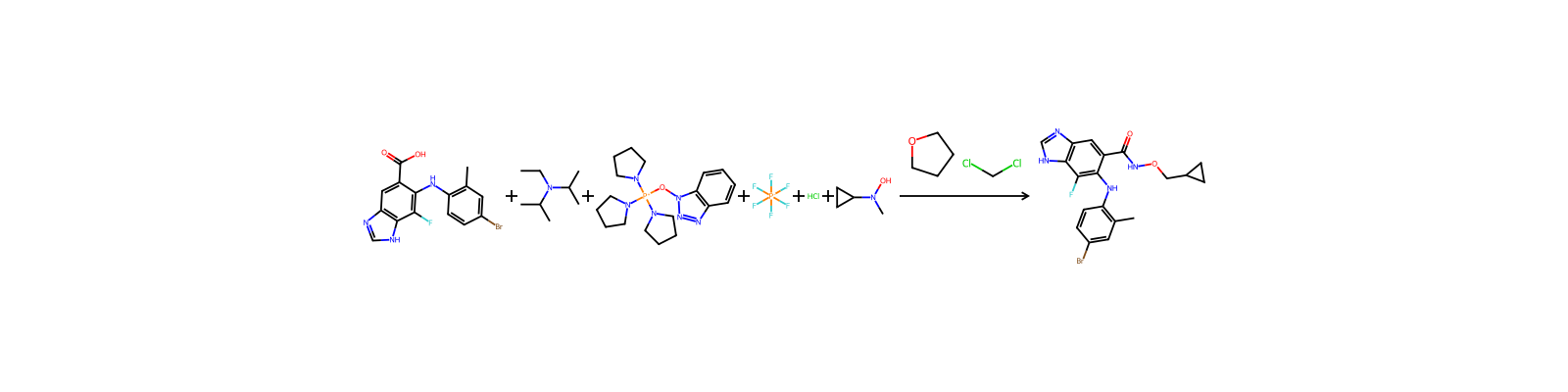
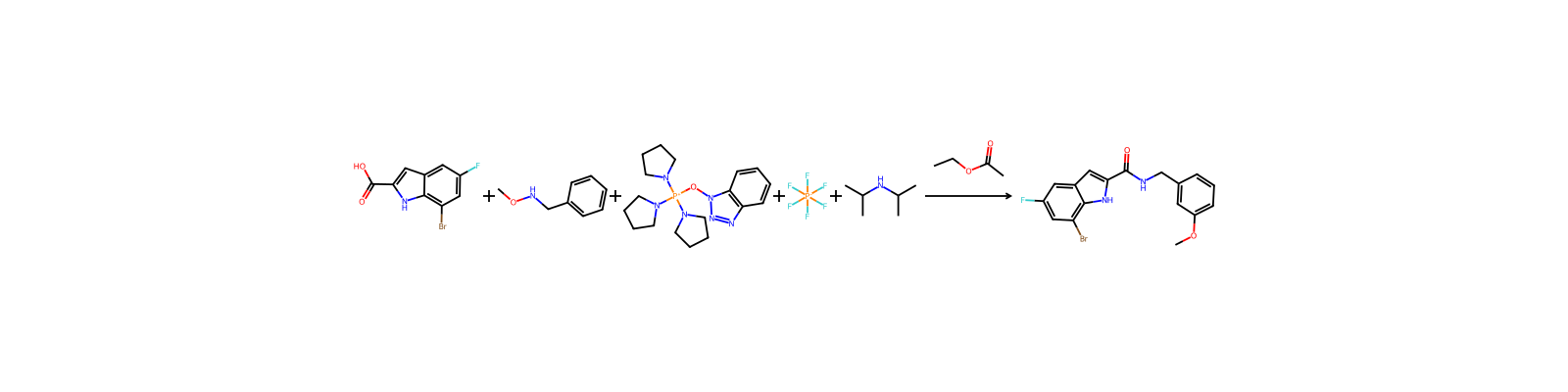
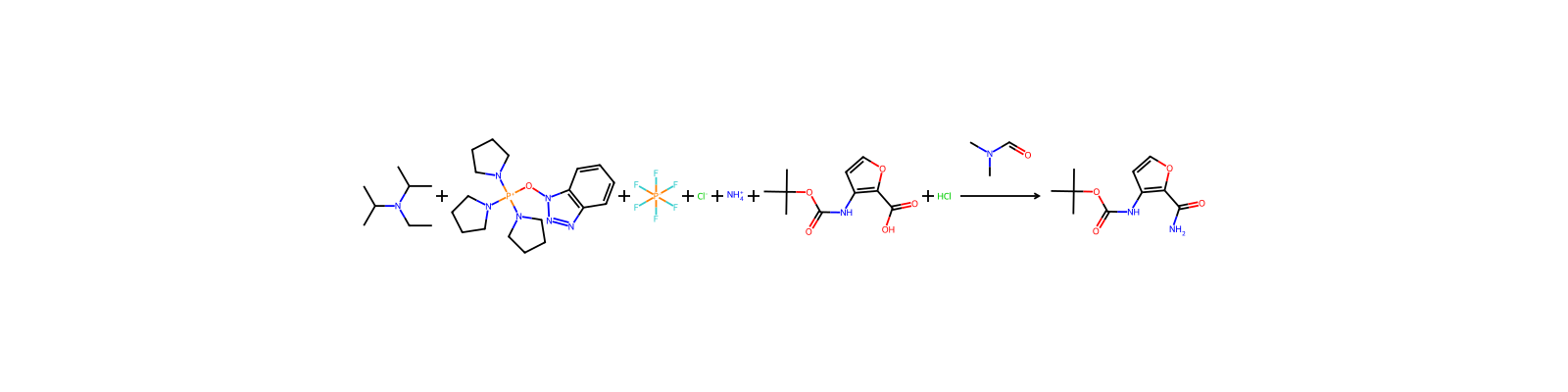
Related reactions
2,957 records




Linked notes
Loading…