Bis(tri-tert-butylphosphine)palladium(0)
Pd(t-Bu3P)2 · BIS(TRI-TERT-BUTYLPHOSPHINE)PALLADIUM · BIS(TRI-T-BUTYLPHOSPHINE)PALLADIUM(0) · Pd(P(t-Bu)3)2 · Bis[tris(tert-butyl)phosphine]palladium · Bis[tris(tert-butyl)phosphine]palladium, 20.9% Pd · bis(tri-tert-butylphosphane) palladium · BIS(TRI-TERT-BUTYLPHOSPHINE)PALLADIUM (0)
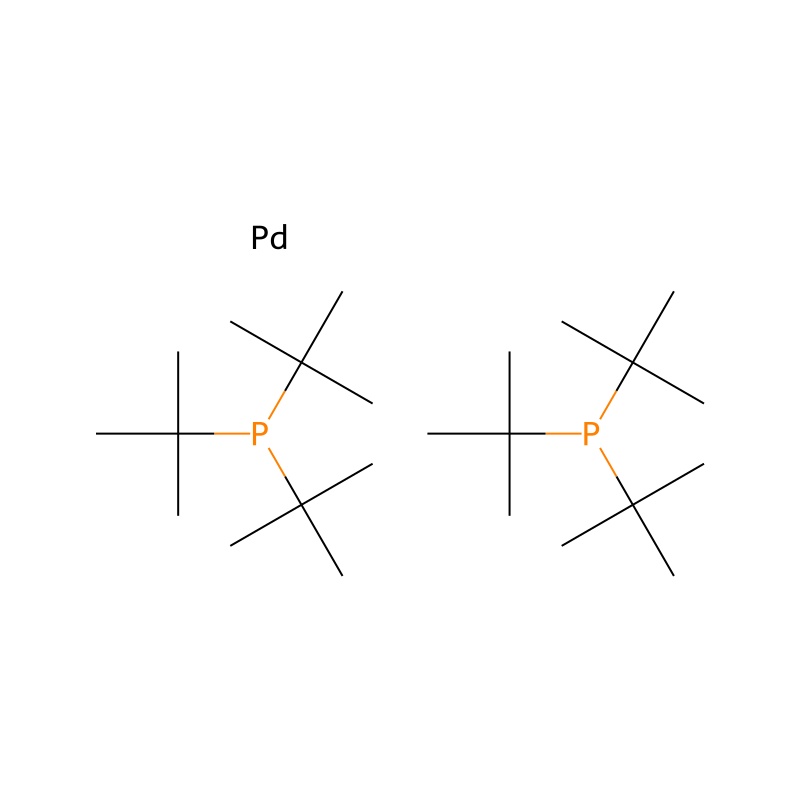
Identifiers & Physical Properties
| CAS No. | 53199-31-8 |
|---|---|
| Molecular formula | C24H54P2Pd |
| Average molar mass | 511.1 g/mol |
| Monoisotopic mass | 510.27356 g/mol |
| SMILES | CC(C)(C)P(C(C)(C)C)C(C)(C)C.CC(C)(C)P(C(C)(C)C)C(C)(C)C.[Pd] |
| InChIKey | MXQOYLRVSVOCQT-UHFFFAOYSA-N |
| PubChem CID | 2734558 |
| EC No. | 640-284-9 |
| DTXSID | DTXSID80370359 |
Chemical & Physical Properties
| Topological polar surface area | 0 |
|---|---|
| Hydrogen bond donors | 0 |
| Hydrogen bond acceptors | 0 |
| Rotatable bonds | 6 |
| Heavy atoms | 27 |
| Formal charge | 0 |
| Complexity | 128 |
| Melting point | >300 °C |
| Storage conditions | -20°C |
| Physical state | Crystals |
| Color | Off-white to orange-brown |
| Solubility | insoluble |
| Sensitivity | Light, Air & Moisture Sensitive |
| InChI | InChI=1S/2C12H27P.Pd/c2*1-10(2,3)13(11(4,5)6)12(7,8)9/h2*1-9H3/q-2/p+2 |
| InChIKey | XULQKWNZCKOVSU-UHFFFAOYSA-P |
| SMILES | P(C(C)(C)C)(C(C)(C)C)(C(C)(C)C)[Pd]P(C(C)(C)C)(C(C)(C)C)C(C)(C)C |
| CAS DataBase Reference | 53199-31-8(CAS DataBase Reference) |
| UNSPSC Code | 12161600 |
| NACRES | NA.22 |
| GHS pictogram | GHS07 |
| Signal word | Warning |
| GHS hazard statements | H315-H319-H335 |
| GHS precautionary statements | P261-P280a-P304+P340-P305+P351+P338-P405-P501a |
| Hazard symbols | Xi |
| Risk statements (R) | 36/37/38 |
| Safety statements (S) | 24/25 |
| Water hazard class (WGK) | 3 |
| TSCA inventory status | No |
| Customs code | 28439000 |
| Storage class | 11 - Combustible Solids |
Safety & Regulations
| GHS classification | DangerH228 (69.7%): Flammable solid [Danger Flammable solids]H251 (66.7%): Self-heatingmay catch fire [Danger Self-heating substances and mixtures]H302+H312+H332 (66.7%): Harmful if swallowed, in contact with skin or if inhaled [Warning Acute toxicity, oralacute toxicity, dermalacute toxicity, inhalation]H302 (75.8%): Harmful if swallowed [Warning Acute toxicity, oral]H312 (75.8%): Harmful in contact with skin [Warning Acute toxicity, dermal]H315 (97%): Causes skin irritation [Warning Skin corrosion/irritation]H317 (66.7%): May cause an allergic skin reaction [Warning Sensitization, Skin]H319 (97%): Causes serious eye irritation [Warning Serious eye damage/eye irritation]H332 (75.8%): Harmful if inhaled [Warning Acute toxicity, inhalation]H335 (27.3%): May cause respiratory irritation [Warning Specific target organ toxicity, single exposureRespiratory tract irritation]H400 (66.7%): Very toxic to aquatic life [Warning Hazardous to the aquatic environment, acute hazard]H410 (66.7%): Very toxic to aquatic life with long lasting effects [Warning Hazardous to the aquatic environment, long-term hazard]P210, P235, P240, P241, P261, P264, P264+P265, P270, P271, P272, P273, P280, P301+P317, P302+P352, P304+P340, P305+P351+P338, P317, P319, P321, P330, P332+P317, P333+P317, P337+P317, P362+P364, P370+P378, P391, P403+P233, P405, P407, P410, P413, P420, and P501 (click each P-code to see the statement)Aggregated GHS information provided per 33 reports by companies from 8 notifications to the ECHA C&L Inventory. Each notification may be associated with multiple companies.Information may vary between notifications depending on impurities, additives, and other factors. The percentage value in parenthesis indicates the notified classification ratio from companies that provide hazard codes. Only hazard codes with percentage values above 10% are shown. For more detailed information, please visit ECHA C&L website. |
|---|---|
| Hazard Classes and Categories | Flam. Sol. 1 (69.7%)Self-heat. 1 (66.7%)Acute Tox. 4 (75.8%)Skin Irrit. 2 (97%)Skin Sens. 1A (66.7%)Eye Irrit. 2 (97%)STOT SE 3 (27.3%)Aquatic Acute 1 (66.7%)Aquatic Chronic 1 (66.7%) |
| Water hazard class (WGK) | 3 |
| TSCA inventory status | No |
| Customs code | 28439000 |
| Risk statements (R) | 36/37/38 |
| Signal word | Warning |
| GHS pictogram | GHS07 |
| Hazard symbols | Xi |
| Safety statements (S) | 24/25 |
| Storage class | 11 - Combustible Solids |
| GHS hazard statements | H315-H319-H335 |
| GHS precautionary statements | P261-P280a-P304+P340-P305+P351+P338-P405-P501a |
Applications & Uses
Uses
Catalyst for Suzuki coupling on a multisubstituted sp 3 -carbon (eq. 1) Catalyst for Stille coupling reaction of aryl chlorides 2 (eq. 2) Catalyst for Negishi coupling reaction 3 (eq. 3) Catalyst for Heck coupling to form tetrasubstituted olefins 4 (eq. 4) Catalyst for Buchwald-Hartwig amination of aryl halide 5 (eq. 5) Catalyst for carbonylation of aryl halides with carbamoylsilanes 6 (eq. 6) t -Bu 3 P) 2 catalyst.
Uses
Bis(tri-tert-butylphosphine)palladium(0) is used in Coupling reactions, Heck couplings. It acts as a palladium catalyst for reductive carbonylation.
General Description
This product has been enhanced for catalytic efficiency.