
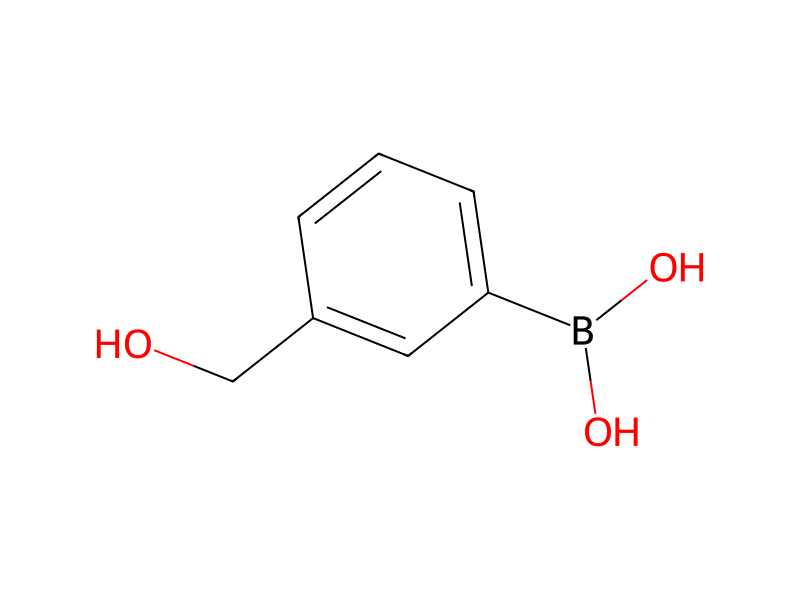
Basic information
- Standard SMILES
OCc1cccc(B(O)O)c1- InChIKey
HGTDLKXUWVKLQX-UHFFFAOYSA-N- Molecular formula
- C7H9BO3
- Average molar mass
- 151.96 g/mol
- Monoisotopic mass
- 152.06447455
Names & identifiers
- Preferred name
- [3-(Hydroxymethyl)phenyl]boronic acid
- IUPAC
- [3-(hydroxymethyl)phenyl]boronic acid
- English name
- 3-(Hydroxymethyl)phenylboronic acid
- Molecular formula
- C7H9BO3
- Molecular weight
- 151.96
Names & synonyms
[3-(hydroxymethyl)phenyl]boronic Acid(3-(Hydroxymethyl)phenyl)boronic acid(3-Hydroxymethyl)phenylboronic acidRefChem:399681672-931-63-(Hydroxymethyl)phenylboronic acid87199-15-33-hydroxymethylphenylboronic acid3-(Hydroxymethyl)benzeneboronic AcidMFCD01317846(3-hydroxymethylphenyl)boronic acid3-(hydroxymethyl)phenyl boronic acid
Show more names
PACR-012RARECHEM AH PB 01893-Boronobenzyl alcohol(3-Boronophenyl)methanol3-hydroxymethylboronic acid3-(hydroxyMethyl)phenylboronic3-HydroMethylphenylboronicacidm-(Hydroxymethyl)phenylboronic Acid
SCHEMBL8832CHEMBL3495163-(hydroxymethyl)-phenylboronic acid3-(hydroxymethyl)phenyl-boronic acid3-(hydroxymethyl)benzene boronic acidAKOS0052581443-(Hydroxymethyl)phenylboronicacid(3-(hydroxymethyl)phenyl)-boronic acid
Database identifiers
- CAS
87199-15-3- PubChem CID
- 2734662
- DTXSID
DTXSID00370432- ChEMBL
CHEMBL349516- EC Number
- 672-931-6
- Nikkaji
- J2.225.064G
Properties
Computed structural properties
- Topological polar surface area
- 60.7 Ų
- Hydrogen bond donors
- 3
- Hydrogen bond acceptors
- 3
- Rotatable bonds
- 2
- Heavy atoms
- 11
- Formal charge
- 0
- Complexity
- 118
Physicochemical properties
- Melting point
- 95 · 95-99 °C (lit.)
- Boiling point
- 380.5 · 380.5±44.0 °C(Predicted)
- Density
- 1.25 · 1.25±0.1 g/cm3(Predicted)
- storage temp.
- Keep in dark place,Sealed in dry,Room Temperature
- pka
- 8.31 · 8.31±0.10(Predicted)
- form
- powder to crystal
- color
- White to Almost white
- Water Solubility
- Soluble in water.
- BRN
- 8832019 · 8832019
- InChI
- InChI=1S/C7H9BO3/c9-5-6-2-1-3-7(4-6)8(10)11/h1-4,9-11H,5H2
- InChIKey
- HGTDLKXUWVKLQX-UHFFFAOYSA-N
- SMILES
- B(C1=CC=CC(CO)=C1)(O)O
- CAS DataBase Reference
- 87199 · 87199-15-3(CAS DataBase Reference)
- UNSPSC Code
- 12352103 · 12352103
- NACRES
- 22 · NA.22
- Symbol(GHS)
- 7 · GHS07
- Signal word
- Warning
- Hazard statements
- 315 · H315-H319-H335
- Precautionary statements
- 261 · P261-P280a-P304+P340-P305+P351+P338-P405-P501a
- PPE
- 95 · Eyeshields, Gloves, type N95 (US)
- Hazard Codes
- Xi
- Risk Statements
- 36 · 36/37/38
- Safety Statements
- 37 · 37/39-26-36-24/25
- WGK Germany
- 3 · 3
- HazardClass
- IRRITANT
- HS Code
- 29319090 · 29319090
- Storage Class
- 11 · 11 - Combustible Solids
- REACH Registrations
- Active
Safety & regulation
GHS classification
GHS Classification
This chemical does not meet GHS hazard criteria for 25% (3 of 12) of reports.
Warning
H315 (75%): Causes skin irritation [Warning Skin corrosion/irritation]
P261, P264, P264+P265, P271, P280, P302+P352, P304+P340, P305+P351+P338, P319, P321, P332+P317, P337+P317, P362+P364, P403+P233, P405, and P501 (click each P-code to see the statement)
Aggregated GHS information provided per 12 reports by companies from 7 notifications to the ECHA C&L Inventory. Each notification may be associated with multiple companies.
Hazard information
Regulatory InformationStatus: Active Update: 27-10-2022 https://echa.europa.eu/registration-dossier/-/registered-dossier/33076
Hazard Classes and CategoriesSkin Irrit. 2 (75%)
Safety data
- PPE
- Eyeshields, Gloves, type N95 (US)
- wgk
- 3
- hs_code
- 29319090
- risk_code
- 36/37/38
- Signal word
- Warning
- Symbol(GHS)
- GHS07
- hazard_code
- Xi
- safety_code
- 37/39-26-36-24/25
- hazard_class
- IRRITANT
- Storage Class
- 11 - Combustible Solids
- Hazard statements
- H315-H319-H335
- REACH Registrations
- Active
- Precautionary statements
- P261-P280a-P304+P340-P305+P351+P338-P405-P501a
Chemistry & industry
Applications
Usessuzuki reaction
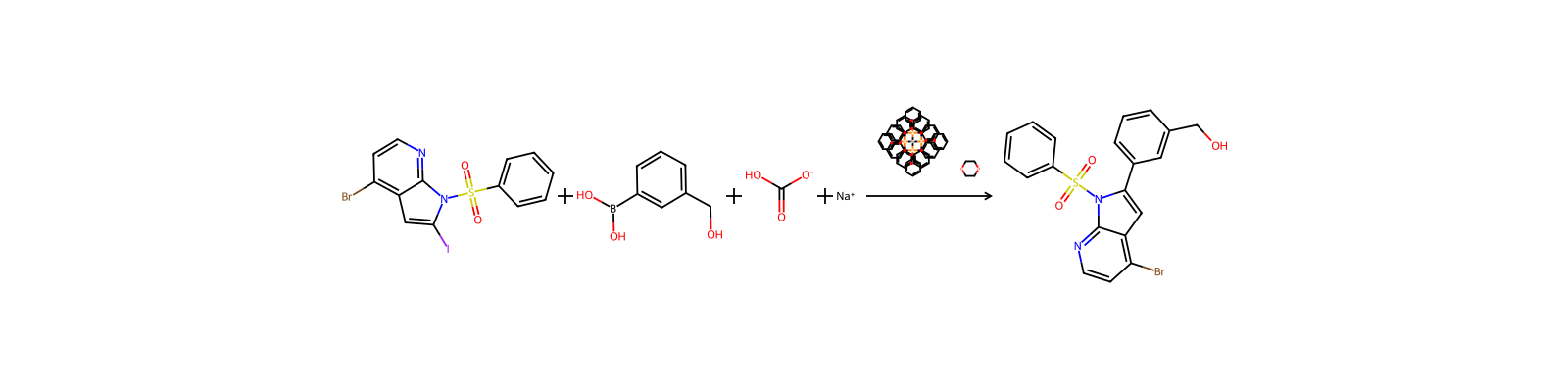
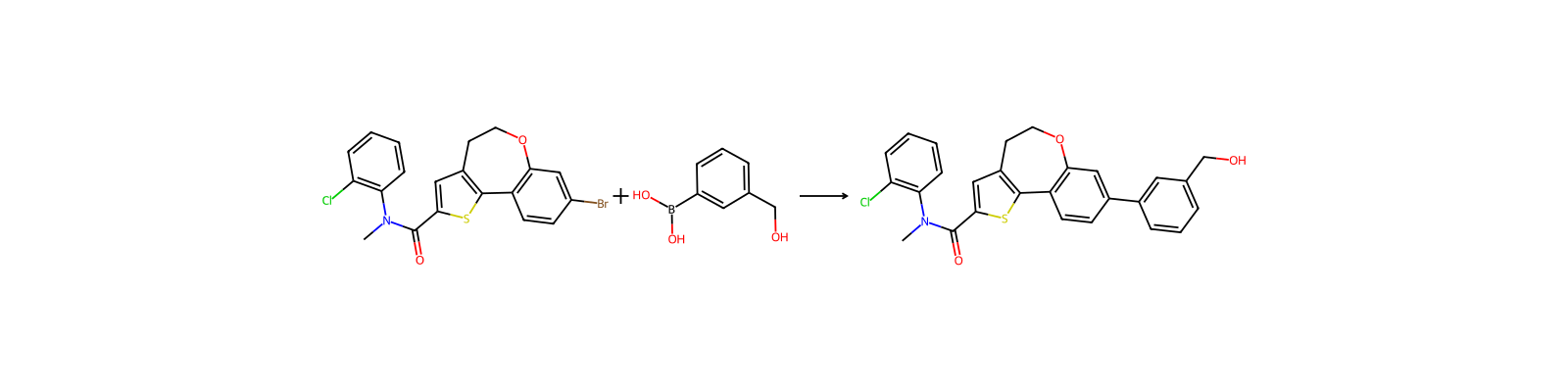
UsesReactant used for copper-mediated trifluoromethylation, copper-catalyzed transformations from arylboronic acids in water, Mitsunobu, Suzuki, and amidation reactions with hydroxyphenylamino bromopyrazinecarboxylate. Reactant involved in the synthesis of biologically active molecules including Mycobacterium tuberculosis H37Rv chorismate mutase inhibitors via Suzuki coupling reactions, HIV protease inhibitors with antiviral activity against drug-resistant viruses, Pyrrole derivatives for use as PDE4B inhibitors.
Upstream & downstream products
Upstream raw materials
Downstream products
Suppliers50 total
国药集团化学试剂有限公司86-21-63210123 · [email protected]
北京华美互利生物化工010-56205725 · [email protected]
梯希爱(上海)化成工业发展有限公司021-67121386 · [email protected]
上海阿拉丁生化科技股份有限公司400-6206333 13167063860 · [email protected]
安徽建竹生物科技有限公司15855184105 · [email protected]
T&W GROUP021-61551611 13296011611 · [email protected]
韶远科技(上海)有限公司021-50795510 4000665055 · [email protected]
科瑞迪化学400-821-5857 021-64326257 · [email protected]
上海迈瑞尔生化科技有限公司4006356688 18621169109 · [email protected]
北京华威锐科化工有限公司0757-86329057 18934348241 · [email protected]
阿法埃莎(中国)化学有限公司400-6106006 · [email protected]
安耐吉化学&3A(安徽泽升科技股份有限公司)400-0056266 · [email protected]
上海柏卡化学技术有限公司400-026-1533/(021) 6478-0600 · [email protected]
上海瀚鸿科技股份有限公司021-54306202 13764082696 · [email protected]
石家庄德科达化工有限公司0311-67790228 15531158659 · [email protected]
上海景颜化工科技有限公司13817811078 · [email protected]
嘉兴市艾森化工有限公司0573-85285100 18627885956 · [email protected]
Pure Chemistry Scientific Inc.001-857-928-2050 or 1-888-588-9418 · [email protected]
上海泰坦科技股份有限公司400-6009262 15618770481 · [email protected]
上海隆盛化工有限公司58099637 13585536065 · [email protected]
南京爱珂医药科技有限公司025-58395930 · [email protected]
山东西亚化学有限公司13355009207 13355009207 · [email protected]
玛雅试剂+86 (573) 82222445 (0)18006601000 452520369 · [email protected]
天津希恩思生化科技有限公司400 638 7771 · [email protected]
上海钰康生物科技有限公司15618758386 15618758386 · [email protected]
南京维奥化工有限公司Please Send Email 18652950785 · [email protected]
广州科瑞生物技术有限公司20-66003216 18666003216 · [email protected]
河南多贝化工有限公司0370-2785118 17550508557 · [email protected]
艾科试剂4008-755-333 18080918076 · [email protected]
上海思域化工科技有限公司86-21-34053660 · [email protected]
赛默飞世尔科技(中国)有限公司800-810-5118 · [email protected]
上海特伯化学科技有限公司+86-21-60341587 · [email protected]
江苏艾康生物医药研发有限公司025-66113011 13913916777 · [email protected]
上海健超生物科技有限公司150-2103-5486 18017383231 · [email protected]
TCI AMERICA800-4238616 · [email protected]
TOKYO CHEMICAL INDUSTRY CO., LTD.03-36680489 · [email protected]
TCI Europe320-37350700 · [email protected]
卡迪亚医药科技有限公司0371-86615086 18203638366 0371-86159066 13526786601
上海仁曲医药科技有限公司18171398856 2968382473 · [email protected]
深圳康特腾科技有限公司86-0755-86635001 · [email protected]
越林试剂021-62960152 · [email protected]
上海睿升化工科技有限公司+86-021-50935922
Clearsynth Labs Limited+91-22-26355700 · [email protected]
上海灏云化工科技有限公司021-68367562 · [email protected]
苏州爱玛特生物科技有限公司0512-56316828 4008675858 · [email protected]
上海将来实业股份有限公司021-61552785 · [email protected]
HBCChem, Inc.+1-510-219-6317 · [email protected]
上海毕得医药科技股份有限公司400-164-7117 18317119277 · [email protected]
上海笛柏生物科技有限公司400-008-9730,021-54359730 400-008-9730 · [email protected]
重庆普瑞生物医药科技有限公司023-89130144 18523560356 · [email protected]
Related reactions
136 records





Linked notes
Loading…