
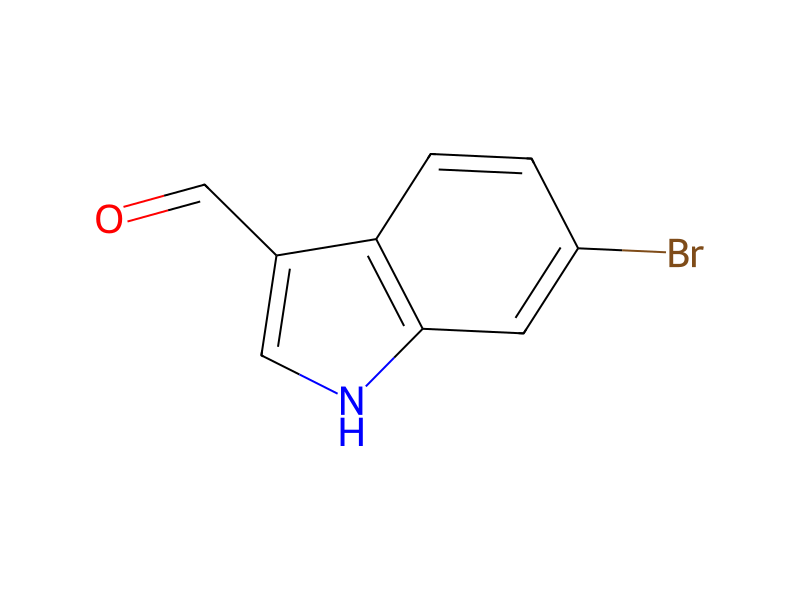
Basic information
- Standard SMILES
O=Cc1c[nH]c2cc(Br)ccc12- InChIKey
WCCLQCBKBPTODV-UHFFFAOYSA-N- Molecular formula
- C9H6BrNO
- Average molar mass
- 224.05 g/mol
- Monoisotopic mass
- 222.96328
Names & identifiers
- Preferred name
- 6-Bromoindole-3-carbaldehyde
- IUPAC
- 6-bromo-1H-indole-3-carbaldehyde
- English name
- 6-Bromoindole-3-carboxaldehyde
- Molecular formula
- C9H6BrNO
- Molecular weight
- 224.05
Names & synonyms
6-bromoindole-3-carbaldehydeRefChem:1043326-Bromo-1H-indole-3-carbaldehyde17826-04-96-Bromoindole-3-carboxaldehyde1H-Indole-3-carboxaldehyde, 6-bromo-6-Bromo-3-formylindoleMFCD00792689CHEMBL33582296-bromo-1H-indol-3-carbaldehyde6-Bromoindole-3-carboxaldehyde, 97%CS-W013077
Show more names
6-broMo-3-carboxaldehyde6-BROMO-3-FORMYL-1H-INDOLE6-Bromoindole-3-carboxaldehyde >6-BROMO-1H-INDOLE-3-CARBOXALDEHYDE6-Aminoindole-3-carboxaldehyde Factory6-Bromo-1H-indole-3-carbaldehyde, 6-Bromo-3-formylindole
AB07122AC-18164SY017962Z916010012Methyl 7-benzyloxyindole-2-carboxylateMFCD0079orb2940310SCHEMBL1081911
Database identifiers
- CAS
17826-04-9- PubChem CID
- 2794830
- DTXSID
DTXSID10383452- ChEMBL
CHEMBL3358229- ChEBI
CHEBI:206959- EC Number
- 627-477-3
- Nikkaji
- J1.461.143F
Properties
Computed structural properties
- XLogP
- 2.4
- Topological polar surface area
- 32.9 Ų
- Hydrogen bond donors
- 1
- Hydrogen bond acceptors
- 1
- Rotatable bonds
- 1
- Heavy atoms
- 12
- Formal charge
- 0
- Complexity
- 185
Physicochemical properties
- Melting point
- 202 · 202-206 °C
- Boiling point
- 395.6 · 395.6±22.0 °C(Predicted)
- Density
- 1.727 · 1.727±0.06 g/cm3(Predicted)
- storage temp.
- Keep in dark place,Sealed in dry,Room Temperature
- pka
- 14.57 · 14.57±0.30(Predicted)
- form
- Solid
- color
- Light yellow to Brown
- InChI
- 1S/C9H6BrNO/c10-7-1-2-8-6(5-12)4-11-9(8)3-7/h1-5,11H
- InChIKey
- WCCLQCBKBPTODV-UHFFFAOYSA-N
- SMILES
- [H]C(=O)c1c[nH]c2cc(Br)ccc12
- CAS DataBase Reference
- 17826 · 17826-04-9(CAS DataBase Reference)
- UNSPSC Code
- 12352100 · 12352100
- NACRES
- 22 · NA.22
- Symbol(GHS)
- 7 · GHS07
- Signal word
- Warning
- Hazard statements
- 302 · H302-H315-H319-H335
- Precautionary statements
- 261 · P261-P264-P270-P301+P312-P302+P352-P305+P351+P338
- target organs
- Respiratory system
- PPE
- 95 · dust mask type N95 (US), Eyeshields, Gloves
- Hazard Codes
- Xn
- Risk Statements
- 22 · 22-36/37/38
- Safety Statements
- 26 · 26-36-36/37/39-22
- RIDADR
- 2811 · UN2811
- WGK Germany
- 3 · 3
- Hazard Note
- Harmful
- HazardClass
- 6.1 · 6.1
- HS Code
- 29339900 · 29339900
- Storage Class
- 11 · 11 - Combustible Solids
- Hazard Classifications
- 4 OralEye · Acute Tox. 4 OralEye Irrit. 2Skin Irrit. 2STOT SE 3
- Limited Quantities
- 5 kg · 5.0 kg (11 lbs) (solid)
- Excepted Quantities
- Max Inner Pack (30g or 30ml) and Max Outer Pack (1Kg or 1L)
Safety & regulation
GHS classification
GHS Classification
Warning
H302 (100%): Harmful if swallowed [Warning Acute toxicity, oral];H315 (100%): Causes skin irritation [Warning Skin corrosion/irritation];H319 (100%): Causes serious eye irritation [Warning Serious eye damage/eye irritation];H335 (97.6%): May cause respiratory irritation [Warning Specific target organ toxicity, single exposure; Respiratory tract irritation]
P261, P264, P264+P265, P270, P271, P280, P301+P317, P302+P352, P304+P340, P305+P351+P338, P319, P321, P330, P332+P317, P337+P317, P362+P364, P403+P233, P405, and P501 (click each P-code to see the statement)
Aggregated GHS information provided per 42 reports by companies from 4 notifications to the ECHA C&L Inventory. Each notification may be associated with multiple companies.;Information may vary between notifications depending on impurities, additives, and other factors. The percentage value in parenthesis indicates the notified classification ratio from companies that provide hazard codes. Only hazard codes with percentage values above 10% are shown. For more detailed information, please visit ECHA C&L website.
Hazard information
Hazard Classes and CategoriesAcute Tox. 4 (100%);Skin Irrit. 2 (100%);Eye Irrit. 2 (100%);STOT SE 3 (97.6%)
Safety data
- PPE
- dust mask type N95 (US), Eyeshields, Gloves
- wgk
- 3
- ridadr
- UN2811
- hs_code
- 29339900
- risk_code
- 22-36/37/38
- Signal word
- Warning
- Symbol(GHS)
- GHS07
- hazard_code
- Xn
- hazard_note
- Harmful
- safety_code
- 26-36-36/37/39-22
- hazard_class
- 6.1
- Storage Class
- 11 - Combustible Solids
- target organs
- Respiratory system
- Hazard statements
- H302-H315-H319-H335
- Limited Quantities
- 5.0 kg (11 lbs) (solid)
- Excepted Quantities
- Max Inner Pack (30g or 30ml) and Max Outer Pack (1Kg or 1L)
- Hazard Classifications
- Acute Tox. 4 OralEye Irrit. 2Skin Irrit. 2STOT SE 3
- Precautionary statements
- P261-P264-P270-P301+P312-P302+P352-P305+P351+P338
Chemistry & industry
Applications
Uses6-Bromoindole-3-carboxaldehyde, also known as 6-Bromo-1H-indole-3-carbaldehyde, is a halogenated reagent used in the synthesis of indoles and their derivatives. It is also a biochemical reagent used in life science related research.
Upstream & downstream products
Upstream raw materials
Downstream products
Suppliers50 total
梯希爱(上海)化成工业发展有限公司021-67121386 · [email protected]
衢州润东化工有限公司0570-8789886 18892685668 · [email protected]
上海恩氟佳科技有限公司15800445152 · [email protected]
上海阿拉丁生化科技股份有限公司400-6206333 13167063860 · [email protected]
上海策嵘生物科技有限公司[email protected]
毕佳索(上海毕得医药科技股份有限公司)400-6005915 · [email protected]
上海麦克林生化科技股份有限公司021-50706066 15221275939 · [email protected]
苏州启航生物科技有限公司18151111370 · [email protected]
温州共赢化学有限公司+86-0086-577-64498589 +86-15355981851 · [email protected]
宁波季诺化学品有限公司0574-87314919 057487319282 · [email protected]
Dayang Chem (Hangzhou) Co.,Ltd.+86-0571-88938639 17705817739 · [email protected]
郑州鸿晟医药科技有限公司0371-55695890 15637198702 · [email protected]
韶远科技(上海)有限公司021-50795510 4000665055 · [email protected]
上海迈瑞尔生化科技有限公司4006356688 18621169109 · [email protected]
安耐吉化学&3A(安徽泽升科技股份有限公司)400-0056266 · [email protected]
烟台凯博医药科技有限公司0535-6385396 · [email protected]
常州科化生物科技有限公司0519-68985668 13685222090 · [email protected]
上海瀚鸿科技股份有限公司021-54306202 13764082696 · [email protected]
上海浦洛凯医药科技有限公司17269768198 · [email protected]
嘉兴市艾森化工有限公司0573-85285100 18627885956 · [email protected]
郑州研德生物科技有限公司0371-63682289 15538176268 · [email protected]
上海攀鸿化工科技有限公司021-56491756 13512199871 · [email protected]
杰达维(上海)医药科技发展有限公司/J & W PharmLab021-64340559 · [email protected]
山东西亚化学有限公司13355009207 13355009207 · [email protected]
南京维奥化工有限公司Please Send Email 18652950785 · [email protected]
安徽实特医药科技有限公司086-21-50829787 13621628489 · [email protected]
武汉泰凯塞科技有限公司027-86697669 13986148687 · [email protected]
上海特伯化学科技有限公司+86-21-60341587 · [email protected]
南京诺利斯医药科技有限公司13901585132 · [email protected]
江苏艾康生物医药研发有限公司025-66113011 13913916777 · [email protected]
TCI AMERICA800-4238616 · [email protected]
TOKYO CHEMICAL INDUSTRY CO., LTD.03-36680489 · [email protected]
TCI Europe320-37350700 · [email protected]
Shanghai Witofly Chemical Co.,Ltd[email protected]
上海伯韵医药科技有限公司13817873692 · [email protected]
上海裕兰生物科技有限公司021-57171705 13817537615 · [email protected]
无锡中坤生化科技有限公司+86 0510-85629785
上海昶衍化工科技有限公司021-20242659 18930833303 · [email protected]
KARMEL TECHNOLOGY (HK) CO.,LIMITED+8618795957998 · [email protected]
上海将来实业股份有限公司400-0066400 13621662912 · [email protected]
上海将来实业股份有限公司021-61552785 · [email protected]
上海毕得医药科技股份有限公司400-164-7117 18317119277 · [email protected]
成都零六生物科技有限公司400-1166-196 13458535857 · [email protected]
雷丁试剂0510-85629785 18013409632 · [email protected]
上海安米克化学品有限公司微信 17321281695 18019252918 · [email protected]
南京恰风和医药科技有限公司025-57018978 18251899859 · [email protected]
Sigma-Aldrich西格玛奥德里奇(上海)贸易有限公司021-61415566 800-8193336 · [email protected]
九鼎化学(上海)科技有限公司4009209199 · [email protected]
广东翁江化学试剂有限公司0751-2886766 13927870850 · [email protected]
南京科晟祥科技有限公司18252089365 · [email protected]
Additional notes
Definition6-bromoindole-3-carboxaldehyde is a member of indoles.
Related reactions
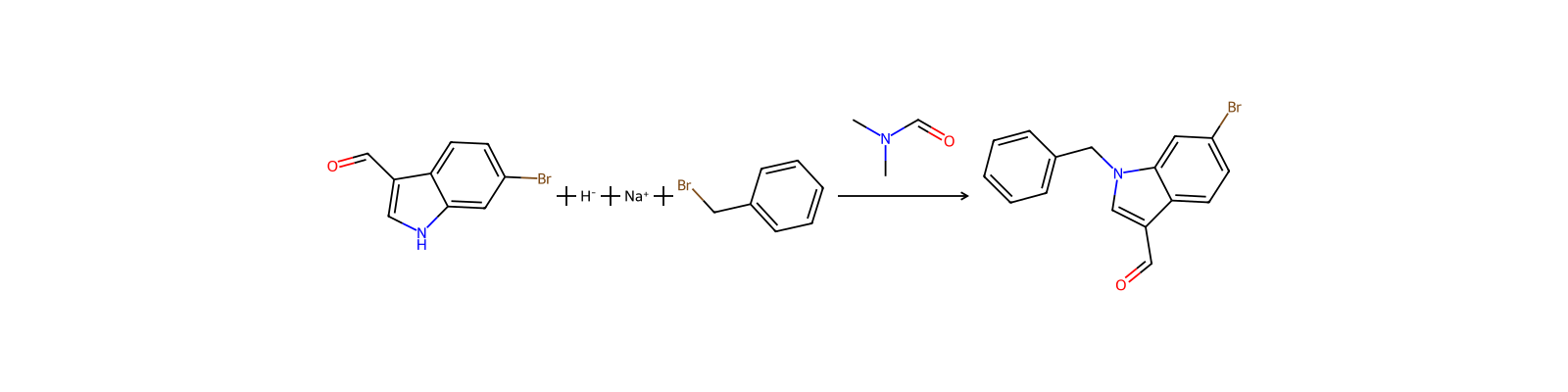
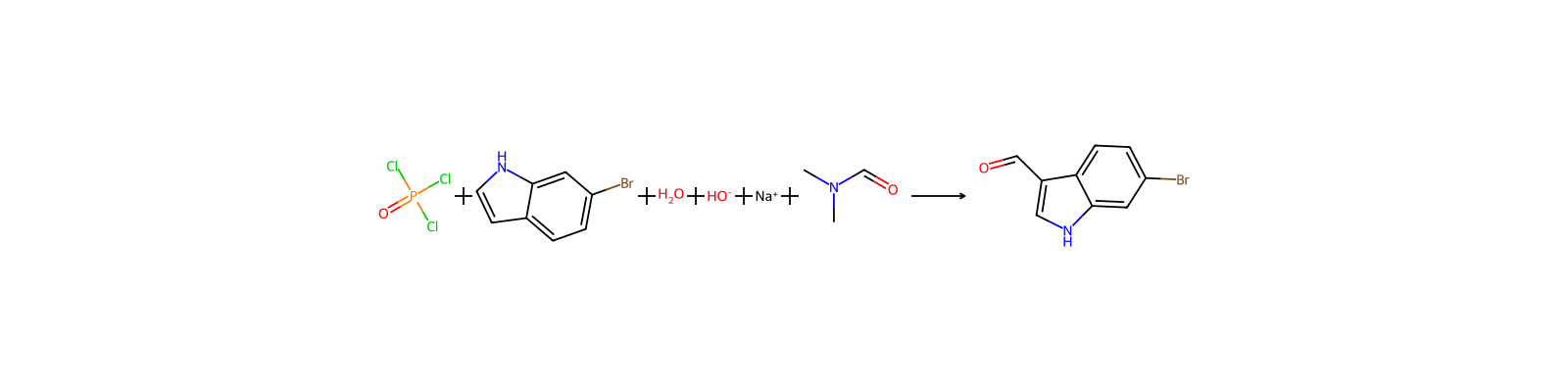
12 records




Linked notes
Loading…