
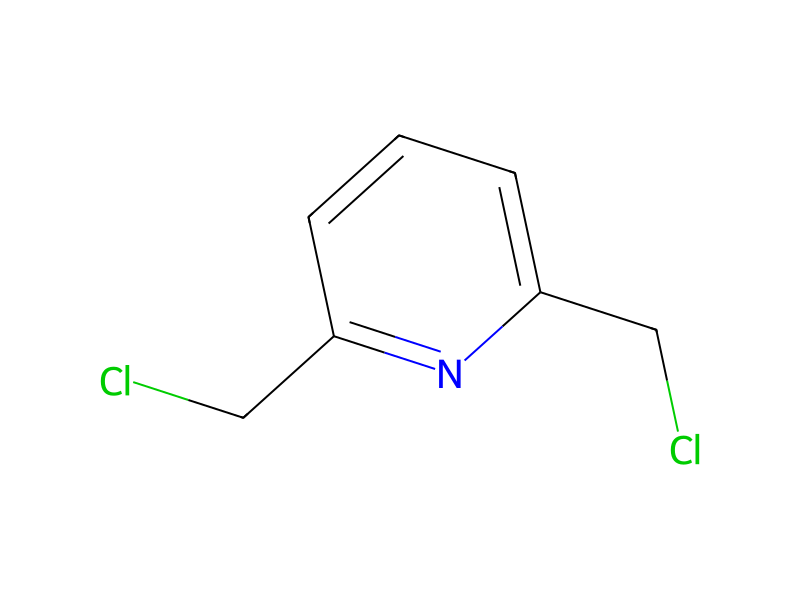
Basic information
- Standard SMILES
ClCc1cccc(CCl)n1- InChIKey
IWQNFYRJSVJWQA-UHFFFAOYSA-N- Molecular formula
- C7H7Cl2N
- Average molar mass
- 176.04 g/mol
- Monoisotopic mass
- 174.99555458
Overview
structure in first source
Names & identifiers
- Preferred name
- 2,6-Bis(chloromethyl)pyridine
- IUPAC
- 2,6-bis(chloromethyl)pyridine
- English name
- 2,6-BIS(CHLOROMETHYL)PYRIDINE
- Molecular formula
- C7H7Cl2N
- Molecular weight
- 176.04
Names & synonyms
2,6-Bis(chloromethyl)pyridine3099-28-3DTXSID30311712RefChem:83089DTXCID30262836627-975-0Pyridine, 2,6-bis(chloromethyl)-MFCD001428442,6-Bis-chloromethyl-pyridineNSC244982SCHEMBL7347282,6-Bis(chloromethyl)pyridine, 99%
Show more names
α,α'-dichloro-2,6-lutidine2,6-Bis(chloromethyl)pyridine >2,6-Bis(chloromethyl)pyridine 99%2,6-BIS(CHLOROMETHYL)PYRIDINE 98+%ALPHA,ALPHA'-DICHLORO-2,6-LUTIDINE2,6-Bis(chloromethyl)pyridine,α,α′-Dichloro-2,6-lutidine
NSC-244982SY053497EN300-6736672FT-07535612,6-Bis(cA820682SCHEMBL59253102,6-bis-(chloromethyl)pyridine
Database identifiers
- CAS
3099-28-3- PubChem CID
- 316654
- DTXSID
DTXSID30311712- EC Number
- 627-975-0
- Nikkaji
- J32.657G
Properties
Computed structural properties
- XLogP
- 1.7
- Topological polar surface area
- 12.9 Ų
- Hydrogen bond donors
- 0
- Hydrogen bond acceptors
- 1
- Rotatable bonds
- 2
- Heavy atoms
- 10
- Formal charge
- 0
- Complexity
- 87.6
Physicochemical properties
- Melting point
- 73 · 73-78 °C (lit.)
- Boiling point
- 110 °C · 110 °C / 3mmHg
- Density
- 1.275 · 1.275±0.06 g/cm3(Predicted)
- storage temp.
- 2 · under inert gas (nitrogen or Argon) at 2-8°C
- form
- powder to crystal
- pka
- 2.19 · 2.19±0.24(Predicted)
- color
- White to Almost white
- BRN
- 116355 · 116355
- InChI
- InChI=1S/C7H7Cl2N/c8-4-6-2-1-3-7(5-9)10-6/h1-3H,4-5H2
- InChIKey
- IWQNFYRJSVJWQA-UHFFFAOYSA-N
- SMILES
- C1(CCl)=NC(CCl)=CC=C1
- CAS DataBase Reference
- 3099 · 3099-28-3(CAS DataBase Reference)
- UNSPSC Code
- 12352100 · 12352100
- NACRES
- 22 · NA.22
- Symbol(GHS)
- 5 · GHS05,GHS07
- Signal word
- Danger
- Hazard statements
- 302 · H302-H315-H318-H335
- Precautionary statements
- 261 · P261-P280-P305+P351+P338
- PPE
- 95 · dust mask type N95 (US), Eyeshields, Gloves
- Hazard Codes
- Xn
- Risk Statements
- 22 · 22-37/38-41
- Safety Statements
- 26 · 26-36/37/39
- RIDADR
- 3335 · UN 3335
- WGK Germany
- 3 · 3
- HS Code
- 29333990 · 29333990
- Storage Class
- 11 · 11 - Combustible Solids
- Hazard Classifications
- 4 OralEye · Acute Tox. 4 OralEye Dam. 1Skin Irrit. 2STOT SE 3
Safety & regulation
GHS classification
GHS Classification
Danger
H302 (97.6%): Harmful if swallowed [Warning Acute toxicity, oral]
P261, P264, P264+P265, P270, P271, P280, P301+P317, P302+P352, P304+P340, P305+P354+P338, P317, P319, P321, P330, P332+P317, P362+P364, P403+P233, P405, and P501 (click each P-code to see the statement)
Aggregated GHS information provided per 42 reports by companies from 4 notifications to the ECHA C&L Inventory. Each notification may be associated with multiple companies.
Hazard information
Hazard Classes and CategoriesAcute Tox. 4 (97.6%)
Safety data
- PPE
- dust mask type N95 (US), Eyeshields, Gloves
- wgk
- 3
- ridadr
- UN 3335
- hs_code
- 29333990
- risk_code
- 22-37/38-41
- Signal word
- Danger
- Symbol(GHS)
- GHS05,GHS07
- hazard_code
- Xn
- safety_code
- 26-36/37/39
- Storage Class
- 11 - Combustible Solids
- Hazard statements
- H302-H315-H318-H335
- Hazard Classifications
- Acute Tox. 4 OralEye Dam. 1Skin Irrit. 2STOT SE 3
- Precautionary statements
- P261-P280-P305+P351+P338
Chemistry & industry
Applications
Uses2,6-Bis(chloromethyl)pyridine may be used in the following studies:Synthesis of a sensitive fluorescent chemosensor for Hg2+, composed of two aminonaphthalimide fluorophores and a receptor of 2,6-bis(aminomethyl)pyridine.Preparation of carbene pincer ligands, required for the preparation of palladium pincer carbene complex.Synthesis of 2-(di-tert-butylphosphinomethyl)-6-diethylaminomethyl)pyridine, PNN ligand.
General Description2,6-Bis(chloromethyl)pyridine is a heterocyclic building block for the synthesis of a variety of pyridine derivatives. It coordinates with metal ions through N-atom to form complexes. The conformational flexibility of the bromomethyl arms makes it an ideal choice for the generation of macrocycles. 2,6-bis(chloromethyl)pyridine crystals are monoclinic with space group P21/c. Its synthesis has been reported. The FT-IR and FT-Raman spectra of 2,6-bis(chloromethyl)pyridine (BCMP) have been recorded in the regions 4000-400cm-1 and 3500-100cm-1, respectively.
Upstream & downstream products
Upstream raw materials
Downstream products
Suppliers50 total
梯希爱(上海)化成工业发展有限公司021-67121386 · [email protected]
上海阿拉丁生化科技股份有限公司400-6206333 13167063860 · [email protected]
Shandong chuangyingchemical Co., Ltd.18853181302 · [email protected]
湖南韵邦生物科技股份有限公司85561037 15386497078 · [email protected]
南通润丰石油化工有限公司66017690 19952660367 · [email protected]
上海艾澜医药有限公司021-58099609-8008 13816260319 · [email protected]
上海麦克林生化科技股份有限公司021-50706066 15221275939 · [email protected]
上海腾准生物科技有限公司19821570922 · [email protected]
普善实业(陕西)有限公司029-81310890 18165209495 · [email protected]
江苏星科元信息科技有限公司400-605-7200 15335295587
安徽合诺生物科技有限公司0555-2761852
陕西缔都化学有限公司029-029-81123119 17391733320 · [email protected]
焦作沃恩生物科技有限责任公司0391-3702345 18739121806
Dayang Chem (Hangzhou) Co.,Ltd.+86-0571-88938639 17705817739 · [email protected]
淮安嘉目生物科技有限公司0517-83187139 18205232085 · [email protected]
毕佳索(上海毕得医药科技股份有限公司)400-6005915 · [email protected]
Syntechem Co.,Ltd[email protected]
上海迈瑞尔生化科技有限公司4006356688 18621169109 · [email protected]
北京索莱宝科技有限公司010-50973130 17801761073 · [email protected]
安耐吉化学&3A(安徽泽升科技股份有限公司)400-0056266 · [email protected]
常州科化生物科技有限公司0519-68985668 13685222090 · [email protected]
上海钰康生物科技有限公司18939844854 · [email protected]
安徽合诺生物科技有限公司18455579438
上海浦洛凯医药科技有限公司17269768198 · [email protected]
常州环灵化工有限公司89803005 18206112582 · [email protected]
郑州研德生物科技有限公司0371-63682289 15538176268 · [email protected]
武汉丰泰威远科技有限公司027-87465837 19945049750 · [email protected]
吉林中科研伸科技有限公司18143011203 · [email protected]
南京唯博特医药科技有限公司18066048793; 18014498793 · [email protected]
山东李比希生物医药科技有限公司15318973357; 15318973357 · [email protected]
上海健超生物科技有限公司15021035486 18081542813 · [email protected]
北京伊诺凯科技有限公司15652467323 · [email protected]
苏州盖德精细材料有限公司0512-66627360 13914021065 · [email protected]
江苏艾康生物医药研发有限公司025-66113011 13913916777 · [email protected]
TCI AMERICA800-4238616 · [email protected]
TOKYO CHEMICAL INDUSTRY CO., LTD.03-36680489 · [email protected]
TCI Europe320-37350700 · [email protected]
上海毕得医药科技股份有限公司400-164-7117 18317119277 · [email protected]
上海笛柏生物科技有限公司400-008-9730,021-54359730 400-008-9730 · [email protected]
Labnetwork lnc.+86-27-50766799 +86-18062016861 · [email protected]
重庆星灿医药科技有限公司13594048950 19923294409 · [email protected]
成都零六生物科技有限公司400-1166-196 13458535857 · [email protected]
上海鑫圭生物科技有限公司15121041756 · [email protected]
Sigma-Aldrich西格玛奥德里奇(上海)贸易有限公司021-61415566 800-8193336 · [email protected]
重庆奥舍生物化工有限公司023-63225655 13320248848 · [email protected]
九鼎化学(上海)科技有限公司4009209199 · [email protected]
杭州创瑞化工科技有限公司17300981287 13757145729 · [email protected]
北京禾兴源科技有限公司18511709189 · [email protected]
北京建强伟业科技有限公司(FUSION弗珍试剂品牌)0531-88924771 15614660963 · [email protected]
sgtlifesciences pvt ltd+91-8790379245 · [email protected]
Related reactions
13 records


Linked notes
Loading…