HuagongsheHuagongshe Chemistry Print Report · For research reference only
9-(Chloromethyl)anthracene
icr448 · ICR 448 · 9-Chlormethyl-anthracen · 9-Chloromethyanthracene · 9-chloromethyl-anthracen · 9-CHLOROMETHYLANTHRACENE · 9-(choromethyl)anthracene · 9-(chloroMethyl)antracene
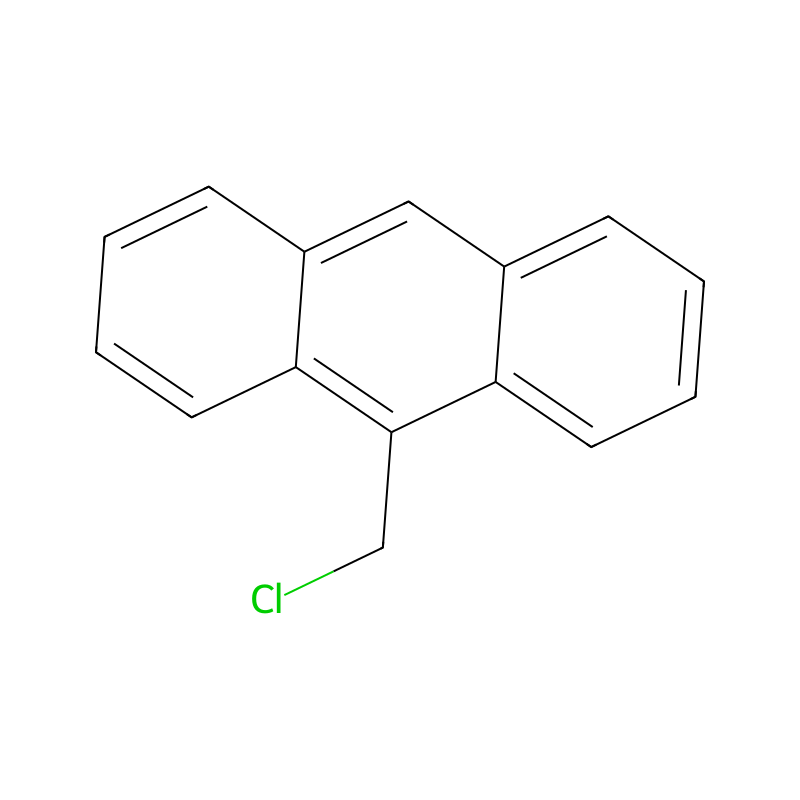
Identifiers & Physical Properties
| CAS No. | 24463-19-2 |
|---|---|
| Molecular formula | C15H11Cl |
| Average molar mass | 226.7 g/mol |
| Monoisotopic mass | 226.05492803 g/mol |
| SMILES | ClCc1c2ccccc2cc2ccccc12 |
| InChIKey | PCVRSXXPGXRVEZ-UHFFFAOYSA-N |
| PubChem CID | 32385 |
| ChEMBL | CHEMBL1446266 |
| EC No. | 246-274-7 |
| DTXSID | DTXSID00179220 |
Chemical & Physical Properties
| XLogP | 5.1 |
|---|---|
| Topological polar surface area | 0 |
| Hydrogen bond donors | 0 |
| Hydrogen bond acceptors | 0 |
| Rotatable bonds | 1 |
| Heavy atoms | 16 |
| Formal charge | 0 |
| Complexity | 216 |
| Melting point | 138-140 °C (lit.) |
| Boiling point | 294.66°C (rough estimate) |
| Density | 1.1510 (rough estimate) |
| Refractive index | 1.6281 (estimate) |
| Storage conditions | under inert gas (nitrogen or Argon) at 2–8 °C |
| Solubility | chloroform: solubleSoluble in chloroform. Insoluble in water. |
| Physical state | Powder |
| Color | Yellow |
| Sensitivity | Light Sensitive |
| BRN | 1873394 |
| InChI | InChI=1S/C15H11Cl/c16-10-15-13-7-3-1-5-11(13)9-12-6-2-4-8-14(12)15/h1-9H,10H2 |
| InChIKey | PCVRSXXPGXRVEZ-UHFFFAOYSA-N |
| SMILES | C1=C2C(C=C3C(=C2CCl)C=CC=C3)=CC=C1 |
| CAS DataBase Reference | 24463-19-2(CAS DataBase Reference) |
| FDA UNII | 8C4ZDD4KUV |
| NIST Chemistry Reference | 9-(Chloromethyl)anthracene(24463-19-2) |
| UNSPSC Code | 12352200 |
| GHS pictogram | GHS07,GHS05 |
| Signal word | Warning |
| GHS hazard statements | H315-H319-H335-H290-H314-H318 |
| GHS precautionary statements | P260h-P301+P330+P331-P303+P361+P353-P501a-P234-P260-P264-P280-P301+P330+P331+P310-P303+P361+P353+P310+P363-P304+P340+P310-P305+P351+P338+P310-P390-P405-P406-P501-P261-P305+P351+P338 |
| Target organs | Respiratory system |
| Personal protective equipment (PPE) | dust mask type N95 (US), Eyeshields, Gloves |
| Hazard symbols | Xi |
| Risk statements (R) | 36/37/38 |
| Safety statements (S) | 26-36 |
| UN transport number | UN 3261 8/PG 2 |
| Water hazard class (WGK) | 3 |
| RTECS number | CA9600000 |
| F | 19 |
| Hazard class | 8Eye Irrit. 2Skin Irrit. 2STOT SE 3 |
| Packing group | III |
| Customs code | 29039990 |
| Storage class | 8A - Combustible corrosive hazardous materials |
| Toxicity | mouse,LDLo,intravenous,2267ug/kg (2.267mg/kg),Cancer Research. Vol. 36, Pg. 2423, 1976. |
| Limited quantities | 1 Kg (2.2 lbs) (solid) |
| Excepted quantities | Max Inner Pack (30g or 30ml) and Max Outer Pack (500g or 500ml) |
Safety & Regulations
| GHS classification | DangerH314 (16.7%): Causes severe skin burns and eye damage [Danger Skin corrosion/irritation]P260, P261, P264, P264+P265, P271, P280, P301+P330+P331, P302+P352, P302+P361+P354, P304+P340, P305+P351+P338, P305+P354+P338, P316, P319, P321, P332+P317, P337+P317, P362+P364, P363, P403+P233, P405, and P501 (click each P-code to see the statement)Aggregated GHS information provided per 48 reports by companies from 7 notifications to the ECHA C&L Inventory. Each notification may be associated with multiple companies. |
|---|---|
| Regulatory information | Anthracene, 9-(chloromethyl)-: Does not have an individual approval but may be used under an appropriate group standard |
| Hazard Classes and Categories | Skin Corr. 1B (16.7%) |
| F | 19 |
| Personal protective equipment (PPE) | dust mask type N95 (US), Eyeshields, Gloves |
| Water hazard class (WGK) | 3 |
| RTECS number | CA9600000 |
| UN transport number | UN 3261 8/PG 2 |
| Customs code | 29039990 |
| Toxicity | mouse,LDLo,intravenous,2267ug/kg (2.267mg/kg),Cancer Research. Vol. 36, Pg. 2423, 1976. |
| Risk statements (R) | 36/37/38 |
| Signal word | Warning |
| GHS pictogram | GHS07,GHS05 |
| Hazard symbols | Xi |
| Safety statements (S) | 26-36 |
| Hazard class | 8Eye Irrit. 2Skin Irrit. 2STOT SE 3 |
| Storage class | 8A - Combustible corrosive hazardous materials |
| Packing group | III |
| Target organs | Respiratory system |
| GHS hazard statements | H315-H319-H335-H290-H314-H318 |
| Limited quantities | 1 Kg (2.2 lbs) (solid) |
| Excepted quantities | Max Inner Pack (30g or 30ml) and Max Outer Pack (500g or 500ml) |
| GHS precautionary statements | P260h-P301+P330+P331-P303+P361+P353-P501a-P234-P260-P264-P280-P301+P330+P331+P310-P303+P361+P353+P310+P363-P304+P340+P310-P305+P351+P338+P310-P390-P405-P406-P501-P261-P305+P351+P338 |
Applications & Uses
Uses
9-(Chloromethyl)anthracene is used as a blocking group reagent used for carboxylic acids, phenols, mercaptans and thiophenols. It is a derivatizing agent for carboxylic acids giving esters with enhanced UV and fluorescence detection in HPLC.