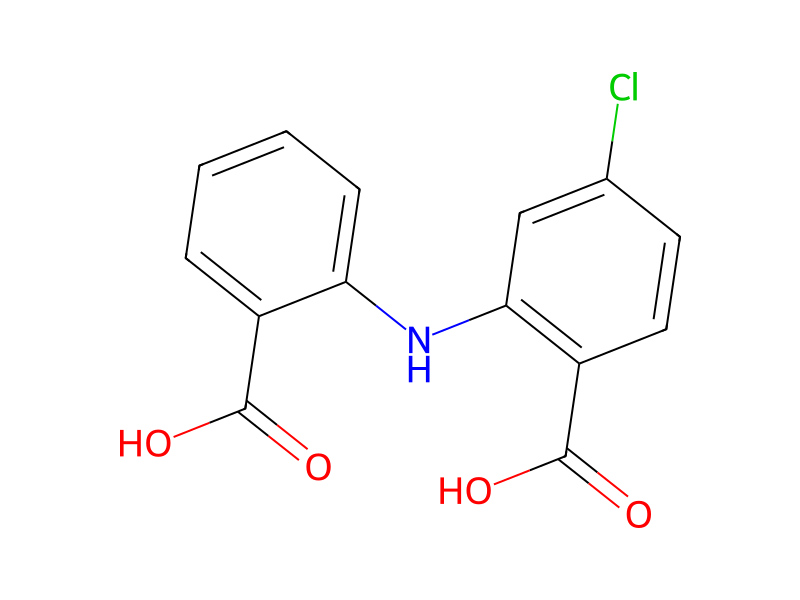
Basic information
- Standard SMILES
O=C(O)c1ccccc1Nc1cc(Cl)ccc1C(=O)O- InChIKey
UGDPYGKWIHHBMB-UHFFFAOYSA-N- Molecular formula
- C14H10ClNO4
- Average molar mass
- 291.68 g/mol
- Monoisotopic mass
- 291.02983548
Overview
Lobenzarit is an aminobenzoic acid.
Names & identifiers
- Preferred name
- Lobenzarit
- IUPAC
- 2-(2-carboxyanilino)-4-chlorobenzoic acid
- English name
- Lobenzarit
- Molecular formula
- C14H10ClNO4
- Molecular weight
- 291.69
Names & synonyms
Show more names
Database identifiers
- CAS
63329-53-3- PubChem CID
- 3946
- DTXSID
DTXSID20212709- ChEMBL
CHEMBL1986706- ChEBI
CHEBI:135215- UNII
- 915EE91P39
- Nikkaji
- J10.658E
Properties
Computed structural properties
- XLogP
- 5.1
- Topological polar surface area
- 86.6 Ų
- Hydrogen bond donors
- 3
- Hydrogen bond acceptors
- 5
- Rotatable bonds
- 4
- Heavy atoms
- 20
- Formal charge
- 0
- Complexity
- 376
Physicochemical properties
- Melting point
- 306 ° · >306°
- Boiling point
- 481 · 481.0±45.0 °C(Predicted)
- Density
- 1.515 · 1.515±0.06 g/cm3(Predicted)
- storage temp.
- -20 °C · Store at -20°C
- solubility
- 100 mg/mL · DMSO : 100 mg/mL (342.83 mM; Need ultrasonic)
- pka
- 3.46 · 3.46±0.36(Predicted)
- form
- Solid
- color
- Light yellow to green yellow
- CAS DataBase Reference
- 63329 · 63329-53-3(CAS DataBase Reference)
- FDA UNII
- 915 EE91P39 · 915EE91P39
- Toxicity
- 50 in · LD50 in male, female rats (mg/kg): 2100, 2600 orally (Tanemura)
Safety & regulation
Safety data
- Toxicity
- LD50 in male, female rats (mg/kg): 2100, 2600 orally (Tanemura)
Chemistry & industry
Pharmacology
MeSH Pharmacological Classification
Substances that augment, stimulate, activate, potentiate, or modulate the immune response at either the cellular or humoral level. The classical agents (Freund's adjuvant, BCG, Corynebacterium parvum, et al.) contain bacterial antigens. Some are endogenous (e.g., histamine, interferon, transfer factor, tuftsin, interleukin-1). Their mode of action is either non-specific, resulting in increased immune responsiveness to a wide variety of antigens, or antigen-specific, i.e., affecting a restricted type of immune response to a narrow group of antigens. The therapeutic efficacy of many biological response modifiers is related to their antigen-specific immunoadjuvanticity.
Anti-inflammatory agents that are non-steroidal in nature. In addition to anti-inflammatory actions, they have analgesic, antipyretic, and platelet-inhibitory actions. They act by blocking the synthesis of prostaglandins by inhibiting cyclooxygenase, which converts arachidonic acid to cyclic endoperoxides, precursors of prostaglandins. Inhibition of prostaglandin synthesis accounts for their analgesic, antipyretic, and platelet-inhibitory actions; other mechanisms may contribute to their anti-inflammatory effects.
Agents that suppress immune function by one of several mechanisms of action. Classical cytotoxic immunosuppressants act by inhibiting DNA synthesis. Others may act through activation of T-CELLS or by inhibiting the activation of HELPER CELLS. While immunosuppression has been brought about in the past primarily to prevent rejection of transplanted organs, new applications involving mediation of the effects of INTERLEUKINS and other CYTOKINES are emerging.
Applications
UsesAntirheumatic.
UsesLobenzarit is an immunomodulator, which is most frequently used to treat arthritis. Its chemical scaffold has also been repurposed to target tryptophan biosynthesis in Mycobacterium tuberculosis
Upstream & downstream products
Upstream raw materials
Suppliers27 total
Additional notes
DefinitionChEBI: Lobenzarit is an aminobenzoic acid.
Related reactions
No reaction records under the current filter.
Linked notes
Loading…