Desogestrel
Desogestrel for system suitability CRS · Desogen · Desogestrel CRS · 13-ethyl-17-ethynyl-11-methylene-1,2,3,6,7,8,9,10,12,14,15,16-dodecahydrocyclopenta[a]phenanthren-17-ol · org2969 · Cyclosa · Dicromil · DESTODENE
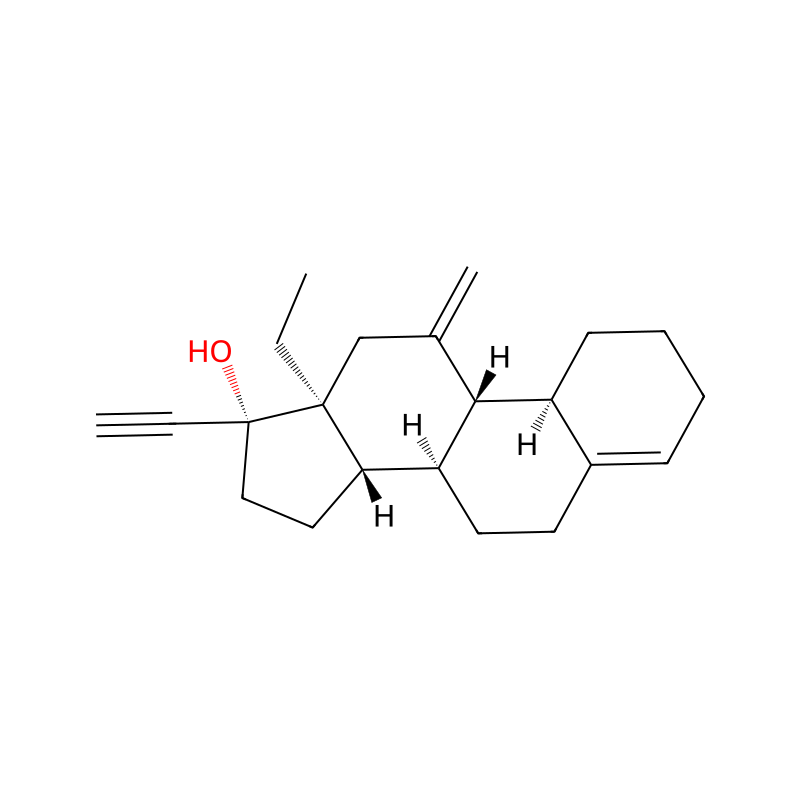
Identifiers & Physical Properties
| CAS No. | 54024-22-5 |
|---|---|
| Molecular formula | C22H30O |
| Average molar mass | 310.5 g/mol |
| Monoisotopic mass | 310.22966558 g/mol |
| SMILES | C#C[C@]1(O)CC[C@H]2[C@@H]3CCC4=CCCC[C@@H]4[C@H]3C(=C)C[C@@]21CC |
| InChIKey | RPLCPCMSCLEKRS-BPIQYHPVSA-N |
| PubChem CID | 40973 |
| ChEMBL | CHEMBL1533 |
| ChEBI | CHEBI:4453 |
| EC No. | 258-929-4 |
| DTXSID | DTXSID6022898 |
Chemical & Physical Properties
| XLogP | 4.9 |
|---|---|
| Topological polar surface area | 20.2 |
| Hydrogen bond donors | 1 |
| Hydrogen bond acceptors | 1 |
| Rotatable bonds | 2 |
| Heavy atoms | 23 |
| Formal charge | 0 |
| Complexity | 605 |
| Drugs | Pharmaceuticals -> Listed in ZINC15 |
| Lipids | Lipids -> Sterol Lipids [ST] -> Steroids [ST02] -> C21 steroids (gluco/mineralocorticoids, progestogins) and derivatives [ST0203] |
| LogP (partition coefficient) | 4 |
| Color/Form | Crystals |
| Solubility | <1 mg/mlSlightly soluble in ethanol and ethyl acetatesparingly soluble in n-hexane.3.01e-03 g/LPractically insoluble in water, very soluble in methanol, freely soluble in anhydrous ethanol and in methylene chloride. |
| Human Drugs | Breast FeedingLactationMilk, HumanContraceptive Agents, FemaleContraceptives, Oral, SyntheticFDA approved drugs -> Active ingredient |
| Endocrine Disruptors | Potential endocrine disrupting compound |
| Boiling point | 428ºC390.62°C (rough estimate) |
| Decomposition | When heated to decomposition it emits acrid smoke and fumes. |
| Melting point | 109-110ºC109-110 °C109.5 °C109-110°C |
| Optical Rotation | Specific optical rotation = +55 deg at 20 °C/D (chloroform) |
| Physical Description | Solid |
| alpha | D20 +55° (chloroform) |
| Density | 1.0169 (rough estimate) |
| Refractive index | 1.5100 (estimate) |
| Storage conditions | -20°C Freezer |
| pKa (acidity coefficient) | 13.07±0.40(Predicted) |
| Physical state | Solid |
| Color | White to Almost white |
| Merck | 14,2926 |
| Major applications | pharmaceutical (small molecule) |
| InChI | InChI=1S/C22H30O/c1-4-21-14-15(3)20-17-9-7-6-8-16(17)10-11-18(20)19(21)12-13-22(21,23)5-2/h2,8,17-20,23H,3-4,6-7,9-14H2,1H3 |
| InChIKey | RPLCPCMSCLEKRS-UHFFFAOYSA-N |
| SMILES | C1C2C(CCC3C2C(=C)CC2(CC)C3CCC2(C#C)O)=CCC1 |
| FDA UNII | 81K9V7M3A3 |
| NCI Drug Dictionary | Cerazette |
| ATC code | G03AC09 |
| UNSPSC Code | 41116107 |
| NACRES | NA.24 |
| GHS pictogram | GHS08,GHS09 |
| Signal word | Danger |
| GHS hazard statements | H360FD-H410 |
| GHS precautionary statements | P202-P273-P280-P308+P313-P391-P405 |
| Safety statements (S) | 24/25 |
| UN transport number | UN 3077 9 / PGIII |
| Water hazard class (WGK) | 3 |
| RTECS number | JF7975000 |
| Customs code | 29372390 |
| Storage class | 6.1C - Combustible acute toxic Cat.3toxic compounds or compounds which causing chronic effects |
| Hazard class | Aquatic Acute 1Aquatic Chronic 1Repr. 1B |
| Hazardous substances data | 54024-22-5(Hazardous Substances Data) |
Safety & Regulations
| GHS classification | DangerH360 (10.8%): May damage fertility or the unborn child [Danger Reproductive toxicity]P203, P260, P264, P270, P273, P280, P318, P319, P391, P405, and P501 (click each P-code to see the statement)Aggregated GHS information provided per 65 reports by companies from 12 notifications to the ECHA C&L Inventory. Each notification may be associated with multiple companies. |
|---|---|
| Regulatory information | Desogestrel: Does not have an individual approval but may be used under an appropriate group standard |
| Fire potential | Not flammable or combustible. |
| FDA requirements | The Approved Drug Products with Therapeutic Equivalence Evaluations identifies currently marketed prescription drug products, including desogestrel, approved on the basis of safety and effectiveness by FDA under sections 505 of the Federal Food, Drug, and Cosmetic Act. |
| Toxic Combustion Products | Hazardous decomposition products formed under fire conditions. - Carbon oxides |
| Hazard Classes and Categories | Repr. 1B (10.8%) |
| Fire fighting procedures | Use water spray, alcohol-resistant foam, dry chemical or carbon dioxide. Wear self contained breathing apparatus for fire fighting if necessary. |
| Storage conditions | Keep container tightly closed in a dry and well-ventilated place.Store at 20 to 25 °C (68 to 77 °F) |
| Cleanup methods | Personal precautions: Use personal protective equipment. Avoid dust formation. Avoid breathing vapors, mist or gas. Ensure adequate ventilation. Evacuate personnel to safe areas. Avoid breathing dust. Environmental precautions: Prevent further leakage or spillage if safe to do so. Do not let product enter drains. Discharge into the environment must be avoided. Methods and materials for containment and cleaning up: Pick up and arrange disposal without creating dust. Sweep up and shovel. Keep in suitable, closed containers for disposal. |
| Disposal methods | SRP: Expired or waste pharmaceuticals shall carefully take into consideration applicable DEA, EPA, and FDA regulations. It is not appropriate to dispose by flushing the pharmaceutical down the toilet or discarding to trash. If possible return the pharmaceutical to the manufacturer for proper disposal being careful to properly label and securely package the material. Alternatively, the waste pharmaceutical shall be labeled, securely packaged and transported by a state licensed medical waste contractor to dispose by burial in a licensed hazardous or toxic waste landfill or incinerator.SRP: At the time of review, regulatory criteria for small quantity disposal are subject to significant revision, however, household quantities of waste pharmaceuticals may be managed as follows: Mix with wet cat litter or coffee grounds, double bag in plastic, discard in trash. |
| Preventive Measures | Handle in accordance with good industrial hygiene and safety practice. Wash hands before breaks and at the end of workday.Skin and body protection: impervious clothing. The type of protective equipment must be selected according to the concentration and amount of the dangerous substance at the specific workplace.Gloves must be inspected prior to use. Use proper glove removal technique (without touching glove's outer surface) to avoid skin contact with this product. Dispose of contaminated gloves after use in accordance with applicable laws and good laboratory practices. Wash and dry hands.Avoid contact with skin and eyes. Avoid formation of dust and aerosols. Provide appropriate exhaust ventilation at places where dust is formed. |
| Personal Protective Equipment (PPE) | Handle with gloves.For nuisance exposures use type P95 (US) or type P1 (EU EN 143) particle respirator.For higher level protection use type OV/AG/P99 (US) or type ABEK-P2 (EU EN 143) respirator cartridges. Use respirators and components tested and approved under appropriate government standards such as NIOSH (US) or CEN (EU). |
| Milk Concentrations | EXPERIMENTAL: Cerazette does not influence the production or the quality (protein, lactose, or fat concentrations) of breast milk. However, small amounts of etonogestrel are excreted in the breast milk. As a result, 0.01 - 0.05 ug etonogestrel per kg body weight per day may be ingested by the child (based on an estimated milk ingestion of 150 mL/kg/day). |
| Human Toxicity Excerpts | /HUMAN EXPOSURE STUDIES/ This study investigated the effect of transdermal T and oral desogestrel on the reproductive axis of healthy men. Twenty-three men were randomized to 1 of 3 treatment groups and received a daily transdermal T patch plus oral desogestrel at a dose of 75, 150, or 300 ug/d for 24 weeks. Baseline blood and semen samples were obtained and then every 4 weeks thereafter for 32 weeks. The outcome measures were sperm density and plasma levels of FSH, LH, total and free T. The results show a dose-dependent suppression of spermatogenesis and gonadotropins. Seven of the 17 subjects became azoospermic. Desogestrel (300 ug daily) in combination with 5 mg daily transdermal T was the most effective (57% azoospermic), whereas a dose of 75 ug was ineffective (0% azoospermic). Total and free plasma T were reduced by approximately 30%. High density lipoprotein cholesterol was significantly reduced. No serious side-effects were encountered. .../SIGNS AND SYMPTOMS/ There have been no reports of serious deleterious effects from overdose. Symptoms that may occur in this case are nausea, vomiting and, in young girls, slight vaginal bleeding./CASE REPORTS/ /The authors/ report a case of coeliac axis thrombosis and splenic infarction presenting in a girl of 14 years who had been on the oral contraceptive pill (OCP), Marvelon (ethinyloestradiol 30 ug plus desogestrel 150 ug), for 3 weeks. She had no other risk factors for thrombo-embolism. Diagnosis was made with duplex Doppler ultrasound and confirmed with dynamically-enhanced computed tomography and magnetic resonance angiography, thus avoiding the need for percutaneous arteriography. Though mesenteric thrombo-embolic disease is recognized in association with use of the combined OCP, it has not previously been reported to affect the coeliac axis. Pediatricians and surgeons should be aware of the risks to young girls on the OCP, and consider it in their differential diagnosis of the acute abdomen./CASE REPORTS/ ... A 20-year-old female taking the third-generation oral contraceptive desogestrel/ethinyl estradiol and ethinyl estradiol (Mircette) developed bruising and increased pain and swelling of her right arm over a 5-day period after whole-blood donation. She was a first-time donor and the venipuncture was reported as being mildly traumatic. There was no personal or family history of thrombosis. Ultrasound examination of her upper extremity revealed the presence of a deep venous thrombosis that required treatment with enoxaparin sodium for 5 days and warfarin for 6 months. Evaluation for thrombophilia was negative. The only risk factor for thrombosis was use of oral contraceptives. ...For more Human Toxicity Excerpts (Complete) data for DESOGESTREL (27 total), please visit the HSDB record page. |
| Drug Induced Liver Injury | Drug-Induced Liver Injury Severity and Toxicity (DILIst)DesogestrelDILI PositiveDOI:10.1016/j.drudis.2019.09.022 |
| Populations at Special Risk | There have been no reports of serious deleterious effects from overdose. Symptoms that may occur in this case are nausea, vomiting and, in young girls, slight vaginal bleeding./The authors/ report a case of coeliac axis thrombosis and splenic infarction presenting in a girl of 14 years who had been on the oral contraceptive pill (OCP), Marvelon (ethinyloestradiol 30 ug plus desogestrel 150 ug), for 3 weeks. She had no other risk factors for thrombo-embolism. Diagnosis was made with duplex Doppler ultrasound and confirmed with dynamically-enhanced computed tomography and magnetic resonance angiography, thus avoiding the need for percutaneous arteriography. Though mesenteric thrombo-embolic disease is recognized in association with use of the combined OCP, it has not previously been reported to affect the coeliac axis. Pediatricians and surgeons should be aware of the risks to young girls on the OCP, and consider it in their differential diagnosis of the acute abdomen.Oral contraceptives like Apri (desogestrel and ethinyl estradiol) tablets should not be used in women who currently have the following conditions: thrombophlebitis or thromboembolic disordersa past history of deep vein thrombophlebitis or thromboembolic disorderscerebral vascular or coronary artery diseaseknown or suspected carcinoma of the breastcarcinoma of the endometrium or other known or suspected estrogen-dependent neoplasiaundiagnosed abnormal genital bleedingcholestatic jaundice of pregnancy or jaundice with prior pill usehepatic adenomas or carcinomas...Cerazette contains less than 65 mg lactose and therefore should not be administered to patients with rare hereditary problems of galactose intolerance, the Lapp lactase deficiency, or glucose-galactose malabsorption.For more Populations at Special Risk (Complete) data for DESOGESTREL (6 total), please visit the HSDB record page. |
| Antidote and Emergency Treatment | /SRP:/ Immediate first aid: Ensure that adequate decontamination has been carried out. If patient is not breathing, start artificial respiration, preferably with a demand valve resuscitator, bag-valve-mask device, or pocket mask, as trained. Perform CPR if necessary. Immediately flush contaminated eyes with gently flowing water. Do not induce vomiting. If vomiting occurs, lean patient forward or place on the left side (head-down position, if possible) to maintain an open airway and prevent aspiration. Keep patient quiet and maintain normal body temperature. Obtain medical attention. /Poisons A and B//SRP:/ Basic treatment: Establish a patent airway (oropharyngeal or nasopharyngeal airway, if needed). Suction if necessary. Watch for signs of respiratory insufficiency and assist ventilations if needed. Administer oxygen by nonrebreather mask at 10 to 15 L/min. Monitor for pulmonary edema and treat if necessary ... . Monitor for shock and treat if necessary ... . Anticipate seizures and treat if necessary ... . For eye contamination, flush eyes immediately with water. Irrigate each eye continuously with 0.9% saline (NS) during transport ... . Do not use emetics. For ingestion, rinse mouth and administer 5 mL/kg up to 200 mL of water for dilution if the patient can swallow, has a strong gag reflex, and does not drool ... . Cover skin burns with dry sterile dressings after decontamination ... . /Poisons A and B//SRP:/ Advanced treatment: Consider orotracheal or nasotracheal intubation for airway control in the patient who is unconscious, has severe pulmonary edema, or is in severe respiratory distress. Positive-pressure ventilation techniques with a bag valve mask device may be beneficial. Consider drug therapy for pulmonary edema ... . Consider administering a beta agonist such as albuterol for severe bronchospasm ... . Monitor cardiac rhythm and treat arrhythmias as necessary ... . Start IV administration of D5W /SRP: "To keep open", minimal flow rate/. Use 0.9% saline (NS) or lactated Ringer's if signs of hypovolemia are present. For hypotension with signs of hypovolemia, administer fluid cautiously. Watch for signs of fluid overload ... . Treat seizures with diazepam or lorazepam ... . Use proparacaine hydrochloride to assist eye irrigation ... . /Poisons A and B/ |
| Effects During Pregnancy and Lactation | ◉ Summary of Use during Lactation |
| EPA Human Health Benchmarks for Pharmaceuticals | Desogestrel0.0030.01Desogestrel is given in combination with ethinyl estradiol. Each orange tablet (debossed with "S3" on one side) contains 0.15 mg desogestrel and 0.03 mg ethinyl estradiol and is taken once per day. To achieve maximum contraceptive effectiveness, desogestrel and ethinyl estradiol tablets must be taken exactly as directed and at intervals not exceeding 24 hours.Data used to generate the benchmarks include the following: Lowest Daily Dose (LDD): 0.15 mg/day, Lowest Therapeutic Dose (LTD): 0.002 mg/kg-day, and Screening Dose: 0.0000006 mg/kg-day.4-Jan-21 |
| Water hazard class (WGK) | 3 |
| RTECS number | JF7975000 |
| UN transport number | UN 3077 9 / PGIII |
| Customs code | 29372390 |
| Signal word | Danger |
| GHS pictogram | GHS08,GHS09 |
| Safety statements (S) | 24/25 |
| Storage class | 6.1C - Combustible acute toxic Cat.3toxic compounds or compounds which causing chronic effects |
| GHS hazard statements | H360FD-H410 |
| Hazard class | Aquatic Acute 1Aquatic Chronic 1Repr. 1B |
| GHS precautionary statements | P202-P273-P280-P308+P313-P391-P405 |
| Hazardous substances data | 54024-22-5(Hazardous Substances Data) |
Applications & Uses
Description
Desogestrel is a synthetic progestogen. It inhibits ovulation and prevents fertilization in rabbits and mice. Desogestrel inhibits rhodamine 123 efflux, a measure of P-glycoprotein activity, ex vivo in human lymphocytes and CD8+ T cells in a dose-dependent manner. Formulations containing desogestrel have been used as oral contraceptives and for the treatment of polycystic ovary syndrome.
Uses
A progestogen with low androgenic potency
General Description
Desogestrel, (17α)-13-ethyl-11-methylene-18,19-dinorpregn-4-en-20-yn-17-ol, is a 19-nortestosterone analog with good progestin activity. Likethe other progestins, it is orally active and used in combinationwith an estrogen in oral contraceptives. Desogestrel is aprodrug that must be oxidized to the 3-one in vivo to haveprogestational action. CYPs 2C9 and 2C19 have been implicatedin the initial hydroxylation of desogestrel at C3.