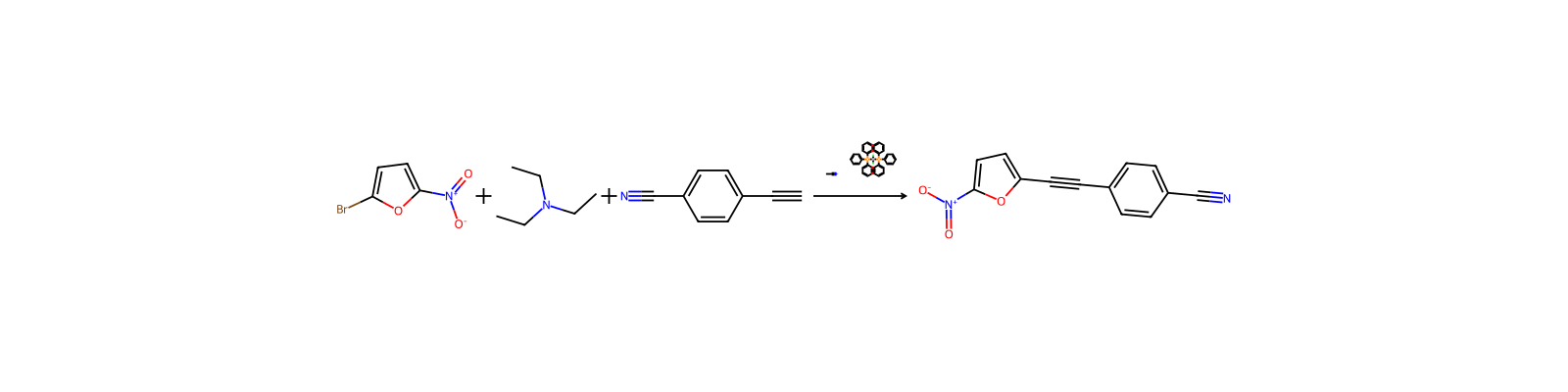
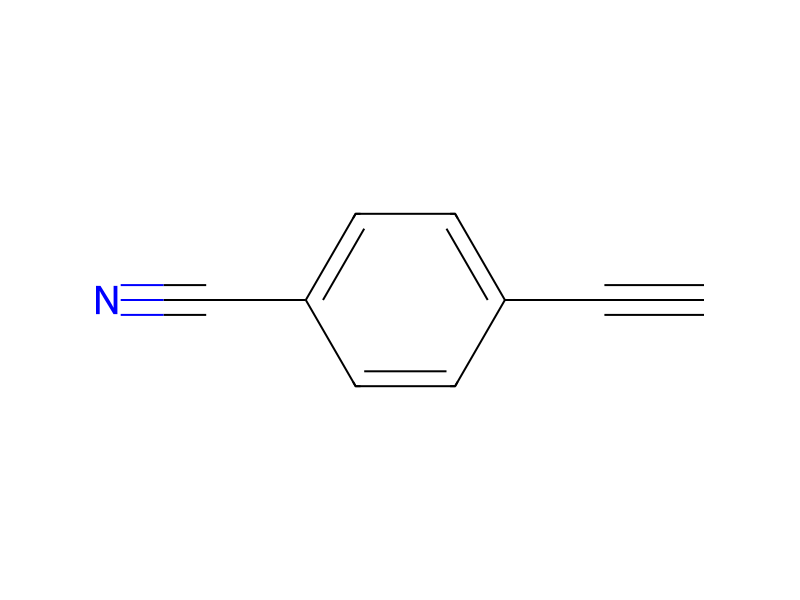
Basic information
- Standard SMILES
C#Cc1ccc(C#N)cc1- InChIKey
LAGNMUUUMQJXBF-UHFFFAOYSA-N- Molecular formula
- C9H5N
- Average molar mass
- 127.14 g/mol
- Monoisotopic mass
- 127.04219916
Names & identifiers
- Preferred name
- 4-Ethynylbenzonitrile
- IUPAC
- 4-ethynylbenzonitrile
- English name
- 4-Ethynylbenzonitrile
- Molecular formula
- C9H5N
- Molecular weight
- 127.14
Names & synonyms
4-Ethynylbenzonitrile3032-92-6DTXSID20404122RefChem:292707DTXCID20354976628-502-0Benzonitrile, 4-ethynyl-4-Cyanophenylacetylene4-Ethynylbenzonitrile 97MFCD049740584-Ethynyl-Bezonitrile4-cyano phenylacetylene
Show more names
4-Ethynylbenzonitrile 97%(4-Cyanophenyl)ethyne1-Cyano-4-ethynylbenzeneBenzonitrile, 4-ethynyl- (9CI)
SCHEMBL853731AKOS015836148CS-W007419AC-18651SY021679EN300-110379Z10692026744-ETHYNYLBENZONITRILE97
Database identifiers
- CAS
3032-92-6- PubChem CID
- 4547245
- DTXSID
DTXSID20404122- EC Number
- 628-502-0
- Nikkaji
- J839.559D
Properties
Computed structural properties
- XLogP
- 1.9
- Topological polar surface area
- 23.8 Ų
- Hydrogen bond donors
- 0
- Hydrogen bond acceptors
- 1
- Rotatable bonds
- 1
- Heavy atoms
- 10
- Formal charge
- 0
- Complexity
- 191
Physicochemical properties
- Melting point
- 156 · 156-160 °C(lit.)
- Boiling point
- 230.2 · 230.2±23.0 °C(Predicted)
- Density
- 1.037 g/mL · 1.037 g/mL at 25 °C(lit.)
- Flash point
- 110 °C · >110 °C
- storage temp.
- Keep in dark place,Sealed in dry,Room Temperature
- form
- Solid
- color
- Pale yellow
- Water Solubility
- Slightly soluble in water.
- InChI
- 1S/C9H5N/c1-2-8-3-5-9(7-10)6-4-8/h1,3-6H
- InChIKey
- LAGNMUUUMQJXBF-UHFFFAOYSA-N
- SMILES
- C#Cc1ccc(cc1)C#N
- UNSPSC Code
- 12352100 · 12352100
- NACRES
- 22 · NA.22
- Symbol(GHS)
- 7 · GHS07
- Signal word
- Warning
- Hazard statements
- 315 · H315-H319-H335
- Precautionary statements
- 261 · P261-P264-P271-P280-P302+P352-P305+P351+P338
- target organs
- Respiratory system
- PPE
- 95 · dust mask type N95 (US), Eyeshields, Gloves
- Hazard Codes
- Xi,Xn
- Risk Statements
- 36 · 36/37/38-20/21/22
- Safety Statements
- 26 · 26-36
- WGK Germany
- 3 · 3
- HS Code
- 2926907090 · 2926907090
- Storage Class
- 11 · 11 - Combustible Solids
- Hazard Classifications
- 2 Skin · Eye Irrit. 2Skin Irrit. 2STOT SE 3
Safety & regulation
GHS classification
GHS Classification
Warning
H315 (100%): Causes skin irritation [Warning Skin corrosion/irritation]
P261, P264, P264+P265, P271, P280, P302+P352, P304+P340, P305+P351+P338, P319, P321, P332+P317, P337+P317, P362+P364, P403+P233, P405, and P501 (click each P-code to see the statement)
Aggregated GHS information provided per 40 reports by companies from 3 notifications to the ECHA C&L Inventory. Each notification may be associated with multiple companies.
Hazard information
Hazard Classes and CategoriesSkin Irrit. 2 (100%)
Safety data
- PPE
- dust mask type N95 (US), Eyeshields, Gloves
- wgk
- 3
- hs_code
- 2926907090
- risk_code
- 36/37/38-20/21/22
- Signal word
- Warning
- Symbol(GHS)
- GHS07
- hazard_code
- Xi,Xn
- safety_code
- 26-36
- Storage Class
- 11 - Combustible Solids
- target organs
- Respiratory system
- Hazard statements
- H315-H319-H335
- Hazard Classifications
- Eye Irrit. 2Skin Irrit. 2STOT SE 3
- Precautionary statements
- P261-P264-P271-P280-P302+P352-P305+P351+P338
Chemistry & industry
Applications
Uses4-Ethynylbenzonitrile is used as a synthetic fragment and as a test compound for cross-coupling reactions. It is used in the study of hydrogen bond formation in multifunctional molecules due to the presence of four hydrogen bonding sites. It is also involved in the preparation of 4-[(trimethylsilyl)ethynyl]benzonitrile.
General DescriptionThe water complexes formed with 4-ethynylbenzonitrile (4EBzN) were studied using IR-UV double resonance spectroscopy.
Upstream & downstream products
Upstream raw materials
Downstream products
Suppliers50 total
阿诺西(上海)生物技术有限公司400-1107768 15058188853 · [email protected]
上海阿拉丁生化科技股份有限公司400-6206333 13167063860 · [email protected]
河南赢创生物科技有限公司16650615803 · [email protected]
上海药森生物科技有限公司18916117619 18916117619
杭州品高化工有限公司0571-87658025 · [email protected]
陕西缔都化学有限公司029-029-81123119 17391733320 · [email protected]
Dayang Chem (Hangzhou) Co.,Ltd.+86-0571-88938639 17705817739 · [email protected]
郑州鸿晟医药科技有限公司0371-55695890 15637198702 · [email protected]
上海弘顺生物科技有限公司15901914505 · [email protected]
韶远科技(上海)有限公司021-50795510 4000665055 · [email protected]
科瑞迪化学400-821-5857 021-64326257 · [email protected]
毕佳索(上海毕得医药科技股份有限公司)400-6005915 · [email protected]
郑州德元凯化工有限公司17837139533 · [email protected]
Syntechem Co.,Ltd[email protected]
北京索莱宝科技有限公司010-50973130 17801761073 · [email protected]
阿法埃莎(中国)化学有限公司400-6106006 · [email protected]
安耐吉化学&3A(安徽泽升科技股份有限公司)400-0056266 · [email protected]
上海瀚鸿科技股份有限公司021-54306202 13764082696 · [email protected]
上海钰康生物科技有限公司18939844854 · [email protected]
上海钰康生物科技有限公司+86-18930848214 +86-021-56762820 · [email protected]
上海景颜化工科技有限公司13817811078 · [email protected]
嘉兴市艾森化工有限公司0573-85285100 18627885956 · [email protected]
郑州药领医药科技有限公司13526569071 · [email protected]
学研惠(武汉)科技有限公司15727060112 · [email protected]
郑州研德生物科技有限公司0371-63682289 15538176268 · [email protected]
菏泽博纳医药科技有限公司15865805009 · [email protected]
山东西亚化学有限公司13355009207 13355009207 · [email protected]
南京维奥化工有限公司Please Send Email 18652950785 · [email protected]
河南多贝化工有限公司0370-2785118 17550508557 · [email protected]
金克隆(北京)生物技术有限公司400-910-1997 15330005590 · [email protected]
上海特伯化学科技有限公司+86-21-60341587 · [email protected]
上海贤鼎生物科技有限公司4009209199 · [email protected]
越林试剂021-62960152 · [email protected]
上海睿升化工科技有限公司+86-021-50935922
上海裕兰生物科技有限公司021-57171705 13817537615 · [email protected]
上海皋翔化工有限公司021-57816257 18930243658 · [email protected]
苏州爱玛特生物科技有限公司0512-56316828 4008675858 · [email protected]
上海毕得医药科技股份有限公司400-164-7117 18317119277 · [email protected]
湖南华腾制药有限公司400-8592883 · [email protected]
上海麦克林生化科技股份有限公司15221275939 15221275939 · [email protected]
上海寰川实业有限公司021-61478794 · [email protected]
上海嵩爰化工科技有限公司010-1234567 18521000990 · [email protected]
江苏艾康生物医药研发有限公司025-66028182 17714375163 · [email protected]
Sigma-Aldrich西格玛奥德里奇(上海)贸易有限公司021-61415566 800-8193336 · [email protected]
厦门志信化学有限公司+86-5922680277 +86-13806087780 · [email protected]
广东翁江化学试剂有限公司0751-2886766 13927870850 · [email protected]
上海金源瑞医药科技有限公司021-18217523 18217523428 · [email protected]
江西弗莱医药科技有限公司15870833005 · [email protected]
箴德化工科技(上海)有限公司15601952568 · [email protected]
嘉兴市浙嘉生物科技有限公司0573-85609002 · [email protected]
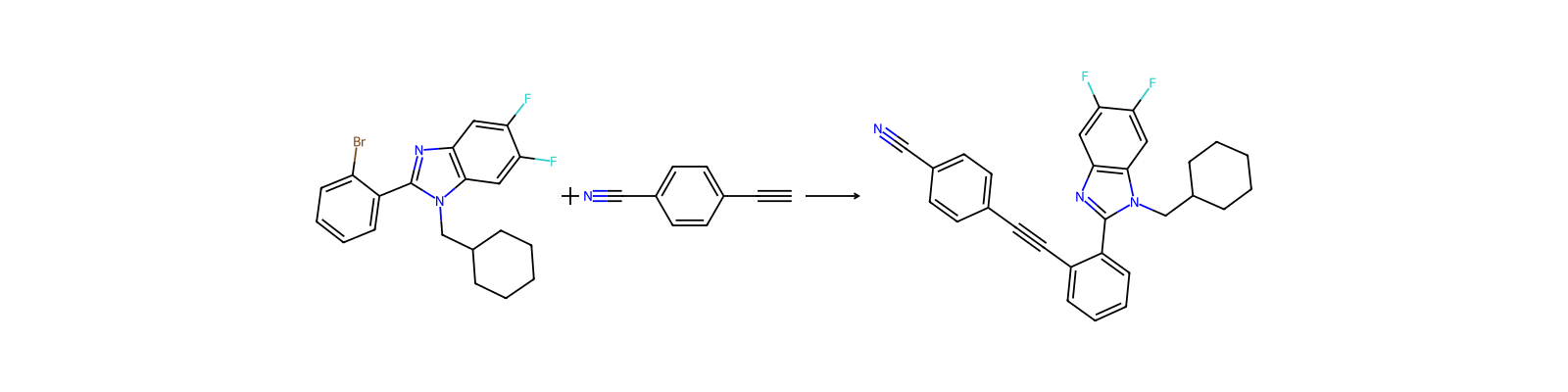
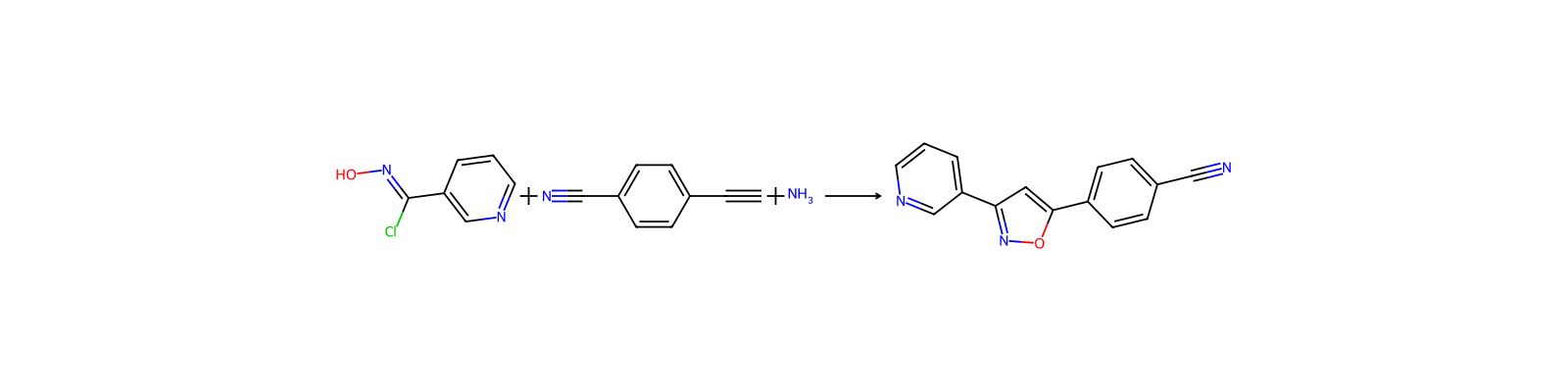
Related reactions
46 records




Linked notes
Loading…