Basic information
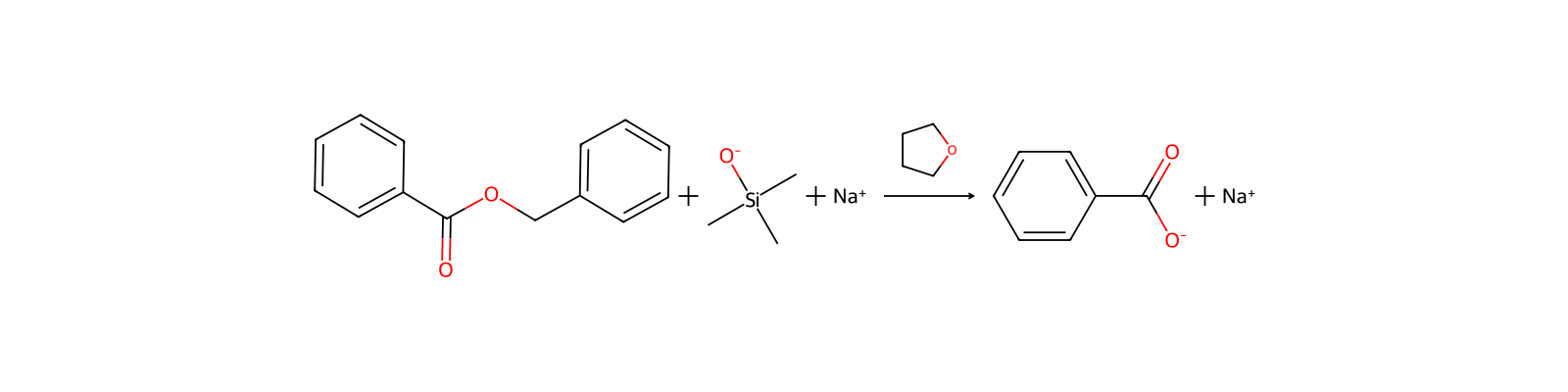
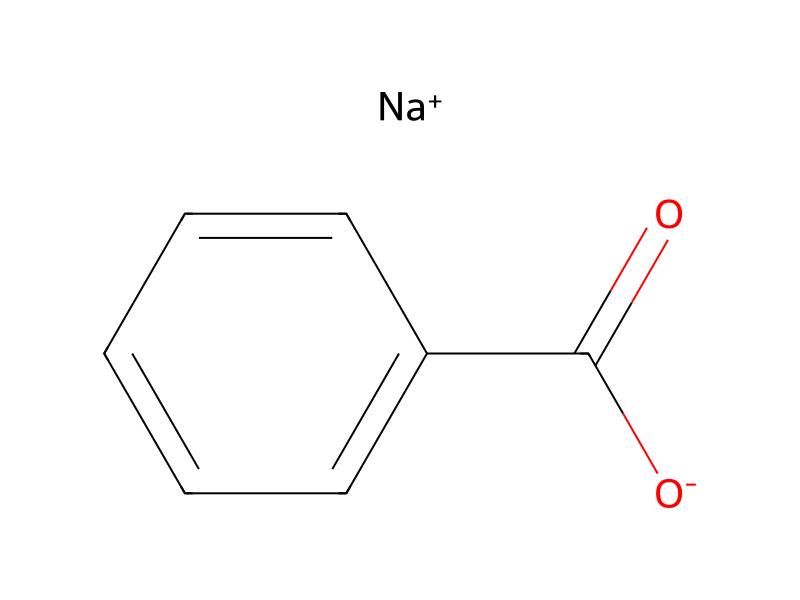
- Standard SMILES
O=C([O-])c1ccccc1.[Na+]- InChIKey
WXMKPNITSTVMEF-UHFFFAOYSA-M- Molecular formula
- C7H5NaO2
- Average molar mass
- 144.1 g/mol
- Monoisotopic mass
- 144.01872368
Names & identifiers
- Preferred name
- Sodium Benzoate
- IUPAC
- sodium benzoate
- English name
- Sodium benzoate
- Molecular formula
- C7H5NaO2
- Molecular weight
- 144.10317
Names & synonyms
sodium benzoate532-32-1SobenateAntimolBenzoic acid, sodium saltsodium;benzoateBenzoate sodiumBenzoate of sodaBenzoate, sodiumNatrium benzoicumFEMA No. 3025Fuminaru
Show more names
Sodium BenzonateSoudium benzoateNatriumbenzoatBENZOIC ACID SODIUM SALTucephanFEMA 3025femanumber3025odium benzoatesodiumbenzoicacid
Benzoan sodnyMicrocare sbPUROX SBenzoesaeure (na-salz)DTXSID1020140OJ245FE5EUEPA Pesticide Chemical Code 009103INS NO.211
Database identifiers
- CAS
532-32-1- PubChem CID
- 517055
- DTXSID
DTXSID1020140- ChEMBL
CHEMBL1356- ChEBI
CHEBI:113455- UNII
- OJ245FE5EU
- EC Number
- 208-534-8
- Nikkaji
- J3.287E
Properties
Computed structural properties
- Topological polar surface area
- 40.1 Ų
- Hydrogen bond donors
- 0
- Hydrogen bond acceptors
- 2
- Rotatable bonds
- 1
- Heavy atoms
- 10
- Formal charge
- 0
- Complexity
- 108
Physicochemical properties
- Melting point
- 300 °C · >300 °C (lit.)
- Density
- 1 · 1,44 g/cm3
- vapor pressure
- 0 Pa · 0Pa at 20℃
- FEMA
- 3025 · 3025 | SODIUM BENZOATE
- Flash point
- 100 °C · >100°C
- storage temp.
- room temp
- solubility
- 2 O: · H2O: 1 M at 20 °C, clear, colorless
- pka
- 4.03 · 4.03[at 20 ℃]
- form
- Crystals, Granules, Flakes or Crystalline Powder
- color
- White
- PH
- 7 · 7.0-8.5 (25℃, 1M in H2O)
- Odor
- odorless
- biological source
- synthetic
- Water Solubility
- soluble
- Merck
- 14 · 14,8582
- BRN
- 3572467 · 3572467
- Stability
- Stable, but may be moisture senstive. Incompatible with strong oxidizing agents, alkalis, mineral acids.
- Cosmetics Ingredients Functions
- FRAGRANCEANTICORROSIVEPRESERVATIVE
- InChI
- 1S/C7H6O2.Na/c8-7(9)6-4-2-1-3-5-6;/h1-5H,(H,8,9);/q;+1/p-1
- InChIKey
- WXMKPNITSTVMEF-UHFFFAOYSA-M
- SMILES
- [Na+].[O-]C(=O)c1ccccc1
- LogP
- 1.88 · 1.88
- Substances Added to Food (formerly EAFUS)
- SODIUM BENZOATE
- FDA 21 CFR
- 181.23 · 181.23; 184.1733; 310.545;582.3733
- SCOGS (Select Committee on GRAS Substances)
- Sodium Benzoate
- CAS DataBase Reference
- 532 · 532-32-1(CAS DataBase Reference)
- EWG's Food Scores
- 1 · 1-3
- FDA UNII
- 245 FE5EU · OJ245FE5EU
- ATC code
- 16 AX11 · A16AX11
- NIST Chemistry Reference
- Sodium benzoate(532-32-1)
- EPA Substance Registry System
- Sodium benzoate (532-32-1)
- UNSPSC Code
- 41116107 · 41116107
- NACRES
- 25 · NA.25
- Symbol(GHS)
- 7 · GHS07
- Signal word
- Warning
- Hazard statements
- 319 · H319
- Precautionary statements
- 264 · P264-P280-P305+P351+P338-P337+P313
- PPE
- 95 · Eyeshields, Gloves, type N95 (US)
- Hazard Codes
- Xi
- Risk Statements
- 36 · 36/37/38-62-63-68-36
- Safety Statements
- 24 · 24/25-36-26
- WGK Germany
- 1 · 1
- RTECS
- 6650000 · DH6650000
- Autoignition Temperature
- 500 °C · >500°C
- TSCA
- TSCA listed
- HS Code
- 29163100 · 29163100
- Storage Class
- 13 · 13 - Non Combustible Solids
- Hazard Classifications
- 2 · Eye Irrit. 2
- Hazardous Substances Data
- 532 · 532-32-1(Hazardous Substances Data)
- Toxicity
- 50 orally · LD50 orally in rats: 4.07 g/kg (Smyth, Carpenter)
- REACH Registrations
- Active
Safety & regulation
Safety data
- PPE
- Eyeshields, Gloves, type N95 (US)
- wgk
- 1
- tsca
- TSCA listed
- rtecs
- DH6650000
- hs_code
- 29163100
- Toxicity
- LD50 orally in rats: 4.07 g/kg (Smyth, Carpenter)
- risk_code
- 36/37/38-62-63-68-36
- Signal word
- Warning
- Symbol(GHS)
- GHS07
- hazard_code
- Xi
- safety_code
- 24/25-36-26
- Storage Class
- 13 - Non Combustible Solids
- Hazard statements
- H319
- REACH Registrations
- Active
- Hazard Classifications
- Eye Irrit. 2
- Autoignition Temperature
- >500°C
- Precautionary statements
- P264-P280-P305+P351+P338-P337+P313
- Hazardous Substances Data
- 532-32-1(Hazardous Substances Data)
Chemistry & industry
Applications
Uses1. Sodium benzoate is also an important preservative of acid type food. It transforms into effective form of benzoic acid during application. See benzoic acid for application range and dosage. In addition, it also can be used as fodder preservative. 2. Preservatives; antimicrobial agent. 3. Sodium benzoate agent is a very important preservative of acid type fodder. It transforms into effective form of benzoic acid during application. See benzoic acid for application range and dosage. In addition, it also can be used as food preservative. 4. Used in the research of pharmaceutical industry and plant genetic, also used as dye intermediates, fungicide and preservatives. 5. The product is used as food additive (preservative), fungicide in pharmaceutical industry, dye mordant, plasticizer in plastic industrial, and also used as organic synthetic intermediate of spices and others.
DescriptionSodium benzoate has the chemical formula NaC7H5O2; it is a widely used food preservative, with E number E211. It is the sodium salt of benzoic acid and exists in this form when dissolved in water. It can be produced by reacting sodium hydroxide with benzoic acid.
OccurrenceBenzoic acid occurs naturally in many plants and in animals. The salt is not found to occur naturally.
HistoryIn 1820, benzoic acid was discovered by German chemist Friedrich Wöhler through the oxidation of toluene. His research laid the groundwork for the eventual production of sodium benzoate. The process typically involves neutralizing benzoic acid with sodium hydroxide, creating sodium benzoate—a stable compound with excellent antibacterial and antifungal properties. Sodium benzoate was commercially introduced in the late 19th century. Its preservative qualities made it particularly valuable as food products began to be mass-produced and distributed. In 1908, sodium benzoate was recognized as a food preservative by the U.S. Food and Drug Administration (FDA). This allowed it to be used in various food products, including soft drinks, pickles, and sauces, to prevent spoilage and extend shelf life.
UsesSodium benzoate is a preservative. It is bacteriostatic and fungistatic under acidic conditions. It is most widely used in acidic foods such as salad dressings (vinegar), carbonated drinks (carbonic acid), jams and fruit juices (citric acid), pickles (vinegar), and condiments. It is also used as a preservative in medicines and cosmetics. As a food additive, sodium benzoate has the E number E211. It is also used in fireworks as a fuel in whistle mix, a powder that emits a whistling noise when compressed into a tube and ignited. The fuel is also one of the fastest burning rocket fuels and provides a lot of thrust and smoke. It does have its downsides: there is a high danger of explosion when the fuel is sharply compressed because of the fuel's sensitivity to impact.
UsesSodium Benzoate is a preservative that is the sodium salt of benzoic acid. it converts to benzoic acid, which is the active form. it has a solubility in water of 50 g in 100 ml at 25°c. sodium benzoate is 180 times as soluble in water at 25°c as is the parent acid. the optimum functionality occurs between ph 2.5 and 4.0 and it is not recom- mended above ph 4.5. it is active against yeasts and bacteria. it is used in acidic foods such as fruit juices, jams, relishes, and bever- ages. its use level ranges from 0.03 to 0.10%.
Usessodium benzoate is a non-toxic, organic salt preservative that is particularly effective against yeast, with some activity against molds and bacteria. It is generally used in concentrations of 0.1 to 0.2 percent.
UsesVasodilator
UsesA benzene compound used as a synthetic reagent.
UsesAntimicrobial agent, flavoring agent and adjuvant in food; not to exceed a maximum level of 0.1% in food (21 CFR, 184.1733, 582.3733). Antifungal and bacteriostatic preservative in pharmaceuticals at concentrations of ~0.1%. Clinical reagent (bilirubin assay).
General DescriptionSodium benzoate is a sodium salt of benzoic acid, that is freely soluble in water compared to benzoic acid. It is generally used as an antimicrobial preservative in cosmetics, food, and pharmaceuticals.Pharmaceutical secondary standards for application in quality control, provide pharma laboratories and manufacturers with a convenient and cost-effective alternative to the preparation of in-house working standards.
Preparation methods
PreparationProduced by the neutralization of benzoic acid with sodium bicarbonate, sodium carbonate or sodium hydroxide.
Upstream & downstream products
Upstream raw materials
Downstream products
Suppliers50 total
国药集团化学试剂有限公司86-21-63210123 · [email protected]
北京华美互利生物化工010-56205725 · [email protected]
梯希爱(上海)化成工业发展有限公司021-67121386 · [email protected]
衢州润东化工有限公司0570-8789886 18892685668 · [email protected]
上海阿拉丁生化科技股份有限公司400-6206333 13167063860 · [email protected]
上海如吉生物科技发展有限公司+86-21-65211385-8001 36031160 · [email protected]
LGM Pharma1-(800)-881-8210 · [email protected]
上海将来实业股份有限公司400-0066400 13621662912 · [email protected]
Syntechem Co.,Ltd[email protected]
上海迈瑞尔生化科技有限公司4006356688 18621169109 · [email protected]
武汉易泰科技有限公司上海分公司18930552037 · [email protected]
阿法埃莎(中国)化学有限公司400-6106006 · [email protected]
安耐吉化学&3A(安徽泽升科技股份有限公司)400-0056266 · [email protected]
上海瀚鸿科技股份有限公司021-54306202 13764082696 · [email protected]
上海景颜化工科技有限公司13817811078 · [email protected]
合肥天健化工有限公司551-65418679 15856988503;15837135945 · [email protected]
武汉丰泰威远科技有限公司027-87465837 19945049750 · [email protected]
天津金汇太亚化学试剂有限公司022-59582624 18622766592 · [email protected]
孝感深远化工有限公司15527621225; 15527621225 · [email protected]
山东西亚化学有限公司13355009207 13355009207 · [email protected]
玛雅试剂+86 (573) 82222445 (0)18006601000 452520369 · [email protected]
四川库利南科技有限公司400-1166-196 18981987031 · [email protected]
上海耐士化工科技有限公司400-188-0725 +86 21 34310725 13611771617
天津希恩思生化科技有限公司400 638 7771 · [email protected]
湖南汇百侍生物科技有限公司0731-85526065 13308475853 · [email protected]
南京化学试剂股份有限公司025-58369808 17895012682 · [email protected]
Connect Chemicals GmbH+49 2102 2077 19 · [email protected]
斯百全化学(上海)有限公司021-021-021-67601398-809-809-809 15221380277 · [email protected]
上海源叶生物科技有限公司13636370518 · [email protected]
青岛保税区鲁联国际贸易有限公司0532-83893697 18561902820 · [email protected]
上海思域化工科技有限公司86-21-34053660 · [email protected]
赛默飞世尔科技(中国)有限公司800-810-5118 · [email protected]
江苏艾康生物医药研发有限公司025-66113011 13913916777 · [email protected]
上海健超生物科技有限公司150-2103-5486 18017383231 · [email protected]
TOKYO CHEMICAL INDUSTRY CO., LTD.03-36680489 · [email protected]
深圳振强药物研发有限公司0755-66853366 13670046396 · [email protected]
潍坊沃腾进出口有限公司0536-2456718
南京杜莱生物技术有限公司025-84699383-8003;025-846993838003-8003 18013301590 · [email protected]
南京生利德生物科技有限公司025-57798810 18652991625 · [email protected]
北京环宇世纪化学科技有限公司hysj_bj.com
上海湄水化工科技有限公司021-60549325 18616193163
上海将来实业股份有限公司400-0066400 13621662912 · [email protected]
上海将来实业股份有限公司021-61552785 · [email protected]
安徽科迪达化工有限公司0554-2106669 · [email protected]
天津阿尔塔科技有限公司022-65378550-8551 · [email protected]
HBCChem, Inc.+1-510-219-6317 · [email protected]
日照力德士化工有限公司010-51268198 · [email protected]
美岚实业(上海)有限公司021-58958189 · [email protected]
上海爱蝶实业有限公司021-58957966 18930537195 · [email protected]
四川省维克奇生物科技有限公司028-81700200 18116577057 · [email protected]
Additional notes
DefinitionChEBI: An organic sodium salt resulting from the replacement of the proton from the carboxy group of benzoic acid by a sodium ion.
Definitionsodium benzoate: An either colourlesscrystalline or white amorphouspowder, C6H5COONa, soluble inwater and slightly soluble in ethanol.It is made by the reaction of sodiumhydroxide with benzoic acid and isused in the dyestuffs industry and asa food preservative. It was formerlyused as an antiseptic.
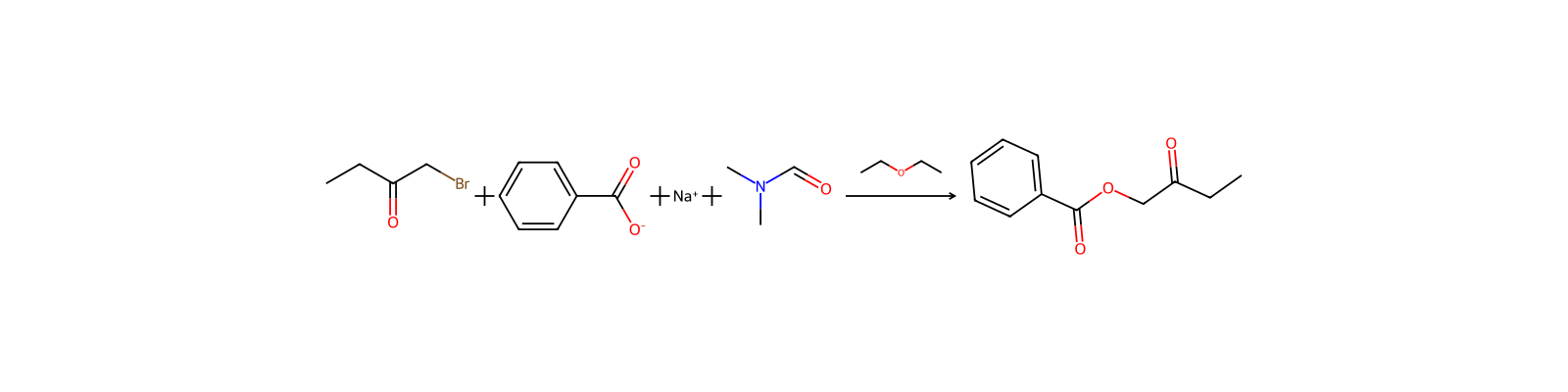
Related reactions
74 records




Linked notes
Loading…