
Basic information
- Standard SMILES
COc1cc2c(=O)c(-c3ccc(O)cc3)coc2cc1O- InChIKey
DXYUAIFZCFRPTH-UHFFFAOYSA-N- Molecular formula
- C16H12O5
- Average molar mass
- 284.26 g/mol
- Monoisotopic mass
- 284.06847348
Overview
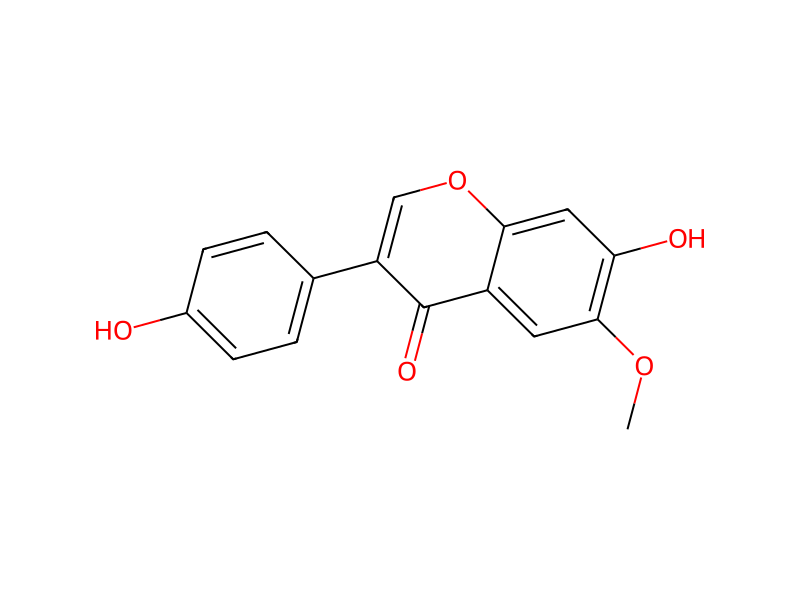
Glycitein is a methoxyisoflavone that is isoflavone substituted by a methoxy group at position 6 and hydroxy groups at positions 7 and 4'. It has been isolated from the mycelia of the fungus Cordyceps sinensis. It has a role as a plant metabolite, a fungal metabolite and a phytoestrogen. It is a 7-hydroxyisoflavone and a methoxyisoflavone. It is functionally related to an isoflavone.
Names & identifiers
- Preferred name
- Glycitein
- IUPAC
- 7-hydroxy-3-(4-hydroxyphenyl)-6-methoxychromen-4-one
- English name
- Glycitein
- Molecular formula
- C16H12O5
- Molecular weight
- 284.26
Names & synonyms
Glycitein40957-83-37,4'-Dihydroxy-6-methoxyisoflavone4H-1-Benzopyran-4-one, 7-hydroxy-3-(4-hydroxyphenyl)-6-methoxy-7-Hydroxy-3-(4-hydroxyphenyl)-6-methoxy-4H-1-benzopyran-4-one7-hydroxy-3-(4-hydroxyphenyl)-6-methoxychromen-4-one92M5F28TVFDTXSID40193960CHEBI:34778RefChem:143895DTXCID801164516-methoxy-7,4'-dihydroxyisoflavone
Show more names
GLYCETEINGliceteinGlycitein-RMGlycitein(SH)Glycitein, >=98%Glycitein (15 mg)Glycitein USP/EP/BP
7-hydroxy-3-(4-hydroxyphenyl)-6-methoxy-4H-chromen-4-one4',7-Dihydroxy-6-methoxyisoflavoneMFCD00016679GyciteinUNII-92M5F28TVFGlycitein (Standard)CHEMBL513024s9107
Database identifiers
- CAS
40957-83-3- PubChem CID
- 5317750
- DTXSID
DTXSID40193960- ChEMBL
CHEMBL513024- ChEBI
CHEBI:34778- UNII
- 92M5F28TVF
- Nikkaji
- J17.583H
Properties
Computed structural properties
- XLogP
- 2.4
- Topological polar surface area
- 76 Ų
- Hydrogen bond donors
- 2
- Hydrogen bond acceptors
- 5
- Rotatable bonds
- 2
- Heavy atoms
- 21
- Formal charge
- 0
- Complexity
- 424
Experimental & physicochemical properties
LipidsPolyketides [PK] -> Flavonoids [PK12] -> Isoflavonoids [PK1205]
LogP2.57
Endocrine DisruptorsPotential endocrine disrupting compound
Physical DescriptionSolid
Physicochemical properties
- Melting point
- 300 °C · >300°C
- Boiling point
- 547.4 · 547.4±50.0 °C(Predicted)
- Density
- 1.42 · 1.420±0.06 g/cm3(Predicted)
- storage temp.
- -20 °C · -20°C
- solubility
- Aqueous Base (Slightly), DMSO (Slightly)
- pka
- 7.03 · 7.03±0.20(Predicted)
- form
- Solid
- color
- Light Brown
- biological source
- synthetic (organic)
- InChI
- InChI=1S/C16H12O5/c1-20-15-6-11-14(7-13(15)18)21-8-12(16(11)19)9-2-4-10(17)5-3-9/h2-8,17-18H,1H3
- InChIKey
- DXYUAIFZCFRPTH-UHFFFAOYSA-N
- SMILES
- C1OC2=CC(O)=C(OC)C=C2C(=O)C=1C1=CC=C(O)C=C1
- LogP
- 2.57 · 2.570 (est)
- CAS DataBase Reference
- 40957 · 40957-83-3(CAS DataBase Reference)
- EWG's Food Scores
- 1 · 1
- FDA UNII
- 92 M5F28TVF · 92M5F28TVF
- UNSPSC Code
- 85151701 · 85151701
- NACRES
- 51 · NA.51
- Symbol(GHS)
- 5 · GHS05,GHS06
- Signal word
- Danger
- Hazard statements
- 301 · H301-H311-H314-H331
- Precautionary statements
- 260 · P260-P264-P270-P271-P280-P301+P330+P331-P302+P352-P303+P361+P353-P304+P340-P305+P351+P338-P310-P403+P233-P405-P501
- PPE
- 95 · Eyeshields, Gloves, type N95 (US)
- Hazard Codes
- Xi
- Safety Statements
- 24 · 24/25
- WGK Germany
- 3 · 3
- HS Code
- 29329990 · 29329990
- Storage Class
- 11 · 11 - Combustible Solids
Safety & regulation
Hazard information
Regulatory Information4H-1-Benzopyran-4-one, 7-hydroxy-3-(4-hydroxyphenyl)-6-methoxy-: Does not have an individual approval but may be used as a component in a product covered by a group standard. It is not approved for use as a chemical in its own right.
Safety data
- PPE
- Eyeshields, Gloves, type N95 (US)
- wgk
- 3
- hs_code
- 29329990
- Signal word
- Danger
- Symbol(GHS)
- GHS05,GHS06
- hazard_code
- Xi
- safety_code
- 24/25
- Storage Class
- 11 - Combustible Solids
- Hazard statements
- H301-H311-H314-H331
- Precautionary statements
- P260-P264-P270-P271-P280-P301+P330+P331-P302+P352-P303+P361+P353-P304+P340-P305+P351+P338-P310-P403+P233-P405-P501
Chemistry & industry
Pharmacology
Metabolism/MetabolitesGlycitein has known human metabolites that include (2S,3S,4S,5R)-3,4,5-trihydroxy-6-[3-(4-hydroxyphenyl)-6-methoxy-4-oxochromen-7-yl]oxyoxane-2-carboxylic acid.
MeSH Pharmacological ClassificationCompounds derived from plants, primarily ISOFLAVONES that mimic or modulate endogenous estrogens, usually by binding to ESTROGEN RECEPTORS.
Cellular LocationsMembrane
Applications
DescriptionGlycitein is an O-methylated isoflavone that comprises 5-10% of the total isoflavones in soy food products. This phytoestrogen is reported to have weak estrogenic activity, displacing estradiol binding at the estrogen receptor in vitro with an IC50 value of 3.94 μM. It suppresses the proliferation of osteoblasts and promotes differentiation from its progenitor. It has also been used to attenuate proliferation (10 μM) of aortic smooth muscle cells related to atherosclerotic vascular change in stroke-prone hypertensive rats and to protect against beta amyloid (Aβ)-induced toxicity and oxidative stress (100 μg/ml) in C. elegans expressing human Aβ.
UsesGlycitein may be used as a reference standard in the determination of glycitein in hydrolyzed dry soya extracts using reversed-phase high-performance liquid chromatography (RP-HPLC).
UsesGlycitein has been used as standard for the analysis of soy isoflavones and metabolites in urine. It has also been used to bind to recombinant estrogen and progesterone receptors to know the relative binding affinity (RBA) for detection of potential endocrine disruptors.
UsesThe compund shows an anti-cancer activity, plasma cholesterol reduction, reduction in postmenopausal bone loss
General DescriptionGlycitein is an isoflavone found in soy food products.
Upstream & downstream products
Upstream raw materials
Downstream products
Suppliers50 total
国药集团化学试剂有限公司86-21-63210123 · [email protected]
北京华美互利生物化工010-56205725 · [email protected]
成都普瑞法科技开发有限公司+86-028-82633397 18982077548 · [email protected]
上海阿拉丁生化科技股份有限公司400-6206333 13167063860 · [email protected]
南京普怡生物科技有限公司13814510036 · [email protected]
成都埃法生物科技有限公司028-028-85142057 19983342022 · [email protected]
合肥翰刚医药科技有限公司+8618062405514 · [email protected]
成都市久鼎化学技术有限公司18584079237 · [email protected]
云南西力生物技术股份有限公司0871-65217109 · [email protected]
T&W GROUP021-61551611 13296011611 · [email protected]
上海如吉生物科技发展有限公司+86-21-65211385-8001 36031160 · [email protected]
上海晶抗生物工程有限公司021-54721350 13524668266 · [email protected]
大连美仑生物技术有限公司0411-62910999 13889544652 · [email protected]
天津万象恒远科技有限公司15722085254 · [email protected]
成都普思生物科技股份有限公司028-85370565-229 18080489829 · [email protected]
成都普菲德生物技术有限公司028-82610909 13388174823 · [email protected]
上海融禾医药科技发展有限公司17301719108 13341702378 · [email protected]
深圳虹彩祥根生物科技有限公司+86-0755-89668383 · [email protected]
MedChemexpress LLC021-58955995 · [email protected]
武汉丰泰威远科技有限公司027-87465837 19945049750 · [email protected]
Aktin Chemicals, Inc.028-85159085 · [email protected]
山东西亚化学有限公司13355009207 13355009207 · [email protected]
四川库利南科技有限公司400-1166-196 18981987031 · [email protected]
成都健腾生物技术有限公司86-28-85159085 · [email protected]
上海源叶生物科技有限公司13636370518 · [email protected]
艾科试剂4008-755-333 18080918076 · [email protected]
成都锦然生物科技有限公司028-83311324 1278112614 · [email protected]
AdooQ BioScience, LLC+1 (866) 930-6790 · [email protected]
上海遐瑞医药科技有限公司+86 21 61551611
深圳振强药物研发有限公司0755-66853366 13670046396 · [email protected]
苏州润新生物科技有限公司0512-62956991 · [email protected]
成都瑞芬思德丹生物科技有限公司2355253622; 18981954830 · [email protected]
上海倍卓生物科技有限公司021-61119791,13386096464 · [email protected]
上海将来实业股份有限公司400-0066400 13621662912 · [email protected]
HBCChem, Inc.+1-510-219-6317 · [email protected]
四川省维克奇生物科技有限公司028-81700200 18116577057 · [email protected]
雷丁试剂0510-85629785 18013409632 · [email protected]
上海卓因生物科技有限公司021-61317773 · [email protected]
上海麦克林生化科技股份有限公司15221275939 15221275939 · [email protected]
上海永叶生物科技有限公司86-021-61559134 15921386130 · [email protected]
南京百鑫德诺生物科技有限公司025-58849295 · [email protected]
凯试(上海)科技有限公司021-50135380 · [email protected]
Sigma-Aldrich西格玛奥德里奇(上海)贸易有限公司021-61415566 800-8193336 · [email protected]
ALB Technology Limited702-983-3769 · [email protected]
TargetMol中国(陶术生物)021-021-33632979 15002134094 · [email protected]
武汉天植生物技术有限公司18607101326 15172504745 · [email protected]
上海陶术生物科技股份有限公司+1-781-999-5354; +1-00000000000 · [email protected]
上海皓之翔生物科技有限公司(原上海拓青化工有限公司)526763801 13301653310 · [email protected]
BOC Sciences16314854226; +8616314854226 · [email protected]
Wuhan ChemNorm Biotech Co.,Ltd.+86-27-8439 4403 18971486879 · [email protected]
Additional notes
DefinitionChEBI: A methoxyisoflavone that is isoflavone substituted by a methoxy group at position 6 and hydroxy groups at positions 7 and 4'. It has been isolated from the mycelia of the fungus Cordyceps sinensis.
Related reactions
2 records
Linked notes
Loading…