
Completing data — usually done within a minute
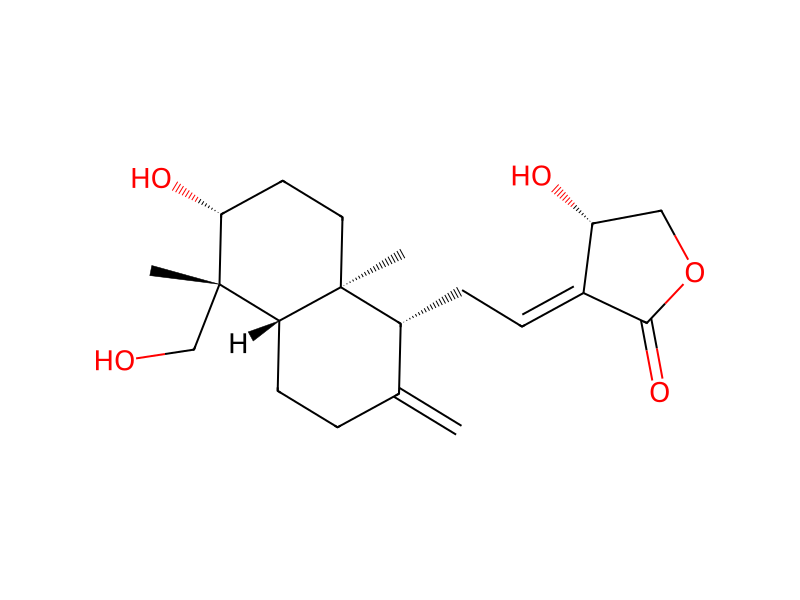
Basic information
- Standard SMILES
C=C1CC[C@@H]2[C@](C)(CO)[C@H](O)CC[C@@]2(C)[C@@H]1C/C=C1/C(=O)OC[C@H]1O- InChIKey
BOJKULTULYSRAS-OTESTREVSA-N- Molecular formula
- C20H30O5
- Average molar mass
- 350.455 g/mol
- Monoisotopic mass
- 350.20932406
Names & identifiers
- Preferred name
- Andrographolide
- IUPAC
- (3E,4S)-4-Hydroxy-3-{2-[(1R,4aS,5R,6R,8aS)-6-hydroxy-5-(hydroxymethyl)-5,8a-dimethyl-2-methylidenedecahydronaphthalen-1-yl]ethylidene}oxolan-2-one
- English name
- Andrographolide
- Molecular formula
- C20H30O5
- Molecular weight
- 350.45
Names & synonyms
ANDROANDROGRAPHISAndrographolid(S,E)-4-Hydroxy-3-(2-((1R,4aS,5R,6R,8aS)-6-hydroxy-5-(hydroxyMethyl)-5,8a-diMethyl-2-Methylenedecahydronaphthalen-1-yl)ethylidene)dihydrofuran-2(3H)-oneAndrographent-(3β,12E,14R)-3,14,19-Trihydroxy-8(17),12-labdadien-16,15-olideAndrographoLNeoandrogrAndrographoL
Database identifiers
- CAS
5508-58-7- PubChem CID
- 5318517
- DTXSID
DTXSID3045980- ChEMBL
CHEMBL186141- ChEBI
CHEBI:65408- UNII
- 410105JHGR
- EC Number
- 226-852-5
- Nikkaji
- J13.236E
Properties
Physicochemical properties
- Melting point
- 229 · 229-232 °C (lit.)
- alpha
- -126 · -126 º (c=1.5,HAc)
- Boiling point
- 557.3 · 557.3±50.0 °C(Predicted)
- Density
- 421 · d421 1.2317
- storage temp.
- 2 · 2-8°C
- solubility
- Soluble in DMSO (up to 25 mg/ml) or in Ethanol (up to 8 mg/ml).
- pka
- 12.36 · 12.36±0.20(Predicted)
- form
- Off-white solid
- color
- Off-white
- optical activity
- 20 · [α]20/D 126°, c = 1.5 in acetic acid
- λmax
- 223 nm · 223nm(MeOH)(lit.)
- Merck
- 14 · 14,633
- BRN
- 42762 · 42762
- Stability
- 2 years · Stable for 2 years from date of purchsae as supplied. Solutions in DMSO or ethanol may be stored at -20°C for up to 3 months.
- Cosmetics Ingredients Functions
- SKIN CONDITIONING
- InChI
- 1S/C20H30O5/c1-12-4-7-16-19(2,9-8-17(23)20(16,3)11-21)14(12)6-5-13-15(22)10-25-18(13)24/h5,14-17,21-23H,1,4,6-11H2,2-3H3/b13-5+/t14-,15-,16+,17-,19+,20+/m1/s1
- InChIKey
- BOJKULTULYSRAS-QPSYGYIJSA-N
- SMILES
- C[C@@]1(CO)[C@H](O)CC[C@@]2(C)[C@H](C\C=C3/[C@H](O)COC3=O)C(=C)CC[C@H]12
- LogP
- 0.424 · 0.424 (est)
- CAS DataBase Reference
- 5508 · 5508-58-7
- EWG's Food Scores
- 1 · 1
- FDA UNII
- 410105 JHGR · 410105JHGR
- UNSPSC Code
- 85151701 · 85151701
- NACRES
- 77 · NA.77
- Symbol(GHS)
- 7 · GHS07
- Signal word
- Warning
- Hazard statements
- 302 · H302-H315-H319-H332-H335
- Precautionary statements
- 261 · P261-P280-P305+P351+P338
- PPE
- 95 · Eyeshields, Gloves, type N95 (US)
- Hazard Codes
- Xn
- Risk Statements
- 20 · 20/21/22-36/37/38
- Safety Statements
- 22 · 22-24/25-36-26
- WGK Germany
- 3 · 3
- RTECS
- 3490750 · LU3490750
- HS Code
- 29322980 · 29322980
- Storage Class
- 11 · 11 - Combustible Solids
Safety & regulation
Safety data
- PPE
- Eyeshields, Gloves, type N95 (US)
- wgk
- 3
- rtecs
- LU3490750
- hs_code
- 29322980
- risk_code
- 20/21/22-36/37/38
- Signal word
- Warning
- Symbol(GHS)
- GHS07
- hazard_code
- Xn
- safety_code
- 22-24/25-36-26
- Storage Class
- 11 - Combustible Solids
- Hazard statements
- H302-H315-H319-H332-H335
- Precautionary statements
- P261-P280-P305+P351+P338
Chemistry & industry
Applications
DescriptionAndrographolide is the bitter principle, a colorless and neutral crystalline substance. It is the major labdane diterpenoid isolated from Andrographis paniculate. It exhibits antiviral, anti-inflammatory, and anticancer activities. The underlying mechanism is the inhibition of the mitogen-activated protein kinase/extracellular signal-regulated kinase (MAPK/ERK) signaling (specifically p38 MAPK/ERK1/2) pathway and downstream transcription factors such as nuclear factor kappa B (NF-κB) and nuclear factor of activated T cells (NFAT). Andrographolide is also confirmed with chemopreventive effects against and the inhibitory effects on cancer cell growth in breast, colon, epidermoid, gastric, liver, leukemia, myeloma, peripheral blood lymphocytes, and prostate cancers. Andrographolide has been used for liver complaints and fever, and as an anti-inflammatory and immunostimulant. Andrographolide exerts anti-growth and pro-apoptotic effects on human rheumatoid arthritis fibroblast- like synoviocytes, the main cellular constituent of pannus, that combined with a massive infiltration of lymphocytes and macrophages, invades and destroys the local articular structure. Thereby, andrographolide is proposed to be used in Rheumatoid Arthritis and other autoimmune diseases.
DescriptionAndrographolide is a diterpene lactone compound extracted from Andrographis. paniculata (Burm. F) Nees. Andrographis paniculata is also known as lanhelian, yijianxi, zhanshecao, kucao, kudancao, etc. Since this product originates in India, it is also known as Indian grass. This product is dry ground part of Jupiteraceae plant Andrographis paniculata (conus) may originate in South Asia. It is commonly cultivated in China such as in Fujian, Guangdong, Hainan, Guangxi, and Yunnan and also in Australia and was also introduced in Jiangsu and Shaanxi.Andrographis paniculata is commonly used in traditional Chinese medicine. Its ability of relieving “snake venom, and internal injuries cough” was recorded in “Lingnan herbal medicine records.” “Quanzhou Materia Medica” described it as “heat-clearing and detoxifying, anti-inflammatory, detumescence and inhibition throat inflammation, dysentery and high fever.”The above ground part of Andrographis paniculata contains andrographolide, neo-andrographolide, 14-deoxygenated andrographolide, etc., and the root contains mainly flavonoids.
OccurrenceAndrographis is found growing wild in India and Sri Lanka and is cultivated in many other parts of the world.
HistoryIn 1911, Gorter firstly isolated a crystalline substance from Andrographis paniculata, identified it as a diterpene lactone compound, and named it andrographolide .Andrographolide structure is complex and difficult to artificially synthesize, so it is often extracted from the plant.Andrographolide water solubility is poor and its bioavailability is low; its pharmacological effects are extensive but weak, so the preparation requirements are strict. Therefore, from the 1970s, drugs and organic chemical researchers have done a lot of work in the modification and transformation of andrographolide, mainly concentrated in the α, β-unsaturated lactone double bond Michael addition, redox, selective esterification of hydroxyl groups, oxidation and substitution reactions, intramolecular cyclization, replacement of lactone rings, etc. They had obtained a number of new derivatives. In the research of pharmacological effects, the main study of the andrographolide derivatives focuses on antitumor, antivirus, and other biological activities and has made some progress .
UsesAndrographolide is a labdane diterpenoid. Andrographolide is the main bioactive component isolated from the medicinal plant Andrographis paniculata. It has a broad range of therapeutic applications including anti-inflammatory and anti-platelet aggregation activities and potential antineoplastic properties. Andrographolide showed significant antihepatotoxic action in P. berghei K173- induced hepatic damage in M. natalensis. Andrographolide inhibits tumor necrosis factor-α (TNF-α)-induced intercellular adhesion mol.-1 (ICAM-1) expression and adhesion of HL-60 cells onto human umbilical vein endothelial cells (HUVEC), which are associated with inflammatory diseases. These findings suggest that Andrographolide may have potential as a cardiovascular-protective agent.
General DescriptionAndrographolide, a bioactive diterpene lactone, is the main constituent of Andrographis paniculata, a plant used in traditional medicines. It is known to have different biological activities such as anti-inflammatory, anti-malarial, anti-cancer and hepatoprotective activity. It also shows potent anti-viral effect against dengue virus.
Upstream & downstream products
Upstream raw materials
Suppliers50 total
国药集团化学试剂有限公司86-21-63210123 · [email protected]
北京华美互利生物化工010-56205725 · [email protected]
梯希爱(上海)化成工业发展有限公司021-67121386 · [email protected]
上海阿拉丁生化科技股份有限公司400-6206333 13167063860 · [email protected]
南通飞宇生物科技有限公司0513-68819626 15152877458 · [email protected]
爱斯特(成都)生物制药股份有限公司+86-28-85122536 85324413 · [email protected]
上海如吉生物科技发展有限公司+86-21-65211385-8001 36031160 · [email protected]
南京丙承生物科技有限公司18805194892
上海迈瑞尔生化科技有限公司4006356688 18621169109 · [email protected]
大连美仑生物技术有限公司0411-62910999 13889544652 · [email protected]
上海德默医药科技有限公司400-021-7337 2355568890 · [email protected]
安耐吉化学&3A(安徽泽升科技股份有限公司)400-0056266 · [email protected]
桂林莱科生物科技有限公司18978670903 18107731009 · [email protected]
上海瀚鸿科技股份有限公司021-54306202 13764082696 · [email protected]
成都普菲德生物技术有限公司028-82610909 13388174823 · [email protected]
上海融禾医药科技发展有限公司17301719108 13341702378 · [email protected]
嘉兴市艾森化工有限公司0573-85285100 18627885956 · [email protected]
Pure Chemistry Scientific Inc.001-857-928-2050 or 1-888-588-9418 · [email protected]
上海泰坦科技股份有限公司400-6009262 15618770481 · [email protected]
深圳虹彩祥根生物科技有限公司+86-0755-89668383 · [email protected]
MedChemexpress LLC021-58955995 · [email protected]
武汉丰泰威远科技有限公司027-87465837 19945049750 · [email protected]
贵州迪大科技有限责任公司0851-8475-2296 18096062265 · [email protected]
杭州东帆化学有限公司86-0571-85151182
孝感深远化工有限公司15527621225; 15527621225 · [email protected]
云南西力生物技术股份有限公司0871-65217109 · [email protected]
山东西亚化学有限公司13355009207 13355009207 · [email protected]
四川库利南科技有限公司400-1166-196 18981987031 · [email protected]
天津希恩思生化科技有限公司400 638 7771 · [email protected]
成都健腾生物技术有限公司86-28-85159085 · [email protected]
上海源叶生物科技有限公司13636370518 · [email protected]
艾科试剂4008-755-333 18080918076 · [email protected]
成都锦然生物科技有限公司028-83311324 1278112614 · [email protected]
上海思域化工科技有限公司86-21-34053660 · [email protected]
西安康培基生物科技有限公司86-029-85456576 · [email protected]
AdooQ BioScience, LLC+1 (866) 930-6790 · [email protected]
上海健超生物科技有限公司150-2103-5486 18017383231 · [email protected]
TCI AMERICA800-4238616 · [email protected]
TOKYO CHEMICAL INDUSTRY CO., LTD.03-36680489 · [email protected]
TCI Europe320-37350700 · [email protected]
深圳康特腾科技有限公司86-0755-86635001 · [email protected]
广州爱纯医药科技有限公司020-39119399 18927568969 · [email protected]
陕西帕尼尔生物科技有限公司13720616393;029-84385017-8003 13720616393 · [email protected]
上海陶素生化科技有限公司021-33632979 · [email protected]
成都瑞芬思德丹生物科技有限公司2355253622; 18981954830 · [email protected]
上海倍卓生物科技有限公司021-61119791,13386096464 · [email protected]
上海将来实业股份有限公司400-0066400 13621662912 · [email protected]
上海将来实业股份有限公司021-61552785 · [email protected]
上海石洋化工有限公司021-56795766 · [email protected]
四川省维克奇生物科技有限公司028-81700200 18116577057 · [email protected]
Additional notes
DefinitionChEBI: Andrographolide is a labdane diterpenoid isolated from the leaves and roots of Andrographis paniculata that exhibits anti-HIV, anti-inflammatory and antineoplastic properties. It has a role as a metabolite, an anti-inflammatory drug, an anti-HIV agent and an antineoplastic agent. It is a gamma-lactone, a primary alcohol, a secondary alcohol, a labdane diterpenoid and a carbobicyclic compound.
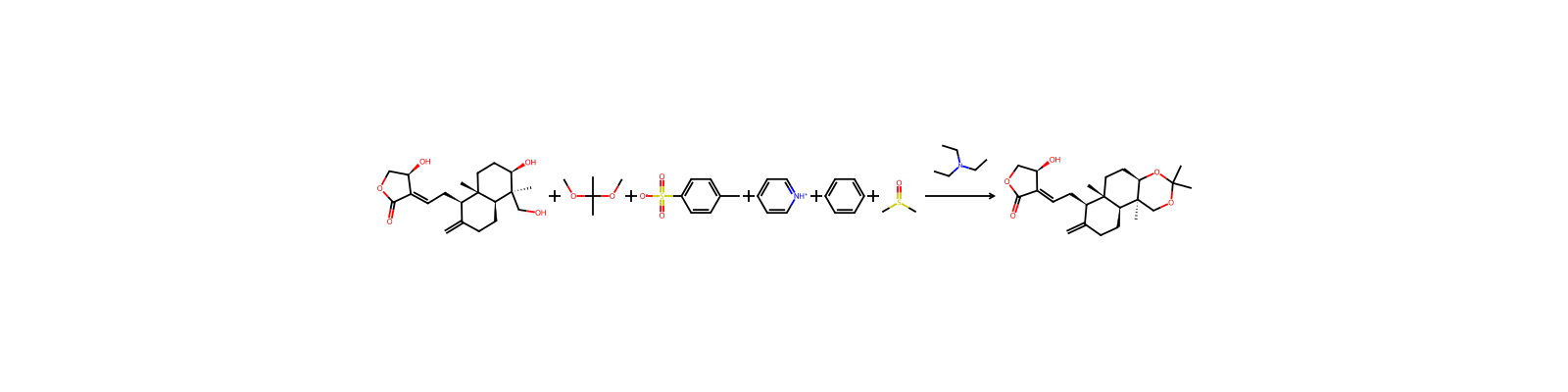
Related reactions
3 records

Linked notes
Loading…