
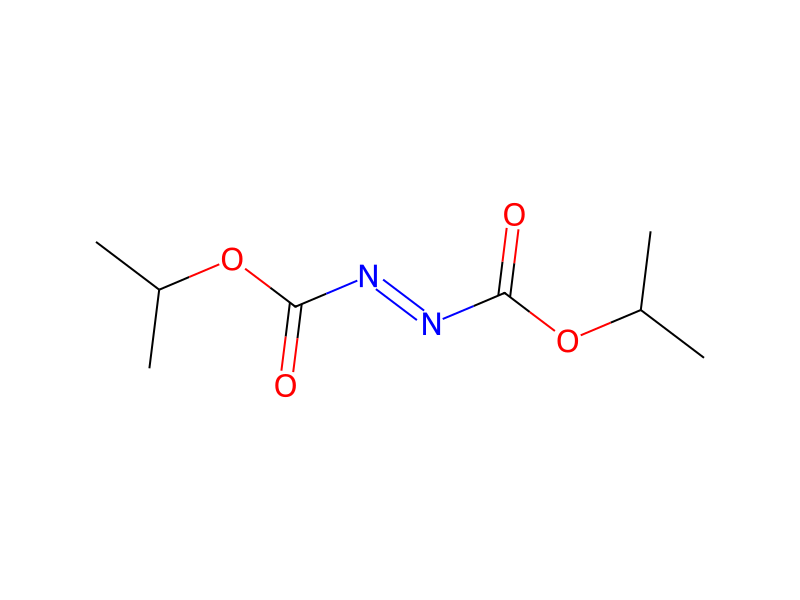
Basic information
- Standard SMILES
CC(C)OC(=O)/N=N/C(=O)OC(C)C- InChIKey
VVWRJUBEIPHGQF-MDZDMXLPSA-N- Molecular formula
- C8H14N2O4
- Average molar mass
- 202.21 g/mol
- Monoisotopic mass
- 202.09535693
Names & identifiers
- Preferred name
- Diisopropyl azodicarboxylate
- IUPAC
- propan-2-yl (NE)-N-propan-2-yloxycarbonyliminocarbamate
- English name
- Diisopropyl azodicarboxylate
- Molecular formula
- C8H14N2O4
- Molecular weight
- 202.21
Names & synonyms
Diisopropyl azodicarboxylate2446-83-5Diisopropyl azodiformate939987-56-1Diisopropyl azodicarboxylate [MI]Formic acid, azodi-, diisopropyl ester7W701BXX4KEINECS 219-502-81,2-Diazenedicarboxylic acid 1,2-bis(1-methylethyl) esterDTXSID50894754Diazenedicarboxylic acid, bis(1-methylethyl) esterRefChem:587897
Show more names
diisopropyl (E)-diazene-1,2-dicarboxylateDisopropyl AzodicarboxylateAZODICARBONIC ACID DIISOPROPYL ESTER(E)-diisopropyl diazene-1,2-dicarboxylateDiisopropyl azodicarboxylate [DIAD]Propan-2-yl N-propan-2-yloxycarbonyliminocarbamateDIAD(Diisopropylazodicarboxylate)
DTXCID4013243121,2Diazenedicarboxylic acid 1,2bis(1methylethyl) ester219-502-8DiisopropylazodicarboxylateDIADDiisopropyl diazene-1,2-dicarboxylateMFCD00008875propan-2-yl (NE)-N-propan-2-yloxycarbonyliminocarbamate
Database identifiers
- CAS
2446-83-5、939987-56-1- PubChem CID
- 5363146
- DTXSID
DTXSID50894754- UNII
- 7W701BXX4K
- EC Number
- 219-502-8
- Nikkaji
- J3.771.302C、J56.134G
Properties
Computed structural properties
- XLogP
- 2.6
- Topological polar surface area
- 77.3 Ų
- Hydrogen bond donors
- 0
- Hydrogen bond acceptors
- 4
- Rotatable bonds
- 4
- Heavy atoms
- 14
- Formal charge
- 0
- Complexity
- 211
Experimental & physicochemical properties
Physical DescriptionOrange liquid; [Merck Index] Pungent odor; [Alfa Aesar MSDS]
Physicochemical properties
- Melting point
- 3 · 3-5 °C
- Boiling point
- 75 °C/0.25 · 75 °C/0.25 mmHg (lit.)
- Density
- 1.027 g/mL · 1.027 g/mL at 25 °C (lit.)
- vapor pressure
- 1.04 hPa · 1.04 hPa (20 °C)
- refractive index
- 20 · n20/D 1.420(lit.)
- Flash point
- 223 °F · 223 °F
- storage temp.
- 30 °C · Store below +30°C.
- solubility
- Chloroform (Slightly), Ethyl Acetate (Slightly)
- form
- Liquid
- color
- Clear to slightly turbid yellow-orange to red
- Water Solubility
- insoluble
- Sensitive
- Light Sensitive
- BRN
- 1912326 · 1912326
- InChI
- InChI=1S/C8H14N2O4/c1-5(2)13-7(11)9-10-8(12)14-6(3)4/h5-6H,1-4H3
- InChIKey
- VVWRJUBEIPHGQF-UHFFFAOYSA-N
- SMILES
- N(C(OC(C)C)=O)=NC(OC(C)C)=O
- CAS DataBase Reference
- 2446 · 2446-83-5(CAS DataBase Reference)
- FDA UNII
- 7 W701BXX4K · 7W701BXX4K
- UNSPSC Code
- 12352302 · 12352302
- NACRES
- 22 · NA.22
- Symbol(GHS)
- 7 · GHS07,GHS08,GHS09
- Signal word
- Warning
- Hazard statements
- 315 · H315-H319-H335-H351-H411
- Precautionary statements
- 202 · P202-P261-P273-P302+P352-P305+P351+P338-P308+P313
- target organs
- Respiratory system
- PPE
- Eyeshields, Faceshields, Gloves, type ABEK (EN14387) respirator filter
- Hazard Codes
- Xn,Xi,N,F
- Risk Statements
- 36 · 36/38-51/53-5-43-36/37/38-11-48/20/22-40
- Safety Statements
- 36 · 36-61-47A-36/37/39-29-26-16-60-36/37
- RIDADR
- 3082 · UN 3082 9/PG 3
- WGK Germany
- 1 · 1
- F
- 4.1 · 4.10-8
- Hazard Note
- Harmful/Irritant
- HazardClass
- 9 · 9
- PackingGroup
- III
- HS Code
- 29270000 · 29270000
- Storage Class
- 10 · 10 - Combustible liquids
- Hazard Classifications
- 2 Carc · Aquatic Chronic 2Carc. 2Eye Irrit. 2Skin Irrit. 2STOT RE 2STOT SE 3
- REACH Registrations
- Active
Safety & regulation
GHS classification
GHS Classification
This chemical does not meet GHS hazard criteria for 35.9% (52 of 145) of reports.
Warning
H315 (62.8%): Causes skin irritation [Warning Skin corrosion/irritation];H319 (62.8%): Causes serious eye irritation [Warning Serious eye damage/eye irritation];H335 (61.4%): May cause respiratory irritation [Warning Specific target organ toxicity, single exposure; Respiratory tract irritation];H373 (54.5%): May causes damage to organs through prolonged or repeated exposure [Warning Specific target organ toxicity, repeated exposure];H411 (61.4%): Toxic to aquatic life with long lasting effects [Hazardous to the aquatic environment, long-term hazard]
P260, P261, P264, P264+P265, P271, P273, P280, P302+P352, P304+P340, P305+P351+P338, P319, P321, P332+P317, P337+P317, P362+P364, P391, P403+P233, P405, and P501 (click each P-code to see the statement)
Aggregated GHS information provided per 145 reports by companies from 21 notifications to the ECHA C&L Inventory. Each notification may be associated with multiple companies.;Reported as not meeting GHS hazard criteria per 52 of 145 reports by companies.;There are 20 notifications provided by 93 of 145 reports by companies with hazard statement code(s).;Information may vary between notifications depending on impurities, additives, and other factors. The percentage value in parenthesis indicates the notified classification ratio from companies that provide hazard codes. Only hazard codes with percentage values above 10% are shown. For more detailed information, please visit ECHA C&L website.
Hazard information
Regulatory Information
Status: Active Update: 02-11-2022 https://echa.europa.eu/registration-dossier/-/registered-dossier/23916
Diisopropylazodicarboxylate: Does not have an individual approval but may be used under an appropriate group standard
Hazards SummaryA skin, respiratory tract, and strong eye irritant; [Alfa Aesar MSDS] See Diethyl azodicarboxylate.
Hazard Classes and CategoriesSkin Irrit. 2 (62.8%);Eye Irrit. 2 (62.8%);STOT SE 3 (61.4%);STOT RE 2 (54.5%);Aquatic Chronic 2 (61.4%)
Regulatory information
Regulatory Information
Status: Active Update: 02-11-2022 https://echa.europa.eu/registration-dossier/-/registered-dossier/23916
Diisopropylazodicarboxylate: Does not have an individual approval but may be used under an appropriate group standard
Safety data
- F
- 4.10-8
- PPE
- Eyeshields, Faceshields, Gloves, type ABEK (EN14387) respirator filter
- wgk
- 1
- ridadr
- UN 3082 9/PG 3
- hs_code
- 29270000
- risk_code
- 36/38-51/53-5-43-36/37/38-11-48/20/22-40
- Signal word
- Warning
- Symbol(GHS)
- GHS07,GHS08,GHS09
- hazard_code
- Xn,Xi,N,F
- hazard_note
- Harmful/Irritant
- safety_code
- 36-61-47A-36/37/39-29-26-16-60-36/37
- hazard_class
- 9
- Storage Class
- 10 - Combustible liquids
- packing_group
- III
- target organs
- Respiratory system
- Hazard statements
- H315-H319-H335-H351-H411
- REACH Registrations
- Active
- Hazard Classifications
- Aquatic Chronic 2Carc. 2Eye Irrit. 2Skin Irrit. 2STOT RE 2STOT SE 3
- Precautionary statements
- P202-P261-P273-P302+P352-P305+P351+P338-P308+P313
Chemistry & industry
Uses & manufacturing
UsesUsed as a reagent; [Merck Index]
Applications
UsesIt can be used as dye intermediates, pharmaceutical intermediates, organic synthesis reagents, and the foaming agent of the rubber plastics liquid. Isopropyl azodicarboxylate can be used for the liquid foaming agent of vinyl resin. It can be used to make light-colored vinyl foam. It has a uniform pore structure with different formulations and processing conditions giving foam of either closed pore or open pore. It can also be used as pharmaceutical intermediates, and organic synthesis reagents.
UsesDiisopropyl Azodicarboxylate is an azodicarboxylic acid derivative used as a reagent in the production of many organic compounds. Diisopropyl Azodicarboxylate is commonly used as an oxidizer in Mitsun obu reactions and can also serve as a selective deprotectant of N-benzyl groups in the presence of other protecting groups.
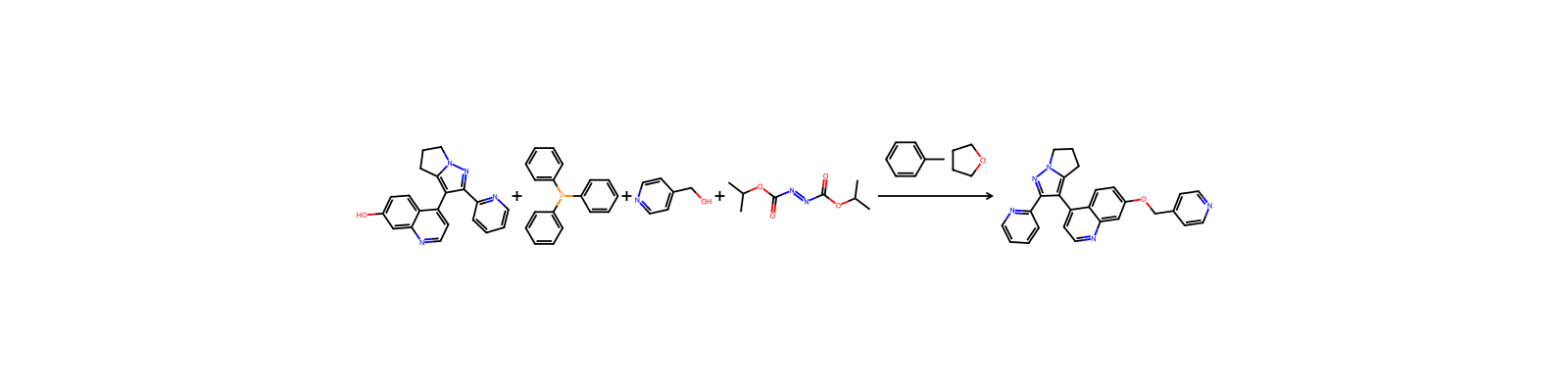
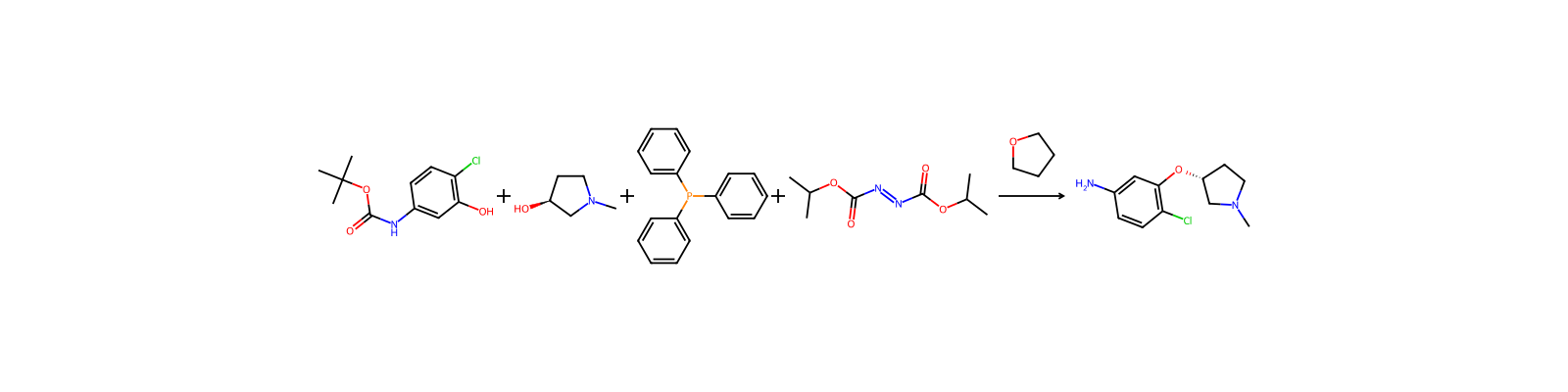
UsesDiisopropyl azodicarboxylate is used as an important reagent in the production of many organic compounds. It is used in association with triphenyl phosphine in Mitsunobu reaction of alcohols, acids and amides. It acts as reactant in the preparation of chromenes resembling classical cannabinoids, norbornene-based guanidine-rich polymers and acceptor-donor-acceptor organic dyes.
General DescriptionReacted with dioxaphosphorinanes and iron catalyst to generate rearranged phosphonium ylide products.
Upstream & downstream products
Upstream raw materials
Downstream products
Suppliers50 total
国药集团化学试剂有限公司86-21-63210123 · [email protected]
北京华美互利生物化工010-56205725 · [email protected]
梯希爱(上海)化成工业发展有限公司021-67121386 · [email protected]
上海阿拉丁生化科技股份有限公司400-6206333 13167063860 · [email protected]
邹平创新药业有限公司13561560789 · [email protected]
杭州品高化工有限公司0571-87658025 · [email protected]
常州瀚轩生物科技有限公司18602598900,18605190599 18602598900 · [email protected]
爱斯特(成都)生物制药股份有限公司+86-28-85122536 85324413 · [email protected]
韶远科技(上海)有限公司021-50795510 4000665055 · [email protected]
科瑞迪化学400-821-5857 021-64326257 · [email protected]
Syntechem Co.,Ltd[email protected]
上海迈瑞尔生化科技有限公司4006356688 18621169109 · [email protected]
阿法埃莎(中国)化学有限公司400-6106006 · [email protected]
太原市瑞和丰科贸有限公司+86 351 7031519 · [email protected]
安耐吉化学&3A(安徽泽升科技股份有限公司)400-0056266 · [email protected]
陕西纬宇新材料有限公司13772052144 13772052144 · [email protected]
上海瀚鸿科技股份有限公司021-54306202 13764082696 · [email protected]
上海相辉医药科技有限公司13761987713 · [email protected]
上海景颜化工科技有限公司13817811078 · [email protected]
嘉兴市艾森化工有限公司0573-85285100 18627885956 · [email protected]
池州捷峰生物科技有限公司0566-8928158 · [email protected]
Pure Chemistry Scientific Inc.001-857-928-2050 or 1-888-588-9418 · [email protected]
武汉丰泰威远科技有限公司027-87465837 19945049750 · [email protected]
上海忆嵘生物科技有限公司18049974220 · [email protected]
泰州市鑫泓川新材料有限公司18651157028 18651157028
山东西亚化学有限公司13355009207 13355009207 · [email protected]
唐山默内德贸易有限公司0315-8309571 15633399667 · [email protected]
玛雅试剂+86 (573) 82222445 (0)18006601000 452520369 · [email protected]
四川库利南科技有限公司400-1166-196 18981987031 · [email protected]
天津希恩思生化科技有限公司400 638 7771 · [email protected]
河南萬象化工有限公司(优势生产供应!)0371-56669001 13949088811 · [email protected]
南京维奥化工有限公司Please Send Email 18652950785 · [email protected]
河南多贝化工有限公司0370-2785118 17550508557 · [email protected]
北京泰亚杰科技有限公司021-33690831-8001 13552411790;18616022633 · [email protected]
艾科试剂4008-755-333 18080918076 · [email protected]
天津科创医药中间体技术生产力促进有限公司022-60116533 13207668525 · [email protected]
上海思域化工科技有限公司86-21-34053660 · [email protected]
苏州思变化学技术有限公司0512-65617459 18915409046 · [email protected]
赛默飞世尔科技(中国)有限公司800-810-5118 · [email protected]
北京伊诺凯科技有限公司400-810-7969 010-59572699 · [email protected]
上海遐瑞医药科技有限公司+86 21 61551611
南京诺利斯医药科技有限公司13901585132 · [email protected]
TOKYO CHEMICAL INDUSTRY CO., LTD.03-36680489 · [email protected]
TCI Europe320-37350700 · [email protected]
上海贤鼎生物科技有限公司4009209199 · [email protected]
深圳振强药物研发有限公司0755-66853366 13670046396 · [email protected]
深圳康特腾科技有限公司86-0755-86635001 · [email protected]
Shanghai Witofly Chemical Co.,Ltd[email protected]
越林试剂021-62960152 · [email protected]
上海汇凯化学科技有限公司021-61995394 18916691159 · [email protected]
Related reactions
1,846 records





Linked notes
Loading…