Atorvastatin
ATORVASTATIN CA · Atorvastatin (Subject to Patent free) · ATORVASTATIN CALCIUM SALT · Atorvastatin acid · ATORVASTATIN DIPROTECTED · Atorvastatin CalciuM Tablets · (3r,5r)-7-[2-(4-fluorophenyl)-3-phenyl-4-(phenylcarbamoyl)-5-propan-2-yl-pyrrol-1-yl]-3,5-dihydroxy-heptanoic acid · Cardyl
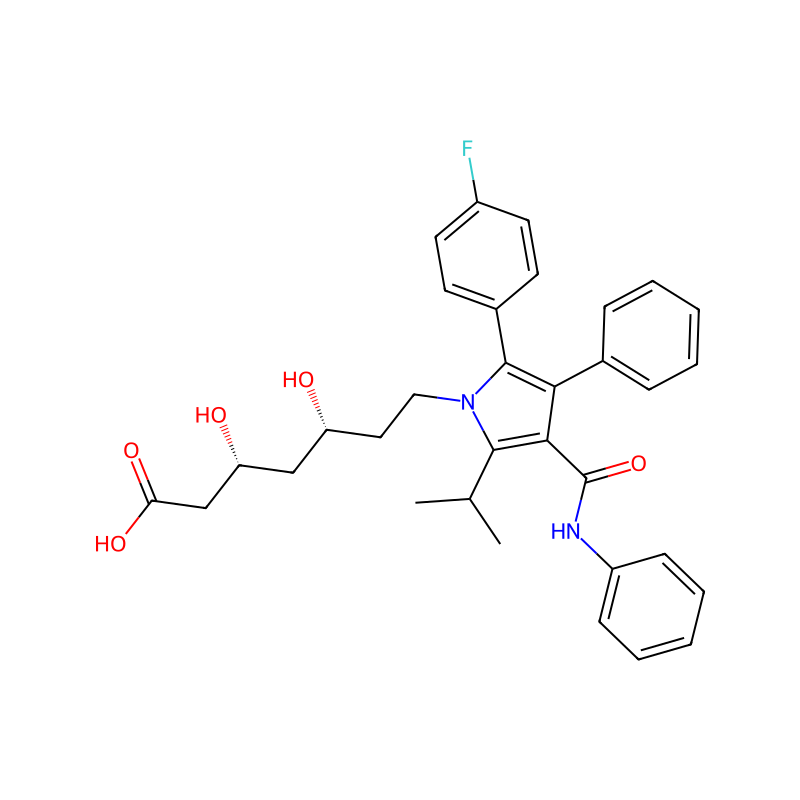
Identifiers & Physical Properties
| CAS No. | 134523-00-5 |
|---|---|
| Molecular formula | C33H35FN2O5 |
| Average molar mass | 558.6 g/mol |
| Monoisotopic mass | 558.25300038 g/mol |
| SMILES | CC(C)c1c(C(=O)Nc2ccccc2)c(-c2ccccc2)c(-c2ccc(F)cc2)n1CC[C@@H](O)C[C@@H](O)CC(=O)O |
| InChIKey | XUKUURHRXDUEBC-KAYWLYCHSA-N |
| PubChem CID | 60823 |
| ChEMBL | CHEMBL1487 |
| ChEBI | CHEBI:39548 |
| EC No. | 806-698-0 |
| DTXSID | DTXSID8029868 |
Chemical & Physical Properties
| XLogP | 5 |
|---|---|
| Topological polar surface area | 112 |
| Hydrogen bond donors | 4 |
| Hydrogen bond acceptors | 6 |
| Rotatable bonds | 12 |
| Heavy atoms | 41 |
| Formal charge | 0 |
| Complexity | 822 |
| LogP (partition coefficient) | 6.36 |
| Solubility | Practically insolubleDMSO: 100 mg/mL (179.01 mM) |
| Boiling point | 722722.2±60.0 °C(Predicted) |
| Melting point | 176159.1 - 190.6 °C176-178°C |
| Optical Rotation | White to off-white crystalline powder. Specific optical rotation at 25 °C for D (sodium) line = -7.4 deg (c = 1 in DMSO). Freely soluble in methanolslightly soluble in ethanolvery slightly soluble in acetonitrile, distilled water, phosphate buffer (pH 7.4). Insoluble in aqueous solutions of pH 4 and below. /Atorvastatin calcium salt trihydrate/ |
| Physical Description | Solid |
| Stability/Shelf Life | Stable under recommended storage conditions. /Atorvastatin calcium salt trihydrate/ |
| Dissociation Constants | 4.464.54 |
| Collision Cross Section | 224.3 Ų [M]+ [CCS Type: DTBuffer gas: N2Ionization: APCI+Dataset: TOXCASTSource Identifier: DTXSID6044303]231.4 Ų [M+Na]+ [CCS Type: DTIonization: ESI+Source Identifier: DTXSID8029868]229.7 Ų [M+H]+ [CCS Type: DT232.2 Ų [M+Na]+ [CCS Type: DT229.1 Ų [M+H]+ [CCS Type: DT228.4 Ų [M-H]- [CCS Type: DTIonization: ESI-228.6 Ų [M-H]- [CCS Type: DT229.8 Ų [M+H]+ [CCS Type: DT230.3 Ų [M+H]+ [CCS Type: DT213.25 Ų [M+H-H2O]+ [CCS Type: TWMethod: calibrated with polyalanine and drug standards]229.87 Ų [M+Na]+ [CCS Type: TW231.37 Ų [M+K]+ [CCS Type: TW231.29 Ų [M+H]+ [CCS Type: TW233 Ų [M+H]+ [CCS Type: TWMethod: Major Mix IMS/Tof Calibration Kit (Waters)]233.34 Ų [M+H]+231.92 Ų [M-H]-233.2 Ų [M+Na]+ |
| Other Experimental Properties | pKa= 4.46. Solubility in water (30 °C) = 20.4 ug/mL (pH 2.1)1.23 mg/mL (pH 6.0) /Atorvastatin sodium salt/MP: 159.2-160.7 °C. Specific optical rotation: +26.05 deg at 25 °C/D (c = 1 in chloroform) /Atorvastatin lactone/ |
| Density | 1.23±0.1 g/cm3(Predicted) |
| Storage conditions | 2-8°C |
| Physical state | Solid |
| pKa (acidity coefficient) | pKa 4.46(H2O t=30 Iuncontrolled) (Uncertain) |
| Color | White to light yellow |
| Major applications | pharmaceutical |
| InChIKey | XUKUURHRXDUEBC-FQWVHLSFNA-N |
| SMILES | C(C1=C(N(CC[C@@H](O)C[C@@H](O)CC(=O)O)C(C2C=CC(F)=CC=2)=C1C1C=CC=CC=1)C(C)C)(=O)NC1C=CC=CC=1 |&1:6,9,r| |
| CAS DataBase Reference | 134523-00-5(CAS DataBase Reference) |
| FDA UNII | A0JWA85V8F |
| ATC code | C10AA05 |
| EPA Substance Registry System | 1H-Pyrrole-1-heptanoic acid, 2-(4-fluorophenyl)-?,?-dihydroxy-5-(1-methylethyl)-3-phenyl-4-[(phenylamino)carbonyl]-, (?R,?R)- (134523-00-5) |
| NACRES | NA.24 |
| GHS pictogram | GHS03,GHS07 |
| Signal word | Warning |
| GHS hazard statements | H272-H315-H319-H335 |
| GHS precautionary statements | P221-P261-P264b-P271-P280-P302+P352-P304+P340-P305+P351+P338-P312-P362+P364-P370+P378r-P370+P380+P375-P380-P501c |
| Hazard symbols | Xn |
| Risk statements (R) | 20/21/22-36/37/38 |
| Safety statements (S) | 26-36 |
| Water hazard class (WGK) | WGK 3 |
| Customs code | 35040000 |
| Storage class | 11 - Combustible Solids |
| Hazard class | Repr. 2 |
| Hazardous substances data | 134523-00-5(Hazardous Substances Data) |
Safety & Regulations
| GHS classification | WarningH315 (66.7%): Causes skin irritation [Warning Skin corrosion/irritation]H319 (66.7%): Causes serious eye irritation [Warning Serious eye damage/eye irritation]H335 (66.7%): May cause respiratory irritation [Warning Specific target organ toxicity, single exposureRespiratory tract irritation]H361 (33.3%): Suspected of damaging fertility or the unborn child [Warning Reproductive toxicity]H361f (33.3%): Suspected of damaging fertility [Warning Reproductive toxicity]H361fd (33.3%): Suspected of damaging fertilitySuspected of damaging the unborn child [Warning Reproductive toxicity]H362 (66.7%): May cause harm to breast-fed children [Reproductive toxicity, effects on or via lactation]P203, P260, P261, P263, P264, P264+P265, P270, P271, P280, P302+P352, P304+P340, P305+P351+P338, P318, P319, P321, P332+P317, P337+P317, P362+P364, P403+P233, P405, and P501 (click each P-code to see the statement)Aggregated GHS information provided per 3 reports by companies from 3 notifications to the ECHA C&L Inventory. Each notification may be associated with multiple companies.Information may vary between notifications depending on impurities, additives, and other factors. The percentage value in parenthesis indicates the notified classification ratio from companies that provide hazard codes. Only hazard codes with percentage values above 10% are shown. For more detailed information, please visit ECHA C&L website. |
|---|---|
| FDA requirements | The Approved Drug Products with Therapeutic Equivalence Evaluations identifies currently marketed prescription drug products, including atorvastatin calcium, approved on the basis of safety and effectiveness by FDA under sections 505 of the Federal Food, Drug, and Cosmetic Act. /Atorvastatin calcium/ |
| Toxic Combustion Products | Special hazards arising from the substance or mixture: Carbon oxides, nitrogen oxides (NOx), hydrogen fluoride, calcium oxide /Atorvastatin calcium salt trihydrate/ |
| Hazard Classes and Categories | Skin Irrit. 2 (66.7%)Eye Irrit. 2 (66.7%)STOT SE 3 (66.7%)Repr. 2 (33.3%)Lact. (66.7%) |
| Hazardous Reactivities and Incompatibilities | Incompatible materials: Strong oxidizing agents. /Atorvastatin calcium salt trihydrate/ |
| Fire fighting procedures | Suitable extinguishing media: Use water spray, alcohol-resistant foam, dry chemical or carbon dioxide. /Atorvastatin calcium salt trihydrate/Advice for firefighters: Wear self-contained breathing apparatus for firefighting if necessary. /Atorvastatin calcium salt trihydrate/ |
| Storage conditions | Keep container tightly closed in a dry and well-ventilated place. Light sensitive. /Atorvastatin calcium salt trihydrate/Store at controlled room temperature 20-25 °C. |
| Cleanup methods | ACCIDENTAL RELEASE MEASURES: Personal precautions, protective equipment and emergency procedures: Use personal protective equipment. Avoid dust formation. Avoid breathing vapors, mist or gas. Ensure adequate ventilation. Avoid breathing dust. Environmental precautions: Do not let product enter drains. Methods and materials for containment and cleaning up: Pick up and arrange disposal without creating dust. Sweep up and shovel. Keep in suitable, closed containers for disposal. /Atorvastatin calcium salt trihydrate/ |
| Disposal methods | SRP: Expired or waste pharmaceuticals shall carefully take into consideration applicable DEA, EPA, and FDA regulations. It is not appropriate to dispose by flushing the pharmaceutical down the toilet or discarding to trash. If possible return the pharmaceutical to the manufacturer for proper disposal being careful to properly label and securely package the material. Alternatively, the waste pharmaceutical shall be labeled, securely packaged and transported by a state licensed medical waste contractor to dispose by burial in a licensed hazardous or toxic waste landfill or incinerator.Product: Offer surplus and non-recyclable solutions to a licensed disposal companyContaminated packaging: Dispose of as unused product. /Atorvastatin calcium salt trihydrate/ |
| Preventive Measures | ACCIDENTAL RELEASE MEASURES: Personal precautions, protective equipment and emergency procedures: Use personal protective equipment. Avoid dust formation. Avoid breathing vapors, mist or gas. Ensure adequate ventilation. Avoid breathing dust. Environmental precautions: Do not let product enter drains. /Atorvastatin calcium salt trihydrate/Precautions for safe handling: Avoid contact with skin and eyes. Avoid formation of dust and aerosols. Provide appropriate exhaust ventilation at places where dust is formed. /Atorvastatin calcium salt trihydrate/Appropriate engineering controls: Handle in accordance with good industrial hygiene and safety practice. Wash hands before breaks and at the end of workday. /Atorvastatin calcium salt trihydrate/Gloves must be inspected prior to use. Use proper glove removal technique (without touching glove's outer surface) to avoid skin contact with this product. Dispose of contaminated gloves after use in accordance with applicable laws and good laboratory practices. Wash and dry hands. /Atorvastatin calcium salt trihydrate/SRP: Local exhaust ventilation should be applied wherever there is an incidence of point source emissions or dispersion of regulated contaminants in the work area. Ventilation control of the contaminant as close to its point of generation is both the most economical and safest method to minimize personnel exposure to airborne contaminants. Ensure that the local ventilation moves the contaminant away from the worker. |
| Personal Protective Equipment (PPE) | Eye/face protection: Safety glasses with side-shields conforming to EN166. Use equipment for eye protection tested and approved under appropriate government standards such as NIOSH (US) or EN 166(EU). /Atorvastatin calcium salt trihydrate/Skin protection: Handle with gloves. /Atorvastatin calcium salt trihydrate/Body Protection: Impervious clothing. The type of protective equipment must be selected according to the concentration and amount of the dangerous substance at the specific workplace. /Atorvastatin calcium salt trihydrate/Respiratory protection: For nuisance exposures use type P95 (US) or type P1 (EU EN 143) particle respirator. For higher level protection use type OV/AG/P99 (US) or type ABEK-P2 (EU EN 143) respirator cartridges. Use respirators and components tested and approved under appropriate government standards such as NIOSH (US) or CEN (EU). /Atorvastatin calcium salt trihydrate/ |
| Interactions | Concomitant use of atorvastatin with efavirenz may result in reductions in plasma concentrations of atorvastatin. Following concomitant use of atorvastatin (10 mg daily for 3 days) and efavirenz (600 mg once daily for 14 days), atorvastatin peak plasma concentration and AUC were decreased by 1 and 41%, respectively.Concomitant use of atorvastatin (80 mg once daily for 14 days) and digoxin (0.25 mg once daily for 20 days) resulted in 20 and 15% increases in digoxin peak plasma concentration and AUC, respectively. Therefore, patients receiving such concomitant therapy should be monitored appropriately.Concomitant use of atorvastatin and azole antifungals (e.g., itraconazole) increases the risk of myopathy or rhabdomyolysis. Following concomitant use of atorvastatin (40 mg as a single dose) and itraconazole (200 mg once daily for 4 days), atorvastatin peak plasma concentration and area under the plasma concentration-time curve (AUC) were increased by 20% and 3.3-fold, respectively. Clinicians considering concomitant use of atorvastatin and itraconazole or other azole antifungals should weigh the benefits and risks of such concomitant therapy. During concomitant therapy with itraconazole, the lowest necessary dosage of atorvastatin should be employed, and dosage of atorvastatin should not exceed 20 mg daily. Patients receiving concomitant therapy with atorvastatin and azole antifungals should be monitored for manifestations of muscle pain, tenderness, or weakness, particularly during the initial months of therapy and following an increase in dosage of either drug.Concomitant use of atorvastatin and cyclosporine increases the risk of myopathy or rhabdomyolysis. Following concomitant use of atorvastatin (10 mg daily for 28 days) and cyclosporine (5.2 mg/kg daily), atorvastatin peak plasma concentration and AUC were increased by 10.7- and 8.7-fold, respectively. Concomitant use of atorvastatin and cyclosporine should be avoided.For more Interactions (Complete) data for ATORVASTATIN (27 total), please visit the HSDB record page. |
| Hepatotoxicity | Atorvastatin therapy is associated with mild, asymptomatic and usually transient serum aminotransferase elevations in 1% to 3% of patients but levels above 3 times ULN in less than 1%. In summary analyses of large scale studies with prospective monitoring, ALT elevations above 3 times the upper limit of normal (ULN) occurred in 0.7% of atorvastatin treated versus 0.3% of placebo recipients. These elevations were more common with higher doses of atorvastatin, being 2.3% with 80 mg daily. Most elevations were self-limited and did not require dose modification.Atorvastatin is also associated with frank, clinically apparent hepatic injury but this is rare, occurring in approximately 1 in 10,000 treated patients. The clinical presentation of atorvastatin hepatotoxicity varies greatly from simple cholestatic hepatitis to mixed forms, to frankly hepatocellular injury. The latency to onset of injury is also highly variable ranging from 1 month to several years. However, most cases arise within 6 months of starting atorvastatin or several months after a dose escalation. The most common presentation is a cholestatic hepatitis that tends to be mild-to-moderate in severity and self-limiting in course (Cases 1 and 2). Atorvastatin hepatotoxicity can also present with a distinctly hepatocellular pattern of injury with marked elevations in serum aminotransferase levels and minimal or no increase in alkaline phosphatase. Rash, fever and eosinophilia are uncommon, but at least one-third of hepatocellular cases have features of autoimmunity, marked by high immunoglobulin levels, ANA or SMA positivity and liver biopsy findings that resemble autoimmune hepatitis (Cases 3 and 4). These autoimmune cases usually resolve once atorvastatin is stopped, although they may require corticosteroid therapy for resolution. Strikingly, however, some cases of apparent autoimmune hepatitis caused by atorvastatin do not resolve with stopping the medication but are self-sustained and require long term immunosuppressive therapy. It is unclear whether these cases of persistent autoimmune hepatitis are caused by the statin therapy or are triggered by statin in a susceptible host. Another possibility is that the association is coincidental and represents a de novo onset of autoimmune hepatitis in someone who happens to be taking a statin.Likelihood score: A (well known cause of clinically apparent liver injury). |
| Ecotoxicity values | EC50Species: Xenopus laevis (African Clawed Frog) blastulaConditions: freshwater, renewal, 23 °C, pH 6.5-9, hardness 16-400 mg/L CaCO3Concentration: 23100 ug/L for 96 hrEffect: development, increased deformation /98.0% purity/Species: Hyalella azteca (Scud) age 7-14 daysConditions: freshwater, renewal, 22.4 °C, pH 7.7, hardness 0.13 mmol, dissolved oxygen 6.5 mg/LConcentration: 2400 ug/L for 10 days (95% confidence interval: 1300-3560 ug/L)Effect: growth, decreased weight /> or=99% purity/LC50Concentration: 1500 ug/L for 10 days (95% confidence interval: 1100-1970 ug/L) /> or=99% purity/Species: Lemna gibba (Inflated Duckweed)Conditions: freshwater, renewal, 25 °CConcentration: 214 ug/L for 7 days (95% confidence interval: 157-272 ug/L)Effect: growth, decreased biomass /98% purity/For more Ecotoxicity Values (Complete) data for ATORVASTATIN (10 total), please visit the HSDB record page. |
| Environmental fate | TERRESTRIAL FATE: Based on a classification scheme(1), an estimated Koc value of 400(SRC), determined from an estimated log Kow of 6.36(2) and a regression-derived equation(2), indicates that atorvastatin is expected to have moderate mobility in soil(SRC). The estimated pKa1 of atorvastatin is 4.3(3), indicating that this compound will exist partially in the anion form in the environment and anions generally do not adsorb more strongly to soils containing organic carbon and clay than their neutral counterparts(4). Volatilization of atorvastatin from moist soil surfaces is not expected to be an important fate process(SRC) given an estimated Henry's Law constant of 2.4X10⁻²³ atm-cu m/mole(SRC), using a fragment constant estimation method(5). Atorvastatin is not expected to volatilize from dry soil surfaces(SRC) based upon an estimated vapor pressure of 7.0X10⁻²⁵ mm Hg at 25 °C(SRC), determined from a fragment constant method(2). 80-90% removal during aerobic wastewater treatment(6) suggests that biodegradation may be an important environmental fate process in soil(SRC).AQUATIC FATE: Based on a classification scheme(1), an estimated Koc value of 400(SRC), determined from an estimated log Kow of 6.36(2) and a regression-derived equation(2), indicates that atorvastatin is expected to adsorb to suspended solids and sediment(SRC). Volatilization from water surfaces is not expected(3) based upon an estimated Henry's Law constant of 2.4X10⁻²³ atm-cu m/mole(SRC), developed using a fragment constant estimation method(4). According to a classification scheme(5), an estimated BCF of 60(SRC), from its estimated log Kow(2) and a regression-derived equation(2), suggests the potential for bioconcentration in aquatic organisms is moderate(SRC). 80-90% removal during aerobic wastewater treatment(6) suggests that biodegradation may be an important environmental fate process in water(SRC).ATMOSPHERIC FATE: According to a model of gas/particle partitioning of semivolatile organic compounds in the atmosphere(1), atorvastatin, which has an estimated vapor pressure of 7.0X10⁻²⁵ mm Hg at 25 °C(SRC), determined from a fragment constant method(2), is expected to exist solely in the particulate phase in the ambient atmosphere. Particulate-phase atorvastatin may be removed from the air by wet and dry deposition(SRC). Atorvastatin contains chromophores that absorb at wavelengths >290 nm(3) and, therefore, may be susceptible to direct photolysis by sunlight(SRC). |
| Adverse effects | Common adverse effects for patients taking atorvastatin include arthralgia, dyspepsia, diarrhea, nausea, nasopharyngitis, insomnia, urinary tract infection, and pain in the extremities.Myopathies have occurred in patients taking atorvastatin, including muscle aches, muscle tenderness, or muscle weakness, with elevated creatine phosphokinase greater than ten times the upper limit of normal. Rhabdomyolysis has been reported in patients using atorvastatin. Patients with impaired renal function may be at increased risk of developing rhabdomyolysis. Using atorvastatin in combination with other medications that increase atorvastatin plasma concentrations increases the risk for myopathies and rhabdomyolysis. Management of statin-induced myopathies includes temporarily holding therapy, switching to an alternative statin, or reducing the dose.Some data suggest that statins may increase the risk of developing diabetes mellitus. In 2012, the FDA added safety label changes to statin safety labeling, indicating that these medications have been shown to increase glycosylated hemoglobin and fasting serum glucose levels. The ACC/AHA guidelines group and other experts state that the risk-reducing benefits of statin therapy outweigh the generally mild rise in serum glucose levels or new-onset diabetes. Clinicians are encouraged to use this opportunity to discuss healthy lifestyle measures with their patients, including weight loss, engaging in regular exercise, and maintaining a balanced diet.Atorvastatin can cause abnormalities in liver function tests. If patients develop serum transaminases that are more than three times the upper limit of normal, plasma concentrations require more frequent monitoring until normalized, or atorvastatin therapy should undergo dose reduction or be discontinued.Drug-Drug Interactions* Using atorvastatin with potent CYP3A4 inhibitors can lead to increased plasma concentrations, which may enhance adverse events, including myopathy. OATP1B1 inhibitors can increase the bioavailability of atorvastatin.* CYP3A4 inducers may cause decreased plasma concentrations of atorvastatin.* Patients taking digoxin should undergo monitoring when starting atorvastatin, as plasma concentrations of digoxin may increase.* Atorvastatin may also increase drug concentrations of norethindrone and ethinyl estradiol. |
| Exposure routes | Atorvastatin is rapidly absorbed after oral administration with maximum plasma concentrations achieved in 1 to 2 hours. The absolute bioavailability of atorvastatin (parent drug) is approximately 14% and the systemic availability of HMG-CoA reductase inhibitory activity is approximately 30%. The low systemic bioavailability is due to presystemic clearance by gastrointestinal mucosa and first-pass metabolism in the liver. |
| Toxicity summary | IDENTIFICATION AND USE: Atorvastatin is anticholesteremic agent and hydroxymethylglutaryl-CoA reductase inhibitor. HUMAN EXPOSURE AND TOXICITY: Cases of fatal and nonfatal hepatic failure have been reported rarely in patients receiving statins, including atorvastatin. Rhabdomyolysis with acute renal failure secondary to myoglobinuria also has been reported rarely in patients receiving statins, including atorvastatin. Lipid lowering drugs offer no benefit during pregnancy because cholesterol and cholesterol derivatives are needed for normal fetal development. Atherosclerosis is a chronic process, and discontinuation of lipid-lowering drugs during pregnancy should have little impact on long-term outcomes of primary hypercholesterolemia therapy. The occurrence of neuropsychiatric reactions is associated with statin treatment. They include behavioral alterationscognitive and memory impairmentssleep disturbanceand sexual dysfunction. ANIMAL STUDIES: In a 2-year carcinogenicity study in rats at dose levels of 10, 30, and 100 mg/kg/day, 2 rare tumors were found in muscle in high-dose females: in one, there was a rhabdomyosarcoma, and in another, there was a fibrosarcoma. Atorvastatin caused no adverse effects on semen parameters, or reproductive organ histopathology in dogs given doses of 10, 40, or 120 mg/kg for two years. Male rats given 100 mg/kg/day for 11 weeks prior to mating had decreased sperm motility, spermatid head concentration, and increased abnormal sperm. Studies in rats performed at doses up to 175 mg/kg produced no changes in fertility. There was aplasia and aspermia in the epididymis of 2 of 10 rats treated with 100 mg/kg/day of atorvastatin for 3 monthstestis weights were significantly lower at 30 and 100 mg/kg and epididymal weight was lower at 100 mg/kg. In a study in rats given 20, 100, or 225 mg/kg/day, from gestation day 7 through to lactation day 21 (weaning), there was decreased pup survival at birth, neonate, weaning, and maturity in pupsSigns and Symptoms of OverdoseA retrospective pharmacovigilance study analyzed 311 pediatric ICSRs related to statin use from the WHO VigiBase, identifying 712 adverse drug reactions (ADRs). Musculoskeletal and general disorders were the most common. About 43% of reports were classified as serious, including rhabdomyolysis and hepatocellular injury. Eleven fatalities occurred, primarily in adolescents, following intentional overdose, often with other drugs. Overdose, accidental exposure, and off-label use were also frequent. These findings suggest that while statins in the pediatric population, especially adolescents, require careful monitoring due to rare but serious risks, they emphasize the need for psychosocial evaluation and safe prescribing practices. Rhabdomyolysis is a rare but serious adverse effect of statins, especially when combined with drugs that increase statin exposure. Laboratory investigations include increased CPK and myoglobinuria. Rhabdomyolysis can lead to acute kidney injurytherefore, serum creatinine levels and electrolytes should be obtained.Management of OverdoseThere are no antidotes available for atorvastatin overdose. Patients should be monitored for adverse events and provided with supportive care. Management of statin-induced rhabdomyolysis involves prompt discontinuation of the statin and initiation of intravenous hydration to prevent acute kidney injury. Correct electrolyte disturbances, and if hyperkalemia is present (potassium >6 mmol/L), begin electrocardiogram monitoring and treat with insulin-dextrose therapy. Continue follow-up to assess for acute kidney injury and electrolyte balance. If statin-associated autoimmune myopathy develops, treat with corticosteroids, methotrexate, intravenous immunoglobulin, or rituximab. Correct electrolyte disturbances, and if hyperkalemia is present (potassium >6 mmol/L), begin electrocardiogram monitoring and treat with insulin-dextrose therapy. Continue follow-up to assess for acute kidney injury and electrolyte balance. Once stable, consider restarting a statin, such as pravastatin, at the lowest effective dose, only with clinical caution. Avoid the concomitant use of fibrates.If statin-associated immune-mediated necrotizing myopathy develops, treat with steroids, rituximab, methotrexate, and intravenous immunoglobulin. In severe cases, contact the Poison Control Center at 1-800-222-1222 for the latest information.Atorvastatin selectively and competitively inhibits the hepatic enzyme HMG-CoA reductase. As HMG-CoA reductase is responsible for converting HMG-CoA to mevalonate in the cholesterol biosynthesis pathway, this results in a subsequent decrease in hepatic cholesterol levels. Decreased hepatic cholesterol levels stimulates upregulation of hepatic LDL-C receptors which increases hepatic uptake of LDL-C and reduces serum LDL-C concentrations. |
| Ecotoxicity excerpts | /AQUATIC SPECIES/ The presence of pharmaceutical substances in the municipal effluents is currently considered the principal source of bio-active molecule emissions into aquatic environments. This study analyzes the genotoxic damage caused by gemfibrozil and atorvastatin, two regulators of the hematic level of lipids, and sildenafil citrate, a vasodilator, on the teleost Danio rerio. The genotoxicity of these three compounds was evaluated using the comet assay, diffusion assay, and RAPD-PCR. The alkaline version (pH 12.1) of the comet assay was used for the erythrocytes of the zebrafish to evaluate the presence of single strand DNA breaks. Furthermore, the diffusion assay was used to estimate the number of apoptotic cells. The fish were treated with the three pharmacological agents at the average concentrations previously found at some Italian treatment plants and were then sacrificed from 5 to 35 days after exposure. The data of the comet assay showed a statistically significant loss of DNA integrity after 5 days of exposure to atorvastatin and after one week of exposure to gemfibrozil. This damage was, however, repaired after 14 days. Sildenafil citrate produced, instead, a statistically significant loss of DNA integrity at the concentrations found only after 35 days of exposure. The genotoxicity at the molecular level was tested by RAPD-PCR. The results from this investigation are in agreement with those from two other tests, confirming the efficacy of the use of the three experimental approaches for the complete evaluation of genotoxic damage./AQUATIC SPECIES/ ...The toxicity of four /pharmaceuticals and personal care products/ (PPCPs)-the lipid regulator atorvastatin (ATO), the antiepileptic drug carbamazepine (CBZ), the synthetic hormone 17a-ethinylestradiol (EE2), and the antimicrobial triclosan (TCS)-to the midge Chironomus tentans and the freshwater amphipod Hyalella azteca /was examined/ in 10-day waterborne exposures. The toxicity of the four compounds varied between 0.20 and 47.3 mg/L (median lethal concentration), with a relative toxicity ranking of TCS > EE2 > ATO > CBZ. Hyalella azteca was more sensitive than C. tentans to these compounds. The toxicity data were used in a hazard quotient approach to evaluate the risk posed by the four PPCPs to benthic invertebrates and other aquatic organisms. For each compound, a hazard quotient was calculated by dividing the lowest toxicity value by the highest exposure value found in the literature, to which an uncertainty factor was applied. With hazard quotients of 3.55 to 11.5, we conclude that potential risks exist toward benthic invertebrates for the toxicity of TCS and CBZ and that further investigations of these compounds are required to characterize more completely the risks to benthic organisms. In contrast, our data also indicate that considering the low concentrations currently detected in the environment, ATO and EE2 pose negligible risks to benthic invertebrates./AQUATIC SPECIES/ ...The aim of the present study was to quantify the cytotoxic effects of acid and lactone forms of two statins, atorvastatin and simvastatin, as well as selected metabolites (ortho- and para-hydroxy atorvastatin acid, ortho-hydroxy atorvastatin lactone, simvastatin hydroxyl carboxylic acid, and 3''hydroxy simvastatin lactone) to hepatocytes from rainbow trout (Oncorhynchus mykiss). Hepatocytes were exposed for 24, 48, and 72 hr to different concentrations of each test substance (0.4-400 uM). Cytotoxicity was measured as metabolic inhibition and loss of membrane integrity with the fluorescent probes alamar blue (AB) and 5-carboxyfluorescein diacetate, acetoxymethyl ester (CFDA-AM), respectively. Atorvastatin, simvastatin, and ortho-hydroxy atorvastatin lactone had dose-dependent cytotoxic effects on hepatocytes. Simvastatin was more toxic than atorvastatin and the lactone form more toxic than the acid form. Exposure time affected atorvastatin and ortho-hydroxy atorvastatin lactone but not simvastatin toxicity. |
| Ongoing Test Status | EPA has released the Interactive Chemical Safety for Sustainability (iCSS) Dashboard. The iCSS Dashboard provides an interactive tool to explore rapid, automated (or in vitro high-throughput) chemical screening data generated by the Toxicity Forecaster (ToxCast) project and the federal Toxicity Testing in the 21st century (Tox21) collaboration. /The title compound was tested by ToxCast and/or Tox21 assays/[USEPAICSS Dashboard ApplicationAvailable from, as of October 28, 2016: http://actor.epa.gov/dashboard/] |
| Effluent Concentrations | Atorvastatin concentrations of 1.56 and 0.21 ug/L were reported in influent and effluent, respectively, at a wastewater treatment plant in southeastern US(1). Based on an annual consumption of 6496.94 kg/yr, the estimated atovastatin elimination from primary and secondary treatment processes was 56.25 and 58%, respectively, from wastewater facilities in Spain in 2009, giving a predicted environmental occurrence of 15.31 ng/L(2). |
| Medical Surveillance | Primarily because of the safety data from the clinical trials, it is reasonable to measure alanine aminotransferase (ALT) at baseline at 3-6 months after therapy is initiated or after increasing the dose. If the ALT values are normal, it is not necessary to repeat the ALT test more than every 6-12 months. /Statins/ |
| Soil Adsorption/Mobility | The Koc of atorvastatin is estimated as 400(SRC), using an estimated log Kow of 6.36(1) and a regression-derived equation(1). According to a classification scheme(2), this estimated Koc value suggests that atorvastatin is expected to have moderate mobility in soil. The estimated pKa1 of atorvastatin is 4.3(3), indicating that this compound will exist partially in the anion form in the environment and anions generally do not adsorb more strongly to soils containing organic carbon and clay than their neutral counterparts(4). |
| Water hazard class (WGK) | WGK 3 |
| Customs code | 35040000 |
| Risk statements (R) | 20/21/22-36/37/38 |
| Signal word | Warning |
| GHS pictogram | GHS03,GHS07 |
| Hazard symbols | Xn |
| Safety statements (S) | 26-36 |
| Storage class | 11 - Combustible Solids |
| GHS hazard statements | H272-H315-H319-H335 |
| Hazard class | Repr. 2 |
| GHS precautionary statements | P221-P261-P264b-P271-P280-P302+P352-P304+P340-P305+P351+P338-P312-P362+P364-P370+P378r-P370+P380+P375-P380-P501c |
| Hazardous substances data | 134523-00-5(Hazardous Substances Data) |
Applications & Uses
History
Parke-Davis's Lipitor (Atorvastatin) was discovered in the mid- to late 1980s and brought to market in 1997. Already ahead of it were four statins: Merck's Mevacor and Zocor, Bristol-Myers Squibb's Pravachol, and Sandoz's Lescol. Despite the competition, by 2006 Lipitor had become the best-selling drug in history, with one-year sales totaling $12.9 billion, more than the net worth of the 10th biggest drug company in the world.
Uses
antihyperlipoproteimic;HMG-CoA reductase inhibition
General Description
Atorvastatin, [R-(R*,R*)]-2-(4-fluorophenyl)-b,d-dihydroxy-5-(1-methylethyl)-3-phenyl-4-[(phenylamino)carbonyl]-lH-pyrrole-1-heptanoic acid(Lipitor), also possesses the heptanoic acid side chain,which is critical for inhibition of HMG-CoA reductase.Although the side chain is less lipophilic than the lactoneform, the high amount of lipophilic substitution causes this agent to have a slightly higher level of CNS penetration thanpravastatin, resulting in a slight increase in CNS side effects.Even so, its CNS profile is much lower than that of lovastatin.Atorvastatin is marketed as a combination therapywith amlodipine under the trade name Norvasc for managementof high cholesterol and high blood pressure.
General Description
Cerivastatin (Baycol) is one of the neweragents in this class of cholesterol-lowering agents. However,it carries a higher incidence of rhabdomyolysis and, as a result,was voluntarily withdrawn from the market by its manufacturerin 2001.