
Basic information
- Standard SMILES
O=C(/C=C/c1ccc(O)cc1)c1ccc(O)cc1O- InChIKey
DXDRHHKMWQZJHT-FPYGCLRLSA-N- Molecular formula
- C15H12O4
- Average molar mass
- 256.25 g/mol
- Monoisotopic mass
- 256.07355886
Overview
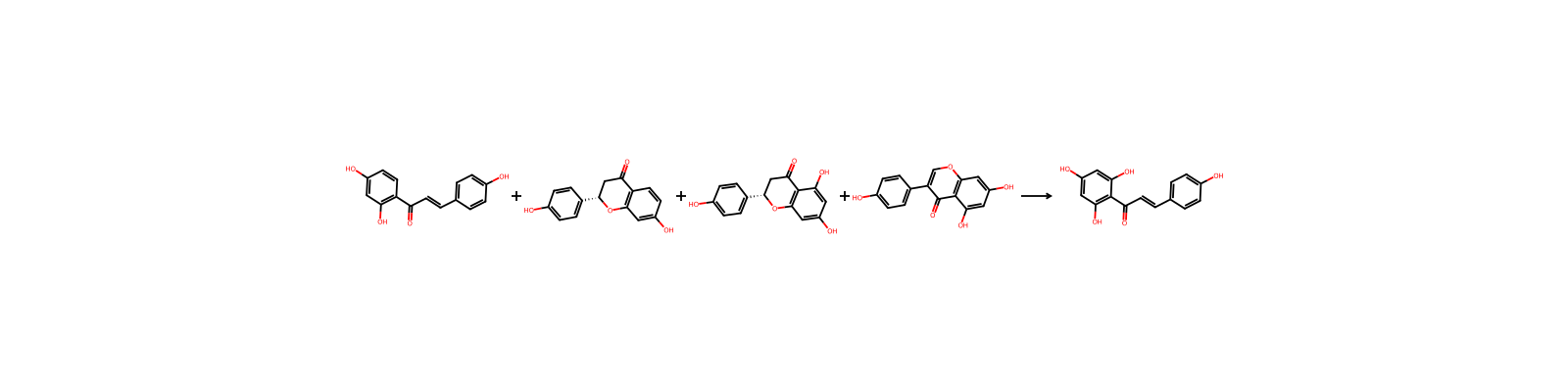
Isoliquiritigenin is a member of the class of chalcones that is trans-chalcone hydroxylated at C-2', -4 and -4'. It has a role as a geroprotector, a metabolite, a biological pigment, an antineoplastic agent, a GABA modulator, an EC 1.14.18.1 (tyrosinase) inhibitor and a NMDA receptor antagonist. It is a member of chalcones and a member of (E)-2'-hydroxy-chalcones. It is functionally related to a trans-chalcone. It is a conjugate acid of an isoliquiritigenin(1-).
Names & identifiers
- Preferred name
- Isoliquiritigenin
- IUPAC
- (E)-1-(2,4-dihydroxyphenyl)-3-(4-hydroxyphenyl)prop-2-en-1-one
- English name
- Isoliquiritigenin
- Molecular formula
- C15H12O4
- Molecular weight
- 256.25
Names & synonyms
isoliquiritigenin961-29-5(E)-1-(2,4-dihydroxyphenyl)-3-(4-hydroxyphenyl)prop-2-en-1-onetrihydroxychalcone6'-deoxychalcone2',4',4-TrihydroxychalconeChalcone, 2',4,4'-trihydroxy-GU 17B9CTI9GB8FGU-17trans-2',4,4'-trihydroxychalcone2-Propen-1-one, 1-(2,4-dihydroxyphenyl)-3-(4-hydroxyphenyl)-, (E)-
Show more names
ISLISOLIQUIRTIGENIN4,2',4'-TRIHYDROXYCHALCONE(2E)-1-(2,4-dihydroxyphenyl)-3-(4-hydroxyphenyl)-2-propen-1-onegu17IsoliquiritigenIsqliquiritigeninISOLIQUIRITIGENIN(P)Isoliquiritigenin>
DTXSID2022466(E)-1-(2,4-Dihydroxy-phenyl)-3-(4-hydroxy-phenyl)-propenoneCHEBI:310312(E)-1-(2,4-dihydroxyphenyl)-3-(4-hydroxyphenyl)-2-propene-1-oneRefChem:51351DTXCID202466677-489-82',4,4'-Trihydroxychalcone
Database identifiers
- CAS
13745-20-5、961-29-5- PubChem CID
- 638278
- DTXSID
DTXSID2022466- ChEMBL
CHEMBL129795- ChEBI
CHEBI:310312- UNII
- B9CTI9GB8F
- EC Number
- 237-316-5、677-489-8
- Nikkaji
- J120.923J、J74.686J
Properties
Computed structural properties
- XLogP
- 3.2
- Topological polar surface area
- 77.8 Ų
- Hydrogen bond donors
- 3
- Hydrogen bond acceptors
- 4
- Rotatable bonds
- 3
- Heavy atoms
- 19
- Formal charge
- 0
- Complexity
- 331
Experimental & physicochemical properties
DrugsPharmaceuticals -> Listed in ZINC15
LipidsPolyketides [PK] -> Flavonoids [PK12] -> Chalcones and dihydrochalcones [PK1212]
LogP1.91
Endocrine DisruptorsPotential endocrine disrupting compound
Melting Point200 - 204 °C
Physical DescriptionSolid
Collision Cross Section
158.3 Ų [M+H]+ [CCS Type: TW; Method: calibrated with polyalanine and drug standards]
147.53 Ų [M+H-H2O]+ [CCS Type: TW; Method: calibrated with polyalanine and drug standards]
165.05 Ų [M+H]+ [CCS Type: DT; Method: stepped-field]
186.2 Ų [M+Na]+
Physicochemical properties
- Melting point
- 206 · 206-210°C
- Boiling point
- 504 · 504.0±42.0 °C(Predicted)
- Density
- 1.384 · 1.384±0.06 g/cm3(Predicted)
- storage temp.
- 2 · 2-8°C
- solubility
- 2 O: · H2O: <0.1 mg/mL
- form
- powder
- pka
- 7.5 · 7.50±0.35(Predicted)
- color
- yellow to orange
- Water Solubility
- 2 O: · H2O: methanol: 10mg/mLDMSO: 20mg/mL
- Sensitive
- Light Sensitive & Hygroscopic
- BRN
- 1914296 · 1914296
- Cosmetics Ingredients Functions
- SKIN CONDITIONING - EMOLLIENT
- InChI
- InChI=1S/C15H12O4/c16-11-4-1-10(2-5-11)3-8-14(18)13-7-6-12(17)9-15(13)19/h1-9,16-17,19H/b8-3+
- InChIKey
- DXDRHHKMWQZJHT-FPYGCLRLSA-N
- SMILES
- C(C1=CC=C(O)C=C1O)(=O)/C=C/C1=CC=C(O)C=C1
- LogP
- 3.11 · 3.110 (est)
- CAS DataBase Reference
- 961 · 961-29-5(CAS DataBase Reference)
- FDA UNII
- 9 CTI9GB8F · B9CTI9GB8F
- UNSPSC Code
- 85151701 · 85151701
- NACRES
- 77 · NA.77
- Symbol(GHS)
- 7 · GHS07
- Signal word
- Warning
- Hazard statements
- 315 · H315-H319-H335
- Precautionary statements
- 261 · P261-P280a-P304+P340-P305+P351+P338-P405-P501a
- Risk Statements
- 36 · 36/37/38
- Safety Statements
- 26 · 26-37
- WGK Germany
- 3 · 3
- RTECS
- 7080000 · FL7080000
- HS Code
- 29145090 · 29145090
- Storage Class
- 11 · 11 - Combustible Solids
Safety & regulation
GHS classification
GHS Classification
Warning
H315 (100%): Causes skin irritation [Warning Skin corrosion/irritation]
P261, P264, P264+P265, P271, P280, P302+P352, P304+P340, P305+P351+P338, P319, P321, P332+P317, P337+P317, P362+P364, P403+P233, P405, and P501 (click each P-code to see the statement)
Aggregated GHS information provided per 5 reports by companies from 2 notifications to the ECHA C&L Inventory. Each notification may be associated with multiple companies.
Hazard information
Hazard Classes and CategoriesSkin Irrit. 2 (100%)
Safety data
- wgk
- 3
- rtecs
- FL7080000
- hs_code
- 29145090
- risk_code
- 36/37/38
- Signal word
- Warning
- Symbol(GHS)
- GHS07
- safety_code
- 26-37
- Storage Class
- 11 - Combustible Solids
- Hazard statements
- H315-H319-H335
- Precautionary statements
- P261-P280a-P304+P340-P305+P351+P338-P405-P501a
Chemistry & industry
Pharmacology
MeSH Pharmacological ClassificationCompounds or agents that combine with an enzyme in such a manner as to prevent the normal substrate-enzyme combination and the catalytic reaction.
Cellular LocationsMembrane
Applications
Usesaldose reductase inhibitor, antineoplastic, antiinflammatory
UsesIsoliquiritigenin (ISL) is a flavonoid found in licorice root and several other plants that displays antioxidant, anti-inflammatory, and antitumor activities as well as hepatoprotection against steatosis-induced oxidative stress. ISL induces quinone reductase-1, a phase II enzyme that deactivates radicals and electrophiles, with a concentration required to double activity (CD) value of 1.8 μM in murine hepatoma cells.
General DescriptionIsoliquiritigenin is an aromatic ketone and belongs to the chalcone group of compound. It is derived from licorice and is a component in medicine and food.
Suppliers50 total
国药集团化学试剂有限公司86-21-63210123 · [email protected]
北京华美互利生物化工010-56205725 · [email protected]
梯希爱(上海)化成工业发展有限公司021-67121386 · [email protected]
上海阿拉丁生化科技股份有限公司400-6206333 13167063860 · [email protected]
西安久启生物科技有限公司18729366352 13186100227
INTATRADE GmbH+49 3493/605464 · [email protected]
上海如吉生物科技发展有限公司+86-21-65211385-8001 36031160 · [email protected]
科瑞迪化学400-821-5857 021-64326257 · [email protected]
Syntechem Co.,Ltd[email protected]
上海迈瑞尔生化科技有限公司4006356688 18621169109 · [email protected]
阿法埃莎(中国)化学有限公司400-6106006 · [email protected]
安耐吉化学&3A(安徽泽升科技股份有限公司)400-0056266 · [email protected]
上海瀚鸿科技股份有限公司021-54306202 13764082696 · [email protected]
上海柯维化学技术有限公司021-64609169 18901607656 · [email protected]
上海诗丹德标准技术服务有限公司021-021-57127007-6622-6622 17621252073 · [email protected]
天津万象恒远科技有限公司15722085254 · [email protected]
成都普思生物科技股份有限公司028-85370565-229 18080489829 · [email protected]
成都普菲德生物技术有限公司028-82610909 13388174823 · [email protected]
上海融禾医药科技发展有限公司17301719108 13341702378 · [email protected]
Pure Chemistry Scientific Inc.001-857-928-2050 or 1-888-588-9418 · [email protected]
深圳虹彩祥根生物科技有限公司+86-0755-89668383 · [email protected]
MedChemexpress LLC021-58955995 · [email protected]
上海瀚香生物科技有限公司177-54423994 17754423994 · [email protected]
南京春秋生物工程有限公司17388075642 13815430202 · [email protected]
武汉丰泰威远科技有限公司027-87465837 19945049750 · [email protected]
云南西力生物技术股份有限公司0871-65217109 · [email protected]
山东西亚化学有限公司13355009207 13355009207 · [email protected]
四川库利南科技有限公司400-1166-196 18981987031 · [email protected]
成都健腾生物技术有限公司86-28-85159085 · [email protected]
上海源叶生物科技有限公司13636370518 · [email protected]
艾科试剂4008-755-333 18080918076 · [email protected]
成都锦然生物科技有限公司028-83311324 1278112614 · [email protected]
上海思域化工科技有限公司86-21-34053660 · [email protected]
AdooQ BioScience, LLC+1 (866) 930-6790 · [email protected]
TCI AMERICA800-4238616 · [email protected]
TOKYO CHEMICAL INDUSTRY CO., LTD.03-36680489 · [email protected]
TCI Europe320-37350700 · [email protected]
上海贤鼎生物科技有限公司4009209199 · [email protected]
上海陶素生化科技有限公司021-33632979 · [email protected]
成都瑞芬思德丹生物科技有限公司2355253622; 18981954830 · [email protected]
上海倍卓生物科技有限公司021-61119791,13386096464 · [email protected]
北京通达维诺科技有限公司010-56371379
上海将来实业股份有限公司400-0066400 13621662912 · [email protected]
上海将来实业股份有限公司021-61552785 · [email protected]
HBCChem, Inc.+1-510-219-6317 · [email protected]
上海笛柏生物科技有限公司400-008-9730,021-54359730 400-008-9730 · [email protected]
四川省维克奇生物科技有限公司028-81700200 18116577057 · [email protected]
雷丁试剂0510-85629785 18013409632 · [email protected]
上海卓因生物科技有限公司021-61317773 · [email protected]
上海麦克林生化科技股份有限公司15221275939 15221275939 · [email protected]
Additional notes
DefinitionChEBI: Isoliquiritigenin is a member of the class of chalcones that is trans-chalcone hydroxylated at C-2', -4 and -4'. It has a role as an EC 1.14.18.1 (tyrosinase) inhibitor, a biological pigment, a NMDA receptor antagonist, a GABA modulator, a metabolite, an antineoplastic agent and a geroprotector. It is functionally related to a trans-chalcone. It is a conjugate acid of an isoliquiritigenin(1-).
Related reactions
1 records
Linked notes
Loading…