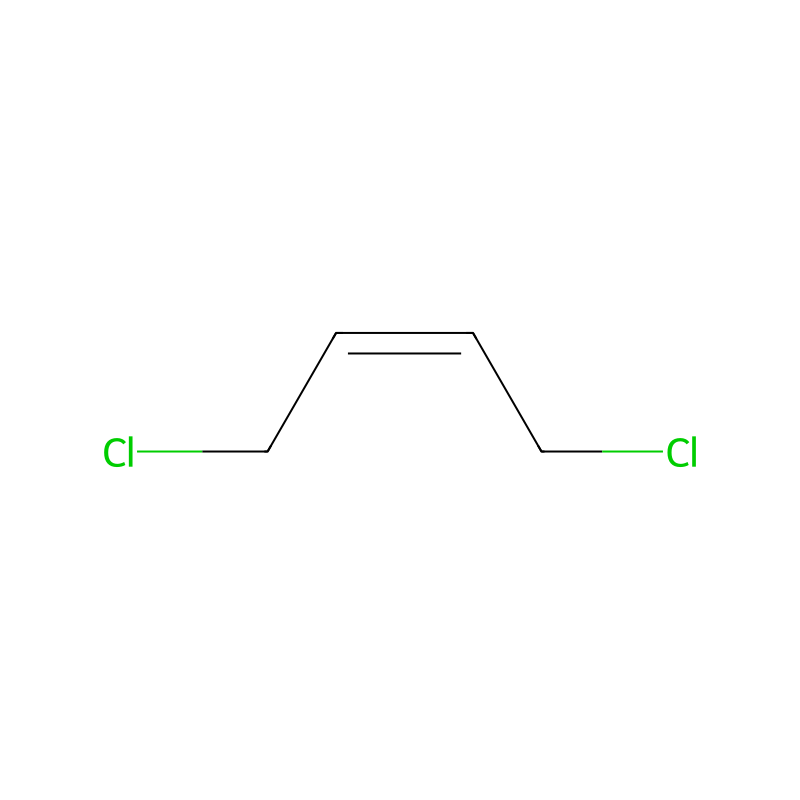
| GHS classification | DangerH226 (98%): Flammable liquid and vapor [Warning Flammable liquids]P203, P210, P233, P240, P241, P242, P243, P260, P262, P264, P270, P271, P273, P280, P284, P301+P316, P301+P330+P331, P302+P352, P302+P361+P354, P303+P361+P353, P304+P340, P305+P354+P338, P316, P318, P320, P321, P330, P361+P364, P363, P370+P378, P391, P403+P233, P403+P235, P405, and P501 (click each P-code to see the statement)Aggregated GHS information provided per 51 reports by companies from 8 notifications to the ECHA C&L Inventory. Each notification may be associated with multiple companies. |
|---|
| Regulatory information | Chemical: 2-Butene, 1,4-dichloro-, (Z)-2-Butene, 1,4-dichloro-, (2Z)-: Does not have an individual approval but may be used as a component in a product covered by a group standard. It is not approved for use as a chemical in its own right. |
|---|
| Fire potential | Flammable /Dichlorobutene/ |
|---|
| Hazards summary | A skin, eye, and respiratory tract irritantA lachrymatorMay cause kidney, liver, and heart injury[HSDB] Very toxic by inhalation and toxic by skin contact and ingestionCauses burnsInhalation may produce pneumonitis and pulmonary edema[MSDSonline] See 1,4-Dichloro-2-butene. |
|---|
| Special Reports | A REVIEW WITH 17 REFERENCES ON ACUTE TOXICITY OF CHLOROPRENE, 1,3-DICHLORO-2-BUTENE, & 1,4-DICHLORO-2-BUTENE. DATA INCL MUTAGENIC, SKIN, EYE & INHALATION TESTING, LETHAL, & TERATOGENIC DOSE VALUES.[CLARY JJENVIRON HEALTH PERSPECT 21: 269-74 (1977)] |
|---|
| Flammable Limits | 1.5-4% /Dichlorobutene/ |
|---|
| Hazard Classes and Categories | Flam. Liq. 3 (98%) |
|---|
| Explosive Limits and Potential | Vapor may explode if ignited in an enclosed area. /Dichlorobutene/ |
|---|
| Skin, Eye, and Respiratory Irritations | ... BOTH LIQUID AND VAPOR ARE HIGHLY DANGEROUS TO THE SKIN, EYES, LUNG, & INTERNAL ORGANS. /DICHLOROBUTENES/LacrimatorInhalation of vapor irritates nose and throat. Contact with eyes causes intense irritation. /Dichlorobutene/ |
|---|
| Critical Temperature and Pressure | Critical temp = 640 deg KCritical pressure = 3.78X10+6 Pa |
|---|
| Firefighting Hazards | Flashback along vapor trail may occur. /Dichlorobutene/ |
|---|
| Fire fighting procedures | If material on fire or involved in fire: Use water in flooding quantities as fog. Cool all affected containers with flooding quantities of water. Apply water from as far a distance as possible. Solid streams of water may be ineffective. Use foam, dry chemical, or carbon dioxide. Use water spray to knock-down vapors. /Dichlorobutene/ |
|---|
| Storage conditions | Storage temperature: Ambient with open venting and equipped with a flame arrester. /Dichlorobutene/ |
|---|
| Disposal methods | SRP: At the time of review, criteria for land treatment or burial (sanitary landfill) disposal practices are subject to significant revision. Prior to implementing land disposal of waste residue (including waste sludge), consult with environmental regulatory agencies for guidance on acceptable disposal practices./1,4-Dichloro-2-butene/ may be disposed of by the use of the following incineration methods: Rotary kiln with a temperature of 820-1600 °C and a residence time of seconds for liquids and gases, and hours for solids. Liquid injection with a temperature of 650-1600 °C with a residence time of 0.1-2 seconds. Fluidized bed with a temperature of 450-980 °C with a residence time of seconds for liquids and gases, longer for solids. /1,4-Dichloro-2-butene/ |
|---|
| Preventive Measures | If material not on fire and not involved in fire: Keep sparks, flames, and other sources of ignition away. Keep material out of water sources and sewers. Build dikes to contain flow as necessary. Use water spray to knock-down vapors. /Dichlorobutene/Personnel protection: Avoid breathing vapors. Keep upwind. Avoid bodily contact with the material. ... Do not handle broken packages unless wearing appropriate personal protective equipment. Wash away any material which may have contacted the body with copious amounts of water or soap and water. Wear positive pressure self-contained breathing apparatus when fighting fires involving this material. If contact with the material anticipated, wear appropriate chemical protective clothing. /Dichlorobutene/SRP: The scientific literature for the use of contact lenses in industry is conflicting. The benefit or detrimental effects of wearing contact lenses depend not only upon the substance, but also on factors including the form of the substance, characteristics and duration of the exposure, the uses of other eye protection equipment, and the hygiene of the lenses. However, there may be individual substances whose irritating or corrosive properties are such that the wearing of contact lenses would be harmful to the eye. In those specific cases, contact lenses should not be worn. In any event, the usual eye protection equipment should be worn even when contact lenses are in place.SRP: Contaminated protective clothing should be segregated in such a manner so that there is no direct personal contact by personnel who handle, dispose, or clean the clothing. Quality assurance to ascertain the completeness of the cleaning procedures should be implemented before the decontaminated protective clothing is returned for reuse by the workers. Contaminated clothing should not be taken home at end of shift, but should remain at employee's place of work for cleaning. |
|---|
| Threshold Limit Values (TLV) | 8 hr Time Weighted Avg (TWA): 0.005 ppm, skin. /1,4-Dichloro-2-butene/Excursion Limit Recommendation: Excursions in worker exposure levels may exceed 3 times the TLV-TWA for no more than a total of 30 minutes during a work day, and under no circumstances should they exceed 5 times the TLV-TWA, provided that the TLV-TWA is not exceeded. /1,4-Dichloro-2-butene/A2Suspected human carcinogen. /1,4-Dichloro-2-butene/ |
|---|
| Personal Protective Equipment (PPE) | Rubber gloveschemical splash gogglesrubber boots & apronbarrier creamorganic canister mask. /Dichlorobutene/Chemical protective clothing composed of polyvinyl alcohol (PVA), Viton (a proprietary fluoroelastomer), or Saranex (a multilayer laminate greater than 0.15 cm in thickness of polyethylene and Saran) is highly recommended, having break through times greater than one hour. Butyl rubber or polyethylene may be used but data suggest break through times of approximately an hour or more. Protective clothing composed of natural rubber, nitrile, chlorinated polyethylene, or polyvinyl chloride (material less than 0.015 cm thick) is not recommended since break through times were found to be significantly less than one hour. /1,4-Dichloro-2-butene/Personnel protection: ... Wear appropriate chemical protective gloves, boots and goggles. /Dichlorobutene/ |
|---|
| Environmental fate | Aquatic Fate: Z-1,4-Dichloro-2-butene /hydrolysis/ yields 4-chloro-3-hydroxy-1-butene, E-1-chloro-4-hydroxy-1-butene, E-1-chloro-4-hydroxy-1-butene, and Z-1-chloro-4-hydroxy-1-butene.TERRESTRIAL FATE: Based on a classification scheme(1), a Koc value of 215(2) indicates that 1,4-dichloro-cis-2-butene is expected to have moderate mobility in soil(SRC). Volatilization of 1,4-dichloro-cis-2-butene from moist soil surfaces is expected to be an important fate process(SRC) given a an estimated Henry's Law constant of 1.2X10⁻³ atm-cu m/mole(SRC), based upon its vapor pressure, 4.09 mm Hg(3), and water solubility, 580 mg/l(4). The potential for volatilization of 1,4-dichloro-cis-2-butene from dry soil surfaces may exist(SRC) based upon its vapor pressure(3). In a soil degradation study, approximately 5-15% of initially added 1,4-dichloro-cis-2-butene was recovered in gas-traps after a 7-day period indicating soil volatilization had occurred(2). Soil degradation studies conducted over a one week incubation period in a sandy loam and silt loam soils found degradation half-lives of 1.8 to 2.5 days in both sterile and non-sterile soils(2)degradation rates in non-sterile soils were not significantly faster than in sterile soils indicating that abiotic or evaporative processes were more important than biological processes for 1,4-dichloro-cis-2-butene(2,5). The hydrolysis half-life of 1,4-dichloro-cis-2-butene was measured as 3.2 days under neutral conditions(6), suggesting hydrolysis may be an important fate process in moist soils.AQUATIC FATE: Based on a classification scheme(1), a Koc value of 215(SRC), indicates that 1,4-dichloro-cis-2-butene is not expected to adsorb to suspended solids and sediment(SRC). Volatilization from water surfaces is expected(3) based upon an estimated Henry's Law constant of 1.2X10⁻³ atm-cu m/mole(SRC), based upon its vapor pressure, 4.09 mm Hg(4), and water solubility, 580 mg/l(5). Using this Henry's Law constant and an estimation method(3), volatilization half-lives for a model river and model lake are 2 hours and 5 days, respectively(SRC). According to a classification scheme(6), an estimated BCF of 17(SRC), from its water solubility(5) and a regression-derived equation(3), suggests the potential for bioconcentration in aquatic organisms is low. The hydrolysis half-life of 1,4-dichloro-cis-2-butene was measured as 3.2 days under neutral conditions(7). Limited soil data suggest that biodegradation will not be an important fate process in water since volatilization and hydrolysis are expected to occur rapidly(2,8).ATMOSPHERIC FATE: According to a model of gas/particle partitioning of semivolatile organic compounds in the atmosphere(1), 1,4-dichloro-cis-2-butene, which has a vapor pressure of 4.09 mm Hg at 25 °C(1) is expected to exist solely as a vapor in the ambient atmosphere. Vapor-phase 1,4-dichloro-cis-2-butene is degraded in the atmosphere by reaction with photochemically-produced hydroxyl radicals and ozone molecules(SRC). The half-life for the reaction in air with hydroxyl radicals is estimated to be 12 hours(SRC), calculated from its rate constants of 3.3X10⁻¹¹ cu cm/molecule-sec at 25 °C(SRC) using a structure estimation method(3). The half-life for the reaction in air with ozone is estimated to be 16 days(SRC), calculated from its rate constants of 7.1X10⁻¹⁹ cu cm/molecule-sec at 25 °C(SRC) using a structure estimation method(3). |
|---|
| Adverse effects | Occupational hepatotoxin - Secondary hepatotoxins: the potential for toxic effect in the occupational setting is based on cases of poisoning by human ingestion or animal experimentation. |
|---|
| Soil Adsorption/Mobility | Using sandy loam and silt loam soils, the Koc of 1,4-dichloro-cis-2-butene was experimentally determined to be 215(1). According to a classification scheme(2), this Koc value suggests that 1,4-dichloro-cis-2-butene will have moderate mobility in soil(SRC). |
|---|
| Human Toxicity Excerpts | Inhalation of vapor irritates nose and throat. Contact with eyes causes intense irritation and tears. Contact of liquid with skin causes severe blistering and dermatitis. Ingestion causes severe irritation of the mouth and stomach. /Dichlorobutene/... BOTH LIQUID AND VAPOR ARE HIGHLY DANGEROUS TO THE SKIN, EYES, LUNG, & INTERNAL ORGANS. /DICHLOROBUTENES/Symptomatology: 1A) Inhalation, high vapor concn: gasping, refusal to breathe, coughing, substernal pain, & extreme respiratory distress at vapor concn over 1500 ppm. Irritation of eyes & upper respiratory mucosa appears promptly after exposure to concentrated vapors. Lacrimation & headache are prominent. Coma may occur rapidly. B) Inhalation, low vapor concn: central nervous depression & moderate irritation of respiratory system. Headache is frequent. 2) Dermal: severe skin irritation with marked inflammatory response of epidermis & underlying tissues. 3) Oral: acute gastrointestinal distress with pulmonary congestion & edema. Central nervous depression, perhaps even in the absence of impaired oxygen uptake. 4) By any route, possible late injuries to liver, kidneys & heart. 5) After inhalation exposures, malaise, headache, chest & abdominal discomfort & irritability have been reported to persist for several weeks & perhaps for several years. |
|---|
| Artificial Pollution Sources | 1,4-Dichloro-cis-2-butene's production and use as a starting material in the manufacture of adiponitrile, butane-1,4-diol and tetrahydrofuran(1) may result in its release to the environment through various waste streams(SRC). It also occurs as an intermediate in the production of chloroprene(1). |
|---|
| Environmental Biodegradation | Soil degradation studies conducted with 1,4-dichloro-cis-2-butene over a one week incubation period in a sandy loam and silt loam soils found degradation half-lives of 1.8 to 2.5 days in both sterile and non-sterile soils(1)degradation rates in non-sterile soils were not significantly faster than in sterile soils indicating that abiotic or evaporative processes were more important than biological processes for 1,4-dichloro-cis-2-butene(1,2). |
|---|
| Environmental Bioconcentration | An estimated BCF of 17 was calculated for 1,4-dichloro-cis-2-butene(SRC), using a water solubility of 580 mg/l(1) and a regression-derived equation(2). According to a classification scheme(3), this BCF suggests the potential for bioconcentration in aquatic organisms is low(SRC). |
|---|
| Volatilization from Water/Soil | The Henry's Law constant for 1,4-dichloro-cis-2-butene is estimated as 1.2X10⁻³ atm-cu m/mole(SRC) based upon its vapor pressure, 4.09 mm Hg(1), and water solubility, 580 mg/l(2). This Henry's Law constant indicates that 1,4-dichloro-cis-2-butene is expected to volatilize from water surfaces(3). Based on this Henry's Law constant, the volatilization half-life from a model river (1 m deep, flowing 1 m/sec, wind velocity of 3 m/sec)(3) is estimated as 2 hours(SRC). The volatilization half-life from a model lake (1 m deep, flowing 0.05 m/sec, wind velocity of 0.5 m/sec)(3) is estimated as 5 days(SRC). 1,4-Dichloro-cis-2-butene's estimated Henry's Law constant(1) indicates that volatilization from moist soil surfaces may occur(SRC). The potential for volatilization of 1,4-dichloro-cis-2-butene from dry soil surfaces may exist(SRC) based upon the vapor pressure of this compound(1). In a soil degradation study, approximately 5-15% of initially added 1,4-dichloro-cis-2-butene was recovered in gas-traps after a 7-day period suggesting volatilization will be important(4). |
|---|
| Evidence for Carcinogenicity | A2Suspected human carcinogen. /1,4-Dichloro-2-butene/ |
|---|
| Environmental Abiotic Degradation | The rate constant for the vapor-phase reaction of 1,4-dichloro-cis-2-butene with photochemically-produced hydroxyl radicals has been estimated as 3.3X10⁻¹¹ cu cm/molecule-sec at 25 °C(SRC) using a structure estimation method(1). This corresponds to an atmospheric half-life of about 12 hours at an atmospheric concentration of 5X10+5 hydroxyl radicals per cu cm(1). The rate constant for the vapor-phase reaction of 1,4-dichloro-cis-2-butene with ozone has been estimated as 7.1X10⁻¹⁹ cu cm/molecule-sec at 25 °C(SRC) using a structure estimation method(1). This corresponds to an atmospheric half-life of about 16 days at an atmospheric concentration of 7X10+11 ozone molecules per cu cm(2). The neutral hydrolysis rate constant of 1,4-dichloro-cis-2-butene has been experimentally determined to be 0.0090/hr at 25 °C which corresponds to a half-life of 3.2 days(3). |
|---|
| Probable Routes of Human Exposure | Occupational exposure to 1,4-dichloro-cis-2-butene may occur through inhalation and dermal contact with this compound at workplaces where 1,4-dichloro-cis-2-butene is produced or used. (SRC) |
|---|
| Environmental Fate/Exposure Summary | 1,4-Dichloro-cis-2-butene's production and use as a starting material in the manufacture of adiponitrile, butane-1,4-diol and tetrahydrofuran may result in its release to the environment through various waste streams. It also occurs as an intermediate in the production of chloroprene. If released to air, a vapor pressure of 4.09 mm Hg at 25 °C indicates 1,4-dichloro-cis-2-butene will exist solely as a vapor in the ambient atmosphere. Vapor-phase 1,4-dichloro-cis-2-butene will be degraded in the atmosphere by reaction with photochemically-produced hydroxyl radicals and ozone molecules. The half-life for the reaction in air with hydroxyl radicals is estimated to be 12 hours and the reaction with ozone molecules is about 16 days. If released to soil, 1,4-dichloro-cis-2-butene is expected to have moderate mobility based upon a Koc of 215. Volatilization from moist soil surfaces is expected to be an important fate process based upon an estimated Henry's Law constant of 1.2X10⁻³ atm-cu m/mole. 1,4-Dichloro-cis-2-butene may volatilize from dry soil surfaces based upon its vapor pressure. The hydrolysis half-life of 1,4-dichloro-cis-2-butene was measured as 3.2 days under neutral conditions, suggesting hydrolysis may be an important fate process in moist soils and water. Limited soil data suggest that biodegradation may occur, but will not be an important fate process since volatilization and hydrolysis are expected to occur rapidly. If released into water, 1,4-dichloro-cis-2-butene is not expected to adsorb to suspended solids and sediment based upon the Koc. Volatilization from water surfaces is expected to be an important fate process based upon this compound's estimated Henry's Law constant. Estimated volatilization half-lives for a model river and model lake are 2 hours and 5 days, respectively. An estimated BCF of 17 suggests the potential for bioconcentration in aquatic organisms is low. Occupational exposure to 1,4-dichloro-cis-2-butene may occur through inhalation and dermal contact with this compound at workplaces where 1,4-dichloro-cis-2-butene is produced or used. (SRC) |
|---|