Carumonam
AMA 1080 · CARUMONAM · Ro 17-2301 · CarlliIIonaln · CARUMONAM USP/EP/BP · Ro-17-2301:A-masulin · Antibiotic Ro 17-2301 · (2S)-2α-(Carbamoyloxymethyl)-3α-[[(Z)-(2-amino-4-thiazolyl)[(carboxymethoxy)imino]acetyl]amino]-4-oxoazetidine-1-sulfonic acid
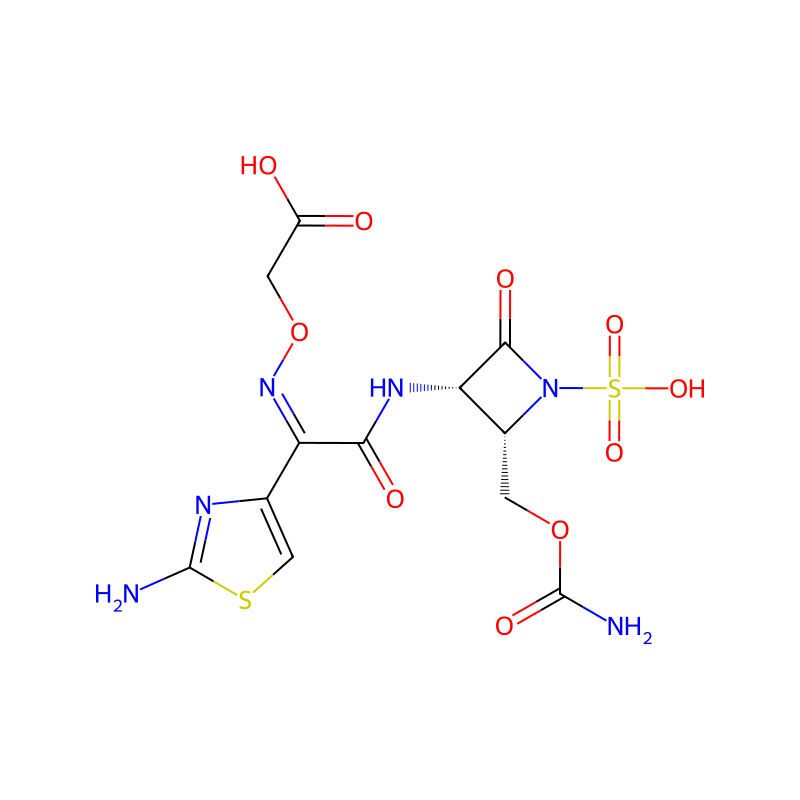
Identifiers & Physical Properties
| CAS No. | 87638-04-8 |
|---|---|
| Molecular formula | C12H14N6O10S2 |
| Average molar mass | 466.4 g/mol |
| Monoisotopic mass | 466.02128265 g/mol |
| SMILES | NC(=O)OC[C@@H]1[C@H](NC(=O)/C(=N\OCC(=O)O)c2csc(N)n2)C(=O)N1S(=O)(=O)O |
| InChIKey | UIMOJFJSJSIGLV-JNHMLNOCSA-N |
| PubChem CID | 6540466 |
| ChEMBL | CHEMBL1614658 |
| ChEBI | CHEBI:55486 |
| DTXSID | DTXSID3048312 |
Chemical & Physical Properties
| XLogP | -1.4 |
|---|---|
| Topological polar surface area | 291 |
| Hydrogen bond donors | 5 |
| Hydrogen bond acceptors | 14 |
| Rotatable bonds | 10 |
| Heavy atoms | 30 |
| Formal charge | 0 |
| Complexity | 858 |
| Drugs | Pharmaceuticals -> Antibiotics |
| alpha | D26 -45° (c = 1 in DMSO) |
| Density | 2.13±0.1 g/cm3(Predicted) |
| pKa (acidity coefficient) | -0.43±0.60(Predicted) |
| FDA UNII | 486890PI06 |
| ATC code | J01DF02 |
Applications & Uses
Description
Canunonam is an injectable antibiotic, the second monobactam ever developed (the first being Squibb’s aztreonam). It is highly active against Gram negative bacteria, particularly pseudomom, and is reportedly effective in the treatment of pneumonia, cystitis, peritonitis and secondary infections.
Uses
CARUMONAM is monocyclic β-lactam antibiotics. Their antibacterial spectrum is similar to amantadine, exhibiting high antibacterial activity against Gram-negative bacteria. While their activity against Pseudomonas aeruginosa is slightly weaker than amantadine and ceftazidime, it is better than other antibiotics. They are highly effective against Klebsiella pneumoniae and are also effective against bacteria resistant to gentamicin and third- and fourth-generation cephalosporins. They are very stable against various bacterial inulinases and chromosomal or plasmid-mediated β-lactamases. They are used for sepsis, chronic respiratory infections, cholangitis, peritonitis, chronic bronchitis, and cystitis caused by susceptible bacteria.