Methyl chloroformate
Methyl carbonochloridate · MCF · Methyl Chloroforate · METHYL CHLOROCARBONATE · METHOXYCARBONYL CHLORIDE · tl438 · TL 438 · Carbono
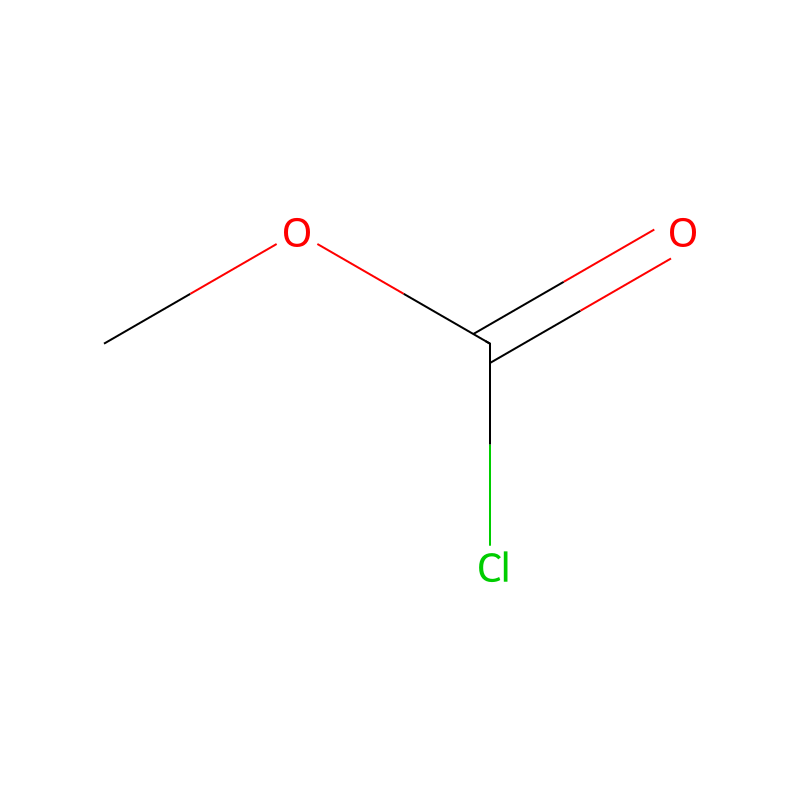
Identifiers & Physical Properties
| CAS No. | 79-22-1 |
|---|---|
| Molecular formula | C2H3ClO2 |
| Average molar mass | 94.5 g/mol |
| Monoisotopic mass | 93.98215702 g/mol |
| SMILES | COC(=O)Cl |
| InChIKey | XMJHPCRAQCTCFT-UHFFFAOYSA-N |
| PubChem CID | 6586 |
| ChEMBL | CHEMBL3182300 |
| EC No. | 201-187-3 |
| DTXSID | DTXSID0024185 |
Chemical & Physical Properties
| XLogP | 1.2 |
|---|---|
| Topological polar surface area | 26.3 |
| Hydrogen bond donors | 0 |
| Hydrogen bond acceptors | 2 |
| Rotatable bonds | 1 |
| Heavy atoms | 5 |
| Formal charge | 0 |
| Complexity | 42.9 |
| Chemical classes | Toxic Gases & Vapors -> Acid HalidesCorrosives |
| SpringerMaterials Properties | Coriolis coupling |
| Pesticides | Pesticide -> EPA IRIS |
| Odor | Unpleasant, acridAcrid. |
| Density | 1.223 at 68 °F (EPA, 1998) - Denser than waterwill sink1.223 @ 20 °C/4 °CRelative density (water = 1): 1.221.22 @ 20°C1.223 g/mL at 25 °C(lit.) |
| Color/Form | CLEAR LIQUID |
| Solubility | SOL IN CHLOROFORM, BENZENE, IN ALL PROPORTIONS IN ALCOHOL, ETHERSolubility in water: poorChloroform, Ethyl Acetatehydrolysis |
| Corrosivity | Corrodes rubber |
| Flash point | 54 °F (EPA, 1998)12 °C24.4 °C (Tag open cup), 17.8 °C (Tag closed cup)76 °F (open cup)73 °F (closed cup)64 °F |
| Boiling point | 160 °F at 760 mmHg (EPA, 1998)71.0 °C71 °C70.5 °C @760 [mm Hg]70-72 °C(lit.) |
| Decomposition | WHEN HEATED TO DECOMPOSITION, EMITS HIGHLY TOXIC FUMES OF METHYL CHLOROFORMATE AND PHOSGENE. |
| Melting point | less than -114 °F (USCG, 1999)Less than -114 °F= less than -81 °C= less than 192 deg K-61 °C-61°C |
| Vapor density | 3.26 (vs air) |
| Vapor pressure | 4.8 psi ( 20 °C) |
| Refractive index | n20/D 1.387(lit.) |
| Storage conditions | Store at 0-5°C |
| Physical state | Liquid |
| Color | Clear colorless to light yellow |
| Merck | 13,6071 |
| Dielectric constant | 12.9 |
| Stability | Moisture Sensitive |
| CAS DataBase Reference | 79-22-1(CAS DataBase Reference) |
| EWG's Food Scores | 1 |
| FDA UNII | RC6VA8OB2N |
| NIST Chemistry Reference | Carbonochloridic acid, methyl ester(79-22-1) |
| EPA Substance Registry System | Methyl chlorocarbonate (79-22-1) |
| GHS pictogram | GHS02,GHS05,GHS06 |
| Signal word | Danger |
| GHS hazard statements | H225-H302-H312-H314-H330 |
| GHS precautionary statements | P210-P280-P305+P351+P338-P310 |
| Hazard symbols | F,T+ |
| Risk statements (R) | 11-21/22-26-34 |
| Safety statements (S) | 14-26-28-36/37/39-45-63-46-28A-39-36/37 |
| UN transport number | UN 1238 |
| Water hazard class (WGK) | 2 |
| RTECS number | FG3675000 |
| F | 10-19-21 |
| Autoignition temperature | 485 °C |
| TSCA inventory status | TSCA listed |
| Hazard class | 6.1 |
| Packing group | I |
| Customs code | 29151300 |
| Hazardous substances data | 79-22-1(Hazardous Substances Data) |
| REACH registrations | Active |
Safety & Regulations
| GHS classification | DangerH225: Highly Flammable liquid and vapor [Danger Flammable liquids]P210, P233, P240, P241, P242, P243, P260, P264, P270, P271, P280, P284, P301+P317, P301+P330+P331, P302+P352, P302+P361+P354, P303+P361+P353, P304+P340, P305+P354+P338, P316, P317, P320, P321, P330, P362+P364, P363, P370+P378, P403+P233, P403+P235, P405, and P501 (click each P-code to see the statement)H225 (100%): Highly Flammable liquid and vapor [Danger Flammable liquids]P210, P233, P240, P241, P242, P243, P260, P264, P264+P265, P270, P271, P280, P284, P301+P316, P301+P317, P301+P330+P331, P302+P352, P302+P361+P354, P303+P361+P353, P304+P340, P305+P354+P338, P316, P317, P320, P321, P330, P362+P364, P363, P370+P378, P403+P233, P403+P235, P405, and P501 (click each P-code to see the statement) |
|---|---|
| Hazards Identification | Toxic/poison by inhalation (TIH/PIH) |
| Regulatory information | Chemical: Carbonochloridic acid, methyl esterCarbonochloridic acid, methyl ester is listed on the EPA's Chemical Data Reporting (CDR) system. Manufacturers and importers of Carbonochloridic acid, methyl ester are required to report information about their production and use of this chemical to the EPA under the Toxic Substances Control Act (TSCA). (40 eCFR Part 711)Status: Active Update: 15-07-2020 https://echa.europa.eu/registration-dossier/-/registered-dossier/13903Methyl chloroformate: HSNO Approval: HSR006728 Approved with controlsThe New Jersey Worker and Community Right to Know Act requires public and private employers to provide information about hazardous substances at their workplaces. (N.J.S.A. 34:5A-1 et. seq.) |
| Other safety information | Evaluation - Chemicals that are unlikely to require further regulation to manage risks to human health |
| DOT label | Poison Inhalation Hazard Flammable Liquid Corrosive |
| Fire hazards | This chemical is very dangerous when exposed to heat sources, sparks, flame, or oxidizers. It will react with water or steam to produce toxic and corrosive fumes. Vapors may travel to a source of ignition and flash back. Withdraw immediately in case of rising sound from venting safety device or any discoloration of tank due to fire. Toxic fumes of phosgene are produced when the material is heated to decomposition. Heat or steam should be avoided. (EPA, 1998)· HIGHLY FLAMMABLE: Will be easily ignited by heat, sparks or flames.Highly flammable. Gives off irritating or toxic fumes (or gases) in a fire. Vapour/air mixtures are explosive. |
| Fire potential | VERY DANGEROUS WHEN EXPOSED TO HEAT SOURCES, SPARKS, FLAME, OR OXIDIZERS. |
| Health hazards | Methyl chloroformate is highly toxic upon inhalation and upon ingestion. A concentration of 1 mg/liter (190 ppm) has been lethal in 10 minutes. It is corrosive and irritating to skin. (EPA, 1998)· TOXIC and/or CORROSIVEinhalation, ingestion or contact (skin, eyes) with vapors, dusts or substance may cause severe injury, burns or death. |
| Hazards summary | Very toxic by inhalationCauses burns[ESIS] A corrosive substance that causes lacrimation and may cause lung edema after inhalation of high concentrations[ICSC] A concentration of 1 mg/liter (190 ppm) has been lethal in 10 minutes. [CAMEO] Flammable, dangerous fire risk[Hawley] Very toxic by inhalation and toxic by skin contact and ingestionLachrymator[MSDSonline] See CHLOROFORMATES. |
| DOT ID and guide | 1238 155 |
| Reactive group | Acyl Halides, Sulfonyl Halides, and Chloroformates |
| EC classification | Symbol: F, T+R: 11-21/22-26-34S: (1/2)-14-26-28-36/37-39-45-46-63 |
| UN classification | UN Hazard Class: 6.1UN Subsidiary Risks: 3 and 8UN Pack Group: I |
| Fire fighting | Isolate for 1/2 mile in all directions if tank car or truck is involved in fire. Wear positive pressure breathing apparatus and special protective clothing.Shut off supplyif not possible and no risk to surroundings, let the fire burn itself out. In other cases extinguish with foam, powder, carbon dioxide, dry sand. In case of fire: keep drums, etc., cool by spraying with water. NO direct contact with water. |
| First aid measures | Fresh air, rest. Half-upright position. Artificial respiration may be needed. Refer for medical attention.Remove contaminated clothes. Rinse and then wash skin with water and soap. Refer for medical attention .First rinse with plenty of water for several minutes (remove contact lenses if easily possible), then refer for medical attention.Rinse mouth. Do NOT induce vomiting. Refer for medical attention . |
| Accidental release measures | · CALL 911. Then call emergency response telephone number on shipping paper. If shipping paper not available or no answer, refer to appropriate telephone number listed on the inside back cover.· ELIMINATE all ignition sources (no smoking, flares, sparks or flames) from immediate area. |
| First aid | Warning: Methyl chloroformate is very irritating and corrosive to the skin, eyes, and mucous membranes. Inhalation exposure for 10 minutes has caused human fatalities at concentrations of 190 ppm. Caution is advised.General First Aid: |
| Safe storage | Fireproof. Provision to contain effluent from fire extinguishing. Separated from strong oxidants and food and feedstuffs. Dry. Well closed. Keep in a well-ventilated room. |
| Firefighting Hazards | Vapor is heavier than air and may travel a considerable distance to a source of ignition and flash back. |
| Exposure control and personal protection | · Wear positive pressure self-contained breathing apparatus (SCBA).TIH (Toxic Inhalation Hazard) - Term used to describe gases and volatile liquids that are toxic when inhaled. Some are TIH materials themselves, e.g., chlorine, and some release TIH gases when spilled in water, e.g., chlorosilanes. [ERG 2016].0.2 [ppm] |
| Fire fighting procedures | Water, dry chem, foam, carbon dioxide. Cool exposed containers with water.If material on fire or involved in fire: Do not extinguish fire unless flow can be stopped. Use "alcohol" foam, dry chemical or carbon dioxide. Cool all affected containers with flooding quantities of water. Apply water from as far a distance as possible. Do not use water on material itself. If large quantities of combustibles are involved, use water in flooding quantities as spray and fog. Use water spray to knock-down vapors. |
| Storage conditions | OWING TO THE FACT THAT THESE CMPD DECOMPOSE EASILY, STORAGE CONTAINERS SHOULD BE VENTED. /CHLOROFORMATES/ |
| Nonfire spill response | Excerpt from ERG Guide 155 [Substances - Toxic and/or Corrosive (Flammable / Water-Sensitive)]: |
| Disposal methods | Generators of waste (equal to or greater than 100 kg/mo) containing this contaminant, EPA hazardous waste number U156, must conform with USEPA regulations in storage, transportation, treatment and disposal of waste.Methyl chloroformate is a waste chemical stream constituent which may be subjected to ultimate disposal by controlled incineration. Incineration, preferably after mixing with another combustible fuelcare must be exercised to assure complete combustion to prevent the formation of phosgene. An acid scrubber is necessary to remove the halo acids produced.A potential candidate for liquid injection incineration at a temperature range of 650 to 1,600 °C and a residence time of 0.1 to 2 seconds. A potential candidate for rotary kiln incineration at a temperature range of 820 to 1,600 °C and residence times of seconds for liquids and gases, and hours for solids. A potential candidate for fluidized bed incineration at a temperature range of 450 to 980 °C and residence times of seconds for liquids and gases, and longer for solids. |
| Spillage disposal | Evacuate danger area! Consult an expert! Personal protection: chemical protection suit including self-contained breathing apparatus. Do NOT let this chemical enter the environment. Collect leaking and spilled liquid in sealable containers as far as possible. Absorb remaining liquid in dry sand or inert absorbent. Then store and dispose of according to local regulations. Do NOT wash away into sewer. |
| Environmental fate | TERRESTRIAL FATE: If methyl chloroformate is released to soil, it should rapidly hydrolyze if the soil is moist, based upon the relatively rapid hydrolysis observed in aqueous solution(1,SRC). Since it rapidly hydrolyzes, biodegradation, adsorption, and volatilization from moist soil are not expected to be significant processes, although no data specifically regarding the fate of methyl chloroformate in soil were located(SRC). Based upon a measured vapor pressure of 108.5 mm Hg at 25 °C(2), volatilization from dry near-surface soil or other surfaces may be a significant process(SRC).AQUATIC FATE: If methyl chloroformate is released to water, it will be expected to hydrolyze relatively rapidly with a calculated half-life of 34.8 min at 19.6 °C(1,SRC). Since it relatively rapidly hydrolyzes, bioconcentration, volatilization, biodegradation, and adsorption to sediment and suspended solids are not expected to be significant processes(SRC).ATMOSPHERIC FATE: If methyl chloroformate is released to the atmosphere, it will be expected to exist almost entirely in the vapor phase(1) based upon a measured vapor pressure of 108.5 mm Hg at 25 °C(2). It will be susceptible to photooxidation via vapor phase reaction with photochemically produced hydroxyl radicals. An atmospheric half-life of 74 days at an atmospheric concentration of 5X10+5 hydroxyl radicals per cu cm has been calculated for this process based upon an estimated rate constant(3,SRC). |
| Adverse effects | Dermatotoxin - Skin burns. |
| Exposure routes | The substance can be absorbed into the body by inhalation of its vapour, through the skin and by ingestion. |
| Signs and Symptoms | Burning sensation. Cough. Laboured breathing. Shortness of breath. Sore throat. Symptoms may be delayed.Redness. Skin burns. Pain. Blisters.Redness. Pain. Loss of vision. Severe deep burns.Abdominal pain. Burning sensation. Shock or collapse. |
| ICSC Environmental Data | The substance is toxic to aquatic organisms. |
| EPA IRIS Information | Methyl chlorocarbonate |
| Soil Adsorption/Mobility | Since methyl chloroformate rapidly hydrolyzes in water(1) and presumably in moist soil(SRC), adsorption to soil is not expected to be a significant process(SRC). |
| Human Toxicity Excerpts | ... HIGHLY CORROSIVE AND IRRITANT TO SKIN AND EYES ... .... IT IS HIGHLY IRRITANT AND CORROSIVE BY INGESTION, INHALATION, OR EYE ... CONTACT. CONCN OF 10 PPM (5.28 MG/CU M) HAVE CAUSED LACRIMATION AND A CONCN OF 190 PPM (1 MG/L) HAS BEEN LETHAL IN 10 MIN.HUMANS EXPOSED TO METHYL CHLOROFORMATE HAVE EXPERIENCED RESPIRATORY TRACT AND EYE IRRITATION, EVEN PERSISTING AFTER CESSATION OF EXPOSURE. SKIN SENSITIZATION MAY OCCUR, ALTHOUGH EMPLOYEES IN CHEMICAL MANUFACTURING PLANT SHOWED NO HEALTH EFFECTS NOR POSITIVE LAB FINDINGS FROM BLOOD AND LIVER FUNCTION TESTS.A CHEM PRODUCTION WORKER WAS EXPOSED TO METHYL CHLOROFORMATE, 2-3 INHALATIONS. BRIEF INITIAL IRRITATION, BUT MASSIVE SYMPTOMS OCCURRED AFTER 36 HR: HEAVY COUGH, DYSPNEA & LIGHT LIP CYANOSIS. IMPROVEMENT AND RELAPSES OCCURRED DURING NEXT 9 DAYS, WITH EVENTUAL FULL RECOVERY.COMPARATIVELY, IRRITANT POTENCY MAY BE ABOUT FIVE TIMES THAT OF CHLORINE AND ONE-HALF THAT OF PHOSGENE. |
| Artificial Pollution Sources | Methyl chloroformate may be released to the environment as a result of its manufacture and use as an intermediate in organic synthesis and in the preparation of insecticides(1). It also has been used as a military poison gas in World War I(2). |
| Environmental Biodegradation | No data were located concerning the biodegradation of methyl chloroformate either in natural systems or in laboratory studies(SRC). Since methyl chloroformate hydrolyzes with a calculated half-life of 34.8 min at 19.6 °C(1,SRC), biodegradation probably will not be a significant process in the environment(SRC). |
| Environmental Bioconcentration | Since methyl chloroformate hydrolyzes in water relatively rapidly(1), bioconcentration in aquatic organisms is not expected to be a significant process(SRC). |
| Volatilization from Water/Soil | Since methyl chloroformate hydrolyzes in water relatively rapidly(1), it is not possible to estimate the half-life for volatilization from aqueous media(SRC). Based upon a measured vapor pressure of 108.5 mm Hg at 25 °C(2), volatilization of methyl chloroformate from surfaces and near-surface dry soil may be significant processes(SRC). In a comparison of relative volatility from wet and dry soil, the evaporation rate of methyl chloroformate was estimated to be approx 3.5 times slower than that of carbon disulfide(3). Since carbon disulfide is known to evaporate quickly from soil, evaporation of methyl chloroformate from soil may be a significant process(SRC). The low-boiling chloroformic esters are highly volatile(4)therefore, evaporation from dry surfaces will occur(SRC). |
| RCRA requirements | U156As stipulated in 40 CFR 261.33, when methyl chlorocarbonate, as a commercial chemical product or manufacturing chemical intermediate or an off-specification commercial chemical product or a manufacturing chemical intermediate, becomes a waste, it must be managed according to Federal and/or State hazardous waste regulations. Also defined as a hazardous waste is any residue, contaminated soil, water, or other debris resulting from the cleanup of a spill, into water or on dry land, of this waste. Generators of small quantities of this waste may qualify for partial exclusion from hazardous waste regulations (40 CFR 261.5). |
| CERCLA reportable quantities | Persons in charge of vessels or facilities are required to notify the National Response Center (NRC) immediately, when there is a release of this designated hazardous substance, in an amount equal to or greater than its reportable quantity of 1000 lb or 454 kg. The toll free number of the NRC is (800) 424-8802In the Washington D.C. metropolitan area (202) 426-2675. The rule for determining when notification is required is stated in 40 CFR 302.4 (section IV. D.3.b).Releases of CERCLA hazardous substances are subject to the release reporting requirement of CERCLA section 103, codified at 40 CFR part 302, in addition to the requirements of 40 CFR part 355. Methyl Chloroformate is an extremely hazardous substance (EHS) subject to reporting requirements when stored in amounts in excess of its threshold planning quantity (TPQ) of 500 lbs. |
| DHS Chemicals of Interest (COI) | Methyl chloroformate1.0010,000Flammable chemical that can be released at a facility. |
| F | 10-19-21 |
| Water hazard class (WGK) | 2 |
| TSCA inventory status | TSCA listed |
| RTECS number | FG3675000 |
| UN transport number | UN 1238 |
| Customs code | 29151300 |
| Risk statements (R) | 11-21/22-26-34 |
| Signal word | Danger |
| GHS pictogram | GHS02,GHS05,GHS06 |
| Hazard symbols | F,T+ |
| Safety statements (S) | 14-26-28-36/37/39-45-63-46-28A-39-36/37 |
| Hazard class | 6.1 |
| Packing group | I |
| GHS hazard statements | H225-H302-H312-H314-H330 |
| REACH registrations | Active |
| Autoignition temperature | 485 °C |
| GHS precautionary statements | P210-P280-P305+P351+P338-P310 |
| Hazardous substances data | 79-22-1(Hazardous Substances Data) |
Applications & Uses
Description
Methyl chloroformate is a colorless liquidwith an unpleasant, acrid odor. This is a highly corrosiveandflammablematerial. Molecular weight = 94.50;Specific gravity (H2O:1)= 1.22; Boiling point= 71℃;Freezing/Melting point=- -61℃; Flash point= 17℃;Autoignition temperature = 504℃. Flammability Limits:LEL= 6.7%; UEL = unknown.Hazard Identification(based on NFPA-704 M Rating System): Health 1,Flammability 3, Reactivity 1. Slightly soluble in water.
Uses
Chloroformic Acid Methyl Ester is used in the synthesis of a new class of potent Cdk4 inhibitors in the treatment of cancer. Also used in the synthesis of Phorboxazole B.
General Description
A colorless liquid with a pungent odor. Flash point 54°F. Corrosive to metals and tissue. Vapors heavier than air. Very toxic by inhalation. Used to make other chemicals and insecticides.