
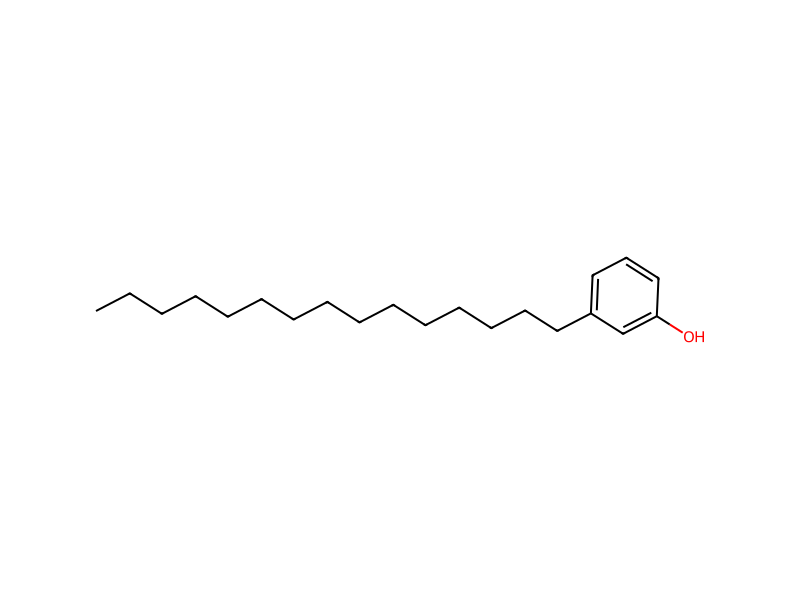
Basic information
- Standard SMILES
CCCCCCCCCCCCCCCc1cccc(O)c1- InChIKey
PTFIPECGHSYQNR-UHFFFAOYSA-N- Molecular formula
- C21H36O
- Average molar mass
- 304.5 g/mol
- Monoisotopic mass
- 304.27661577
Overview
3-Pentadecylphenol is a member of phenols.
Names & identifiers
- Preferred name
- Hydrogenated cardanol
- IUPAC
- 3-pentadecylphenol
- English name
- 3-Pentadecylphenol
- Molecular formula
- C21H36O
- Molecular weight
- 304.51
Names & synonyms
3-Pentadecylphenol501-24-63-n-Pentadecylphenolm-PentadecylphenolHydrocardanolPhenol, 3-pentadecyl-TetrahydroanacardolCyclogallipharaolPhenol, m-pentadecyl-J10ATZ45ZUNSC-9781DTXSID9060108
Show more names
1-Hydroxy-3-pentadecylbenzeneNC 510NSC 9781Cardolite NC 510Cardolite NC-507Cyclogallipharol
Hydrogenated cardanolRefChem:789137DTXCID8040777207-921-9HydroginkgolCardanol C15:0Anacardol, tetrahydro-3-Pentadecyl-phenol
Database identifiers
- CAS
501-24-6- PubChem CID
- 68146
- DTXSID
DTXSID9060108- ChEMBL
CHEMBL34689- ChEBI
CHEBI:174189- UNII
- J10ATZ45ZU
- EC Number
- 207-921-9
- Nikkaji
- J150.114C
Properties
Computed structural properties
- XLogP
- 9.4
- Topological polar surface area
- 20.2 Ų
- Hydrogen bond donors
- 1
- Hydrogen bond acceptors
- 1
- Rotatable bonds
- 14
- Heavy atoms
- 22
- Formal charge
- 0
- Complexity
- 226
Experimental & physicochemical properties
LipidsLipids -> Polyketides [PK] -> Phenolic lipids [PK15] -> Alkyl phenols and derivatives [PK1501]
LogP10.1
Melting Point54.5 °C
Physical DescriptionSolid
Physicochemical properties
- Melting point
- 50 · 50-53 °C(lit.)
- Boiling point
- 190 · 190-195 °C1 mm Hg(lit.)
- Density
- 0.9096 · 0.9096 (rough estimate)
- refractive index
- 1.496 · 1.4960 (estimate)
- Flash point
- 230 °F · >230 °F
- storage temp.
- 2 · 2-8°C
- pka
- 10.06 · 10.06±0.10(Predicted)
- form
- powder to lump
- color
- White to Gray to Brown
- Major Application
- food and beverages
- InChI
- InChI=1S/C21H36O/c1-2-3-4-5-6-7-8-9-10-11-12-13-14-16-20-17-15-18-21(22)19-20/h15,17-19,22H,2-14,16H2,1H3
- InChIKey
- PTFIPECGHSYQNR-UHFFFAOYSA-N
- SMILES
- C1(O)=CC=CC(CCCCCCCCCCCCCCC)=C1
- CAS DataBase Reference
- 501 · 501-24-6(CAS DataBase Reference)
- FDA UNII
- 10 ATZ45ZU · J10ATZ45ZU
- EPA Substance Registry System
- 3 · Phenol, 3-pentadecyl- (501-24-6)
- UNSPSC Code
- 85151701 · 85151701
- NACRES
- 24 · NA.24
- Symbol(GHS)
- 7 · GHS07
- Signal word
- Warning
- Hazard statements
- 302 · H302+H312+H332-H315-H319-H335
- Precautionary statements
- 261 · P261-P280-P301+P312-P302+P352+P312-P304+P340+P312-P305+P351+P338
- target organs
- Respiratory system
- Hazard Codes
- Xn
- Risk Statements
- 20 · 20/21/22-36/37/38
- Safety Statements
- 26 · 26-36
- WGK Germany
- 3 · 3
- TSCA
- TSCA listed
- HS Code
- 29071990 · 29071990
- Storage Class
- 11 · 11 - Combustible Solids
- Hazard Classifications
- 4 DermalAcute · Acute Tox. 4 DermalAcute Tox. 4 InhalationAcute Tox. 4 OralEye Irrit. 2Skin Irrit. 2STOT SE 3
- REACH Registrations
- Active
Safety & regulation
GHS classification
GHS Classification
Warning
H302 (93.3%): Harmful if swallowed [Warning Acute toxicity, oral]
P261, P264, P264+P265, P270, P271, P280, P301+P317, P302+P352, P304+P340, P305+P351+P338, P317, P319, P321, P330, P332+P317, P337+P317, P362+P364, P403+P233, P405, and P501 (click each P-code to see the statement)
Aggregated GHS information provided per 45 reports by companies from 7 notifications to the ECHA C&L Inventory. Each notification may be associated with multiple companies.
Hazard information
Hazard Classes and CategoriesAcute Tox. 4 (93.3%)
Safety data
- wgk
- 3
- tsca
- TSCA listed
- hs_code
- 29071990
- risk_code
- 20/21/22-36/37/38
- Signal word
- Warning
- Symbol(GHS)
- GHS07
- hazard_code
- Xn
- safety_code
- 26-36
- Storage Class
- 11 - Combustible Solids
- target organs
- Respiratory system
- Hazard statements
- H302+H312+H332-H315-H319-H335
- REACH Registrations
- Active
- Hazard Classifications
- Acute Tox. 4 DermalAcute Tox. 4 InhalationAcute Tox. 4 OralEye Irrit. 2Skin Irrit. 2STOT SE 3
- Precautionary statements
- P261-P280-P301+P312-P302+P352+P312-P304+P340+P312-P305+P351+P338
Chemistry & industry
Pharmacology
Cellular LocationsMembrane
Uses & manufacturing
General Manufacturing InformationPhenol, 3-pentadecyl-: ACTIVE
Applications
Description3-Pentadecylphenol (PDP) is an amphiphilic compound and belongs to a large group of phenolic lipids which is composed of an aromatic headgroup related to phenol or dihydroxybenzene connected to a hydrophobic hydrocarbon chain. PDP is derived from the shell of the cashew nut (Anacardium occidentale L.) which contains oil internationally named “cashew nut shell liquid” (CNSL). PDP can effectively function as an antiobesity agent by inhibiting the activity of α-glucosidase enzyme and finally can regulate body weight in the animal. PDP has also quite promising antioxidant activity. Researchers believe that this compound as an amphiphilic compound should be inserted into the biomembranes and be the antioxidant agent[1]. In particular, phenolic lipids comprise a large group of compounds of natural abundance, which are found in plants, fungi, and bacteria and have different biological functions, like antibacterial, fungicides, and cytotoxic activity[2].
Uses3-Pentadecylphenol may be used as a reference standard for the analysis of 3-pentadecylphenol as a bioactive compound in Aplotaxis auriculata rhizome by gas chromatography-mass spectrometry (GC-MS). It has been reported to have been used as a reference standard for the determination of 3-pentadecylphenol in Sakhalin-Ainu as well as Ryukyu lacquerwares and in Japanese ancient lacquerwares excavated from Jomon period ruins by pyrolysis GC-MS.
General Description3-Pentadecylphenol is classified under the amphiphilic phenolic lipids group of chemicals.
Upstream & downstream products
Upstream raw materials
Downstream products
Suppliers50 total
梯希爱(上海)化成工业发展有限公司021-67121386 · [email protected]
郑州阿尔法化工有限公司+86-18530059196 · [email protected]
湖北永阔科技有限公司027-59223108 15972152991 · [email protected]
湖北万得化工有限公司15377098680 15377098680 · [email protected]
南通润丰石油化工有限公司66017690 19952660367 · [email protected]
毕佳索(上海毕得医药科技股份有限公司)400-6005915 · [email protected]
温州共赢化学有限公司+86-0086-577-64498589 +86-15355981851 · [email protected]
常州市紫东联化进出口有限公司0519-85560282 13656141470 · [email protected]
Dayang Chem (Hangzhou) Co.,Ltd.+86-0571-88938639 17705817739 · [email protected]
武汉绿景丰华生物科技有限公司19972070065 · [email protected]
Syntechem Co.,Ltd[email protected]
上海迈瑞尔生化科技有限公司4006356688 18621169109 · [email protected]
江苏普乐司生物科技有限公司0513-66017706 18551496367 · [email protected]
上海颖心实验室设备有限公司021-59178156 17002132182 · [email protected]
武汉市聚舜化工有限公司027-02783261126 18971318572 · [email protected]
安耐吉化学&3A(安徽泽升科技股份有限公司)400-0056266 · [email protected]
湖北兴琰新材料科技有限公司13129948835 · [email protected]
广东云星生物技术有限公司0751-18902340975/189023400307 18902340307 · [email protected]
成都普思生物科技股份有限公司028-85370565-229 18080489829 · [email protected]
郑州研德生物科技有限公司0371-63682289 15538176268 · [email protected]
湖北广奥生物科技有限公司027-02702759223056 18162699093 · [email protected]
合肥天健化工有限公司551-65418679 15856988503;15837135945 · [email protected]
武汉丰泰威远科技有限公司027-87465837 19945049750 · [email protected]
广东谦进化学试剂有限公司0751-2818792 13435114148 · [email protected]
玛雅试剂+86 (573) 82222445 (0)18006601000 452520369 · [email protected]
天津希恩思生化科技有限公司400 638 7771 · [email protected]
TCI AMERICA800-4238616 · [email protected]
TOKYO CHEMICAL INDUSTRY CO., LTD.03-36680489 · [email protected]
TCI Europe320-37350700 · [email protected]
武汉普洛夫生物科技有限公司17612776928 · [email protected]
天津普西唐生物医药科技有限公司010-60605840 · [email protected]
上海麦克林生化科技股份有限公司15221275939 15221275939 · [email protected]
杭州杰恒化工有限公司0571-87396432 · [email protected]
武汉弘德悦欣医药科技有限公司027-83855396 15271852016
武汉贝乐叶生物医药科技有限公司18086118078 · [email protected]
Sigma-Aldrich西格玛奥德里奇(上海)贸易有限公司021-61415566 800-8193336 · [email protected]
深圳振强药物研发有限公司+86-0755-66853366 +86-13670046396 · [email protected]
九鼎化学(上海)科技有限公司4009209199 · [email protected]
上海谱振生物科技有限公司4001650900 13817534909 · [email protected]
上海珈得尔化学技术有限公司021-4007787-550 400-7787-550 · [email protected]
陕西缔都医药化工有限公司029-029-81120477 17792793610 · [email protected]
启源(广东)医药化工有限公司18026564465 · [email protected]
陕西缔都医药化工有限公司+86-29-81139210 +86-17392587031 · [email protected]
上海源叶生物科技有限公司13636370518 · [email protected]
湖北阡陌生物科技有限公司0711-3812399 18062309155 · [email protected]
武汉市承天精细化工有限公司18164098996 · [email protected]
上海颖心实验室设备有限公司021-021-59178156 15300768757 · [email protected]
湖北齐飞医药化工有限公司027-59322506 18071128681 · [email protected]
武汉克米克生物医药技术有限公司027-13163388153 13163388153 · [email protected]
广东翁江化学试剂有限公司0751-2886750 13927877953 · [email protected]
Additional notes
DefinitionChEBI: 3-Pentadecylphenol is a member of phenols.
Related reactions
18 records



Linked notes
Loading…