
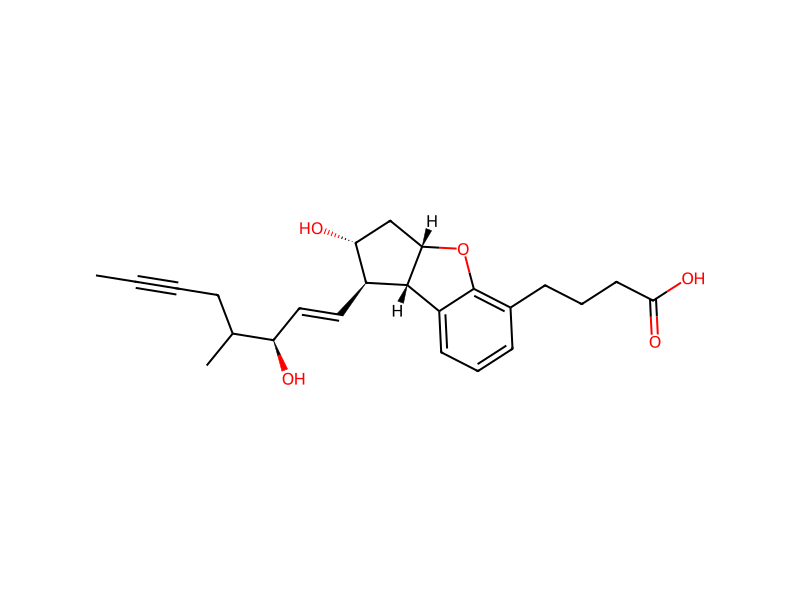
Basic information
- Standard SMILES
CC#CCC(C)[C@H](O)/C=C/[C@@H]1[C@H]2c3cccc(CCCC(=O)O)c3O[C@H]2C[C@H]1O- InChIKey
CTPOHARTNNSRSR-APJZLKAGSA-N- Molecular formula
- C24H30O5
- Average molar mass
- 398.5 g/mol
- Monoisotopic mass
- 398.20932406
Overview
Beraprost is an organic heterotricyclic compound that is (3aS,8bS)-2,3,3a,8b-tetrahydro-1H-benzo[b]cyclopenta[d]furan in which the hydrogens at positions 1R, 2R and 5 are replaced by (3S)-3-hydroxy-4-methyloct-1-en-6-yn-1-yl, hydroxy and 3-carboxypropyl groups, respectively. It is a prostaglandin receptor agonist which is approved to treat pulmonary arterial hypertension in Asia. It has a role as a vasodilator agent, an antihypertensive agent, a platelet aggregation inhibitor, a prostaglandin receptor agonist and an anti-inflammatory agent. It is a secondary allylic alcohol, a monocarboxylic acid, an organic heterotricyclic compound, a secondary alcohol and an enyne. It is a conjugate acid of a beraprost(1-).
Names & identifiers
- Preferred name
- Beraprost
- IUPAC
- 4-[(1R,2R,3aS,8bS)-2-hydroxy-1-[(E,3S)-3-hydroxy-4-methyloct-1-en-6-ynyl]-2,3,3a,8b-tetrahydro-1H-cyclopenta[b][1]benzofuran-5-yl]butanoic acid
Names & synonyms
beraprostBeraprostum88430-50-6MDL-201229ML-1229MDL 201229ML 122935E3NJJ4O6TRK-100STP FREE ACIDDTXSID7049136CHEBI:1356331H-Cyclopenta(b)benzofuran-5-butanoic acid, 2,3,3a,8b-tetrahydro-2-hydroxy-1-(3-hydroxy-4-methyl-1-octen-6-ynyl)-
Show more names
2-Hydroxy-1-(3-hydroxy-4-methyl-1-octen-6-ynyl)-2,3,3a,8b-tetrahydro-1H-cyclopenta(b)benzofuran-5-butanoic acid4-(1,2,3a,8b-tetrahydro-2-hydroxy-1-(3-hydroxy-4-methyloct-6-yne-1-enyl)-5-cyclopenta(b)benzofuranyl)butyrateRefChem:119032DTXCID4029062B01AC194-(4-hydroxy-3-((1E)-3-hydroxy-4-methyloct-1-en-6-yn-1-yl)-7-oxatricyclo(6.4.0.0^(2,6))dodeca-1(12),8,10-trien-9-yl)butanoic acidsodium 4-((2S,3R,4R,6S)-4-hydroxy-3-((1E,3S)-3-hydroxy-4-methyloct-1-en-6-yn-1-yl)-7-oxatricyclo(6.4.0.02,?)dodeca-1(12),8,10-trien-9-yl)butanoate218432-32-7
Database identifiers
- CAS
88430-50-6- PubChem CID
- 6917951
- DTXSID
DTXSID7049136- ChEMBL
CHEMBL1207745- ChEBI
CHEBI:135633- UNII
- 35E3NJJ4O6
- Nikkaji
- J372.792K
Properties
Computed structural properties
- XLogP
- 3.2
- Topological polar surface area
- 87 Ų
- Hydrogen bond donors
- 3
- Hydrogen bond acceptors
- 5
- Rotatable bonds
- 8
- Heavy atoms
- 29
- Formal charge
- 0
- Complexity
- 659
Experimental & physicochemical properties
Endocrine DisruptorsPotential endocrine disrupting compound
Safety & regulation
Toxicology
Drug Induced Liver Injury
Drug-Induced Liver Injury Severity and Toxicity (DILIst)
Beraprost
DILI Positive
DOI:10.1016/j.drudis.2019.09.022
Chemistry & industry
Pharmacology
ATC Code
B - Blood and blood forming organs
QB - Blood and blood forming organs
QC - Cardiovascular system
Pharmacodynamics
Beraprost is a stable, orally active prostacyclin analogue with vasodilatory, antiplatelet and cytoprotective effects. Beraprost is generally well tolerated and appears to be an effective agent in the treatment of patients with Buerger's disease and arteriosclerosis obliterans. Comparative data from a large randomised trial indicated that the drug appears as effective as ticlopidine in patients with these conditions. In patients with intermittent claudication, significant benefits of beraprost compared with placebo were reported in a randomised clinical trial; however, the use of beraprost in these patients is not supported by recent preliminary unpublished data from a large, phase III, placebo-controlled study. Limited data suggest some efficacy with long-term beraprost treatment of patients with PAH, where options are few and where oral administration of the drug could be a considerable advantage over intravenous prostacyclin (PGI2) therapy.
Mechanism of Action
Beraprost acts by binding to prostacyclin membrane receptors ultimately inhibiting the release of Ca<sup>2+</sup> from intracellular storage sites. This reduction in the influx of Ca<sup>2+</sup> has been postulated to cause relaxation of the smooth muscle cells and vasodilation.
Biological Half-Life35–40 minutes
MeSH Pharmacological Classification
Drugs or agents which antagonize or impair any mechanism leading to blood platelet aggregation, whether during the phases of activation and shape change or following the dense-granule release reaction and stimulation of the prostaglandin-thromboxane system.
Drugs used to cause dilation of the blood vessels.
Absorption, Distribution and ExcretionOral bioavailability is 50–70%.
Related reactions
1 records
Linked notes
Loading…