HuagongsheHuagongshe Chemistry Print Report · For research reference only
2,6-Dimethyl-3-pyridinol
3-HYDROXY-2,6-LUTIDINE · 2,6-dimethyl-3-pyridino · 2,6-DIMETHYLPYRIDIN-3-OL · 2,6-DIMETHYL-3-PYRIDINOL · 2,6-DIMETHYLPYRIDINE-3-OL · 3-Pyridinol, 2,6-diMethyl- · 2,6-dimethyl-3-oxypyridine · 2,6-DIMETHYL-3-HYDROXYPYRIDINE
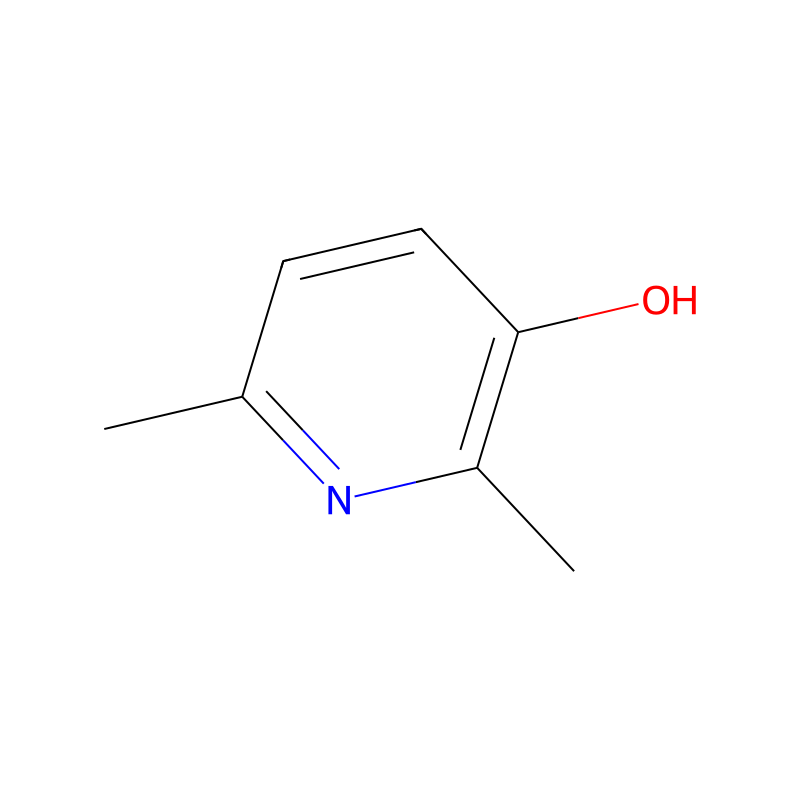
Identifiers & Physical Properties
| CAS No. | 1122-43-6 |
|---|---|
| Molecular formula | C7H9NO |
| Average molar mass | 123.15 g/mol |
| Monoisotopic mass | 123.06841391 g/mol |
| SMILES | Cc1ccc(O)c(C)n1 |
| InChIKey | AMQJAKKATFMFTR-UHFFFAOYSA-N |
| PubChem CID | 70732 |
| EC No. | 214-348-8 |
| DTXSID | DTXSID80149946 |
Chemical & Physical Properties
| XLogP | 1.3 |
|---|---|
| Topological polar surface area | 33.1 |
| Hydrogen bond donors | 1 |
| Hydrogen bond acceptors | 2 |
| Rotatable bonds | 0 |
| Heavy atoms | 9 |
| Formal charge | 0 |
| Complexity | 94.9 |
| Melting point | 210-212°C |
| Boiling point | 278.9±35.0 °C(Predicted) |
| Density | 1.083±0.06 g/cm3(Predicted) |
| Storage conditions | Inert atmosphere,Room Temperature |
| Solubility | DMSO (Slightly, Sonicated), Methanol (Slightly, Sonicated) |
| Physical state | Solid |
| pKa (acidity coefficient) | 10.72±0.10(Predicted) |
| Color | Pale Yellow to Pale Beige |
| CAS DataBase Reference | 1122-43-6(CAS DataBase Reference) |
| EWG's Food Scores | 1 |
| FDA UNII | 7Z5V74623S |
| GHS pictogram | GHS07 |
| Signal word | Warning |
| GHS hazard statements | H315-H319-H335 |
| GHS precautionary statements | P261-P271-P280 |
| Hazard symbols | Xi |
| Risk statements (R) | 36/37/38 |
| Safety statements (S) | 26-36/37/39-37/39 |
| Hazard Note | Irritant |
| Customs code | 2933399990 |
| Toxicity | mammal (species unspecified),LD50,unreported,675mg/kg (675mg/kg),BEHAVIORAL: CHANGES IN MOTOR ACTIVITY (SPECIFIC ASSAY)BEHAVIORAL: ALTERED SLEEP TIME (INCLUDING CHANGE IN RIGHTING REFLEX),Pharmaceutical Chemistry Journal Vol. 16, Pg. 259, 1982. |
Safety & Regulations
| GHS classification | DangerH302 (97.6%): Harmful if swallowed [Warning Acute toxicity, oral]P261, P264, P264+P265, P270, P271, P280, P301+P317, P302+P352, P304+P340, P305+P354+P338, P317, P319, P321, P330, P332+P317, P362+P364, P403+P233, P405, and P501 (click each P-code to see the statement)Aggregated GHS information provided per 42 reports by companies from 4 notifications to the ECHA C&L Inventory. Each notification may be associated with multiple companies. |
|---|---|
| Hazard Classes and Categories | Acute Tox. 4 (97.6%) |
| Customs code | 2933399990 |
| Toxicity | mammal (species unspecified),LD50,unreported,675mg/kg (675mg/kg),BEHAVIORAL: CHANGES IN MOTOR ACTIVITY (SPECIFIC ASSAY)BEHAVIORAL: ALTERED SLEEP TIME (INCLUDING CHANGE IN RIGHTING REFLEX),Pharmaceutical Chemistry Journal Vol. 16, Pg. 259, 1982. |
| Risk statements (R) | 36/37/38 |
| Signal word | Warning |
| GHS pictogram | GHS07 |
| Hazard symbols | Xi |
| hazard_note | Irritant |
| Safety statements (S) | 26-36/37/39-37/39 |
| GHS hazard statements | H315-H319-H335 |
| GHS precautionary statements | P261-P271-P280 |
Applications & Uses
Uses
2,6-Dimethyl-3-hydroxypyridine is a useful research chemical for organic synthesis and other chemical processes.