9-Anthracenemethanol
Anthracen-9-ylmethanol · 9-AM · NSC 241166 · AKOS B023870 · 9-Anthrylcarbinol · 9-Anthrylmethanol · RARECHEM AL BD 0006 · ART-CHEM-BB B023870
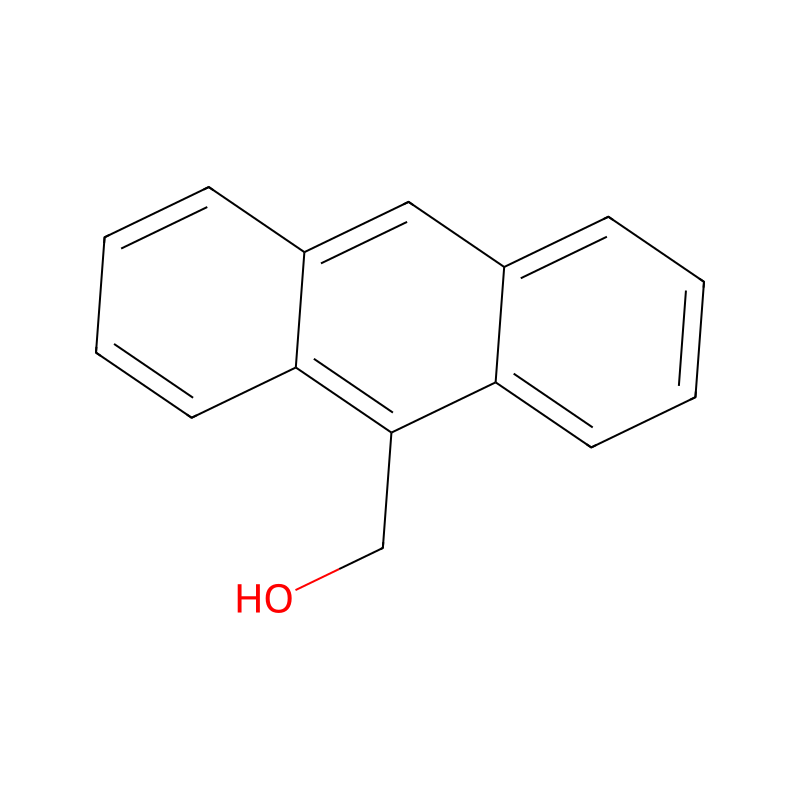
Identifiers & Physical Properties
| CAS No. | 1468-95-7 |
|---|---|
| Molecular formula | C15H12O |
| Average molar mass | 208.25 g/mol |
| Monoisotopic mass | 208.088815 g/mol |
| SMILES | OCc1c2ccccc2cc2ccccc12 |
| InChIKey | JCJNNHDZTLRSGN-UHFFFAOYSA-N |
| PubChem CID | 73848 |
| ChEMBL | CHEMBL3188668 |
| EC No. | 215-998-5 |
| DTXSID | DTXSID1049221 |
Chemical & Physical Properties
| XLogP | 3.8 |
|---|---|
| Topological polar surface area | 20.2 |
| Hydrogen bond donors | 1 |
| Hydrogen bond acceptors | 1 |
| Rotatable bonds | 1 |
| Heavy atoms | 16 |
| Formal charge | 0 |
| Complexity | 216 |
| Polymers | Other Classes -> Polycyclic Aromatic Hydrocarbons |
| LogP (partition coefficient) | 3.04 |
| Vapor pressure | 0.00000005 [mmHg] |
| Physical Description | Yellow powder[Alfa Aesar MSDS] |
| Melting point | 162-164 °C(lit.) |
| Boiling point | 307.46°C (rough estimate) |
| Density | 1.0459 (rough estimate) |
| Refractive index | 1.5361 (estimate) |
| Storage conditions | Sealed in dry,Room Temperature |
| Solubility | Soluble in hot methanol very faint turbidity. |
| pKa (acidity coefficient) | 14.36±0.10(Predicted) |
| Physical state | Crystalline Powder |
| Color | Yellow |
| BRN | 1873402 |
| Stability | Stable. Incompatible with oxidizing agents. |
| InChI | 1S/C15H12O/c16-10-15-13-7-3-1-5-11(13)9-12-6-2-4-8-14(12)15/h1-9,16H,10H2 |
| InChIKey | JCJNNHDZTLRSGN-UHFFFAOYSA-N |
| SMILES | OCc1c2ccccc2cc3ccccc13 |
| CAS DataBase Reference | 1468-95-7(CAS DataBase Reference) |
| EWG's Food Scores | 1 |
| FDA UNII | 2N7UVX2HLM |
| NIST Chemistry Reference | 9-Anthracenemethanol(1468-95-7) |
| EPA Substance Registry System | 9-Anthracenemethanol (1468-95-7) |
| UNSPSC Code | 12352100 |
| NACRES | NA.22 |
| GHS pictogram | GHS08 |
| Signal word | Warning |
| GHS hazard statements | H341 |
| GHS precautionary statements | P201-P202-P280-P308+P313-P405-P501 |
| Personal protective equipment (PPE) | Eyeshields, Gloves, type N95 (US) |
| Risk statements (R) | 20/21/22-36/37/38 |
| Safety statements (S) | 24/25 |
| Water hazard class (WGK) | 3 |
| RTECS number | CB0577500 |
| TSCA inventory status | TSCA listed |
| Customs code | 29062900 |
| Storage class | 11 - Combustible Solids |
| Toxicity | mic-bac-sat 390 mmol/L CRNGDP 15,2605,94 |
| REACH registrations | Active |
Safety & Regulations
| GHS classification | This chemical does not meet GHS hazard criteria for 40% (2 of 5) of reports.WarningH302+H312+H332 (20%): Harmful if swallowed, in contact with skin or if inhaled [Warning Acute toxicity, oralacute toxicity, dermalacute toxicity, inhalation]P203, P261, P264, P264+P265, P270, P271, P273, P280, P301+P317, P302+P352, P304+P340, P305+P351+P338, P317, P318, P319, P321, P330, P332+P317, P337+P317, P362+P364, P403+P233, P405, and P501 (click each P-code to see the statement)Aggregated GHS information provided per 5 reports by companies from 4 notifications to the ECHA C&L Inventory. Each notification may be associated with multiple companies.Not Classified |
|---|---|
| Regulatory information | Status: Active Update: 21-02-2018 https://echa.europa.eu/registration-dossier/-/registered-dossier/22743 |
| Hazards summary | May cause irritation[Alfa Aesar MSDS] See POLYCYCLIC AROMATIC HYDROCARBONS. |
| Hazard Classes and Categories | Skin Irrit. 2 (40%) |
| Personal protective equipment (PPE) | Eyeshields, Gloves, type N95 (US) |
| Water hazard class (WGK) | 3 |
| TSCA inventory status | TSCA listed |
| RTECS number | CB0577500 |
| Customs code | 29062900 |
| Toxicity | mic-bac-sat 390 mmol/L CRNGDP 15,2605,94 |
| Risk statements (R) | 20/21/22-36/37/38 |
| Signal word | Warning |
| GHS pictogram | GHS08 |
| Safety statements (S) | 24/25 |
| Storage class | 11 - Combustible Solids |
| GHS hazard statements | H341 |
| REACH registrations | Active |
| GHS precautionary statements | P201-P202-P280-P308+P313-P405-P501 |
Applications & Uses
Uses
An anthracene derivative used in Diels-Alder reactions. Also used in the preparation of 9-anthracenylmethyl-1-piperazinecarboxylate.
Uses
9-Anthracenemethanol can be used:As a starting material to prepare 9-anthracenylmethyl-1-piperazinecarboxylate, which acts as a reagent in the determination of isocyanates using HPLC.In the Diels-Alder reaction with dimethylacetylene-dicarboxylate to yield lactone derivatives.As an initiator in the ring-opening polymerization of δ-valerolactone to yield poly(δ-valerolactone).As a starting material in the synthesis of polymer-supported anthracene, which acts as a dienophile scavenger in cycloaddition reactions.
General Description
9-Anthracenemethanol participates in ring-opening polymerization of L-lactide catalyzed by alumoxane. It undergoes proton exchange reaction with potassium tert-butoxide to yield potassium 9-anthracenemethoxide.
Preparation & Synthesis
Preparation
9-Anthracenemethanol is synthesized by hydrogenation of 9-anthracenecarboxaldehyde. It is a versatile precursor to supramolecular assemblies.