
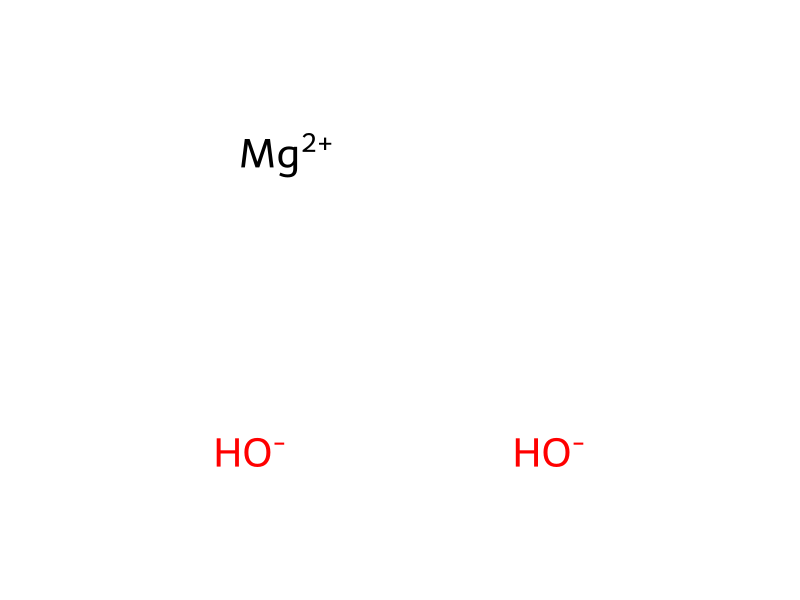
Basic information
- Standard SMILES
[Mg+2].[OH-].[OH-]- InChIKey
VTHJTEIRLNZDEV-UHFFFAOYSA-L- Molecular formula
- H2MgO2
- Average molar mass
- 58.32 g/mol
Overview
Magnesium dihydroxide is a magnesium hydroxide in which the magnesium atom is bound to two hydroxide groups. It has a role as an antacid and a flame retardant.
Names & identifiers
- Preferred name
- Magnesium Hydroxide
- IUPAC
- magnesium dihydroxide
Names & synonyms
MAGNESIUM HYDROXIDE1309-42-8Milk of magnesiaMagnesium dihydroxideMagnesium hydrateMagnesium hydroxide (Mg(OH)2)Magnesium(II) hydroxidePhillips magnesia tabletsMagnesium (as hydroxide)Magnesii hydroxidumINS NO.528DTXSID4049662
Show more names
Phillips milk of magnesia liquidINS-528NBZ3QY004SCHEBI:6637E-528Hydrate, Magnesium215-170-3Hydroxide, Magnesium
Database identifiers
- CAS
1309-42-8、1317-43-7- PubChem CID
- 73981
- DTXSID
DTXSID4049662- ChEMBL
CHEMBL1200718- ChEBI
CHEBI:6637- UNII
- NBZ3QY004S
- EC Number
- 215-170-3
- Nikkaji
- J43.883I
Properties
Computed structural properties
- Topological polar surface area
- 2 Ų
- Hydrogen bond donors
- 2
- Hydrogen bond acceptors
- 2
- Rotatable bonds
- 0
- Heavy atoms
- 3
- Formal charge
- 0
- Complexity
- 0
Experimental & physicochemical properties
Chemical ClassesMetals -> Metals, Inorganic Compounds
Polymers
Plastics -> Flame retardants
Plastics -> Polyolefin-I; Polyolefin-II; ABS
Cosmetics
Cosmetic ingredients (Magnesium Hydroxide) -> CIR (Cosmetic Ingredient Review)
Buffering; Absorbent
pHpH = 9.5-10.5 (aqueous slurry)
SpringerMaterials Propertiescrystal structure
Pesticides
Agrochemicals -> Pesticide active substances
Active substance -> EU Pesticides database: Approved
OdorOdorless
Food AdditivesCOLOR OR COLORING ADJUNCT, DRYING AGENT, NUTRIENT SUPPLEMENT, PH CONTROL AGENT, PROCESSING AID -> FDA Substance added to food
Density
2.36 g/mL
2.36 @25 °C
Flame RetardantsFlame retardants
Color/Form
Amorphous powder
White, hexagonal crystals
Granules
Solubility
Practically insoluble in water and in ethanol
White, friable masses or bulky, white powder; at about 700 °C is converted to MgO; sol in about 3,300 parts CO2-free water; more sol in water containing CO2; sol in dilute acids with effervescence; insol in alcohol /Magnesium carbonate hydroxide/
Soluble in dilute acids
0.0009 G SOL IN 100 CC WATER @ 18 °C; 0.004 G SOL IN 100 CC WATER @ 100 °C; SOL IN AMMONIUM SALTS
Almost insoluble in alcohol
Safety & regulation
GHS classification
GHS Classification
Not Classified
Aggregated GHS information provided per 736 reports by companies from 13 notifications to the ECHA C&L Inventory.
Hazard information
Regulatory Information
Chemical: Magnesium hydroxide (Mg(OH)2)
Magnesium hydroxide (Mg(OH)2) is listed on the EPA's Chemical Data Reporting (CDR) system. Manufacturers and importers of Magnesium hydroxide (Mg(OH)2) are required to report information about their production and use of this chemical to the EPA under the Toxic Substances Control Act (TSCA). (40 eCFR Part 711)
Reg. (EU) 2024/836
Status: Active Update: 21-04-2023 https://echa.europa.eu/registration-dossier/-/registered-dossier/16073
Magnesium hydroxide: Does not have an individual approval but may be used under an appropriate group standard
Other Safety InformationIMAP assessments - Magnesium hydroxide (Mg(OH)2): Environment tier I assessment
Hazards SummaryMay cause eye injury; [HSDB] An eye irritant; [eChemPortal: ERMA] Powder irritates eyes; [MSDSonline] See Magnesium.
FDA Requirements
This substance is generally recognized as safe when used in accordance with good manufacturing or feeding practice.
Substance added directly to human food affirmed as generally recognized as safe (GRAS).
Drug products containing certain active ingredients offered over-the-counter (OTC) for certain uses. Magnesium hydroxide is included in digestive aid products.
The Approved Drug Products with Therapeutic Equivalence Evaluations List identifies currently marketed over-the-counter drug products, incl magnesium hydroxide, approved on the basis of safety and effectiveness by FDA under sections 505 of the Federal Food, Drug, and Cosmetic Act.
Antacid products for over-the-counter (OTC) human use. Magnesium hydroxide is included on this list of specific active ingredients.
EPA Safer ChemicalChemical: Magnesium hydroxide
Hazard Classes and CategoriesNot Classified
Hazardous Reactivities and Incompatibilities
Phosphorus boiled with alkaline hydroxides yields mixed phosphines which may ignite spontaneously in air. /Alkaline hydroxides/
ALKALI & OTHER ALKALINE EARTH COMPD...MAGNESIUM COMPD...CAUSE EXPLOSIVE DECOMP OF MALEIC ANHYDRIDE.
Safety & protection
Storage ConditionsKEEP WELL CLOSED
Disposal Methods
SRP: At the time of review, criteria for land treatment or burial (sanitary landfill) disposal practices are subject to significant revision. Prior to implementing land disposal of waste residue (including waste sludge), consult with environmental regulatory agencies for guidance on acceptable disposal practices.
Protective Action Criteria (PAC)
26 [mg/m3]
280 [mg/m3]
1700 [mg/m3]
Toxicology
Interactions
...MAGNESIUM HYDROXIDE MAY INTERFERE WITH ABSORPTION OF WARFARIN BY ALKALINIZING GASTROINTESTINAL CONTENTS. ...IT HAS BEEN DEMONSTRATED THAT MAGNESIUM HYDROXIDE SUSPENSION ACTUALLY ENHANCES THE ABSORPTION OF DICUMAROL...HIGHER PEAK SERUM LEVELS...
ALKALINIZATION OF URINE CAN DECR EXCRETION OF VARIOUS WEAKLY BASIC DRUGS (EG QUINIDINE). MG(OH2) INCR ABSORPTION OF WARFARIN IN MAN & DECR ABSORPTION OF BARBITURATES IN RATS.
Toxicity Summary
The CIR Expert Panel concluded that ... Magnesium Hydroxide is safe in hair straighteners and depilatories under conditions of recommended use; users should minimize skin contact. These ingredients are safe for all other present practices of use and concentration described in this safety assessment when formulated to be nonirritating.
Safe for use in cosmetics, with qualifications
Natural Pollution Sources
OCCURS IN NATURE AS THE MINERAL BRUCITE.
OCCURS AS AN ALTERATION PRODUCT OF PERICLASE IN SERPENTINE AND MARBLE AND IN CHLORITE AND DOLOMITE SCHISTS
Human Toxicity Excerpts
/HUMAN EXPOSURE STUDIES/ Compounds with a basic pH are potentially even more damaging to the eye than are strong acids. Among the compounds of clinical significance in terms of frequency and severity of injuries are ... magnesium hydroxide.
/HUMAN EXPOSURE STUDIES/ IF EVACUATION FAILS (BOWEL OBSTRUCTION OR ATONY), MUCOSAL IRRITATION & ABSORPTION OCCUR. SYSTEMICALLY MG PRODUCES CNS DEPRESSION, ABOLITION OF REFLEXES, & DEATH FROM RESP PARALYSIS.
/HUMAN EXPOSURE STUDIES/ PROLONGED USE OF MG(OH)2 MAY RARELY CAUSE RECTAL STONES COMPOSED OF MGCO3 & MG(OH)2.
Non-Human Toxicity Excerpts
/LABORATORY ANIMALS: Acute Exposure/ ...IN DOGS, THE MAGNESIUM CONTENT OF GASTRIC MUCOSA & MUSCULARIS IS INCR & IT IS POSSIBLE THAT THE EFFECT TO DECR ANTRAL MOTILITY & UROPEPSIN SECRETION IS FROM A DIRECT LOCAL ACTION.
/LABORATORY ANIMALS: Acute Exposure/ ...MILK OF MAGNESIA ON RABBIT EYES...TWICE A DAY FOR THREE OF FOUR DAYS CAUSED DAMAGE TO CORNEAL EPITHELIUM DEMONSTRABLE BY STAINING WITH FLUORESCEIN. AFTER THE APPLICATIONS...WERE DISCONTINUED, CORNEAS RETURNED TO NORMAL IN TWO OR THREE DAYS.
/LABORATORY ANIMALS: Subchronic or Prechronic Exposure/ The effects of magnesium hydroxide were examined on methylazoxymethanol (MAM) acetate-induced c-myc expression and cell proliferation of colonic mucosal epithelium in rats. Rats were divided into four groups and treated as follows: MAM acetate alone (25 mg/kg i.p. injection, five times, once a week for 5 weeks), MAM acetate and feeding of 0.2% magnesium hydroxide in diet, magnesium hydroxide alone and non-treatment. At 4, 8 and 16 weeks after the start of experiment, 10 rats in each group were sacrificed. Magnesium hydroxide inhibited the MAM-induced expression of c-myc proto-oncogene, and also suppressed the increased bromodeoxyuridine (BrdU) and proliferating cell nuclear antigen (PCNA) labelling indexes induced by MAM acetate in colon mucosa in initiation and post-initiation phase. These results suggest that the anti-carcinogenic effect of magnesium hydroxide on rat colon carcinogenesis induced by MAM acetate may be related to the inhibition of the carcinogen-induced expression of c-myc proto-oncogene and cell proliferation.
/LABORATORY ANIMALS: Chronic Exposure or Carcinogenicity/ Preventive effect of magnesium hydroxide on carcinogen-induced, large bowel carcinogenesis was examined in three experiments using F344 rats. Experiment I: Rats received dietary administration of magnesium hydroxide at concentrations of 500 or 1,000 ppm after treatment with methylazoxymethanol (MAM) acetate (25 mg/kg, 3 times). These rats had a lower incidence of large bowel neoplasms than animals given MAM acetate alone. Reduction of the tumor incidence was especially significant at a dose of 500 ppm. Experiment II: Rats given magnesium hydroxide (250, 500, or 1,000 ppm) together with 1,2-dimethylhydrazine (DMH) (20 mg/kg, 10 times) showed a lower multiplicity of large bowel tumors than those given DMH alone. Experiment III: The labeling indices of the cryptal cells of the large bowel (cecum or proximal colon or distal colon) or rates given magnesium hydroxide for 4, 6, or 8 weeks after treatment with MAM acetate (25 mg/kg, 3 times) were smaller than those of animals given MAM acetate alone, indicating that magnesium hydroxide suppressed, carcinogen-induced epithelial cell (large bowel) proliferation. The results of the three experiments suggest that magnesium, one of the essential metals, is a promising chemopreventive agent in humans.
Effects During Pregnancy and Lactation◉ Summary of Use during Lactation
Non-Human Toxicity Values
LD50 Rat oral 8500 mg/kg
LD50 Rat intraperitoneal 2780 mg/kg
Regulatory information
FDA Requirements
This substance is generally recognized as safe when used in accordance with good manufacturing or feeding practice.
Substance added directly to human food affirmed as generally recognized as safe (GRAS).
Drug products containing certain active ingredients offered over-the-counter (OTC) for certain uses. Magnesium hydroxide is included in digestive aid products.
The Approved Drug Products with Therapeutic Equivalence Evaluations List identifies currently marketed over-the-counter drug products, incl magnesium hydroxide, approved on the basis of safety and effectiveness by FDA under sections 505 of the Federal Food, Drug, and Cosmetic Act.
Antacid products for over-the-counter (OTC) human use. Magnesium hydroxide is included on this list of specific active ingredients.
Chemistry & industry
Pharmacology
ATC Code
G - Genito urinary system and sex hormones
A - Alimentary tract and metabolism
QA - Alimentary tract and metabolism
QG - Genito urinary system and sex hormones
Protein BindingMagnesium hydroxide does not have any protein binding properties.
Pharmacodynamics
As an antacid, magnesium hydroxide suspension neutralizes gastric acid by reacting with hydrochloric acid in the stomach to form magnesium chloride and water. It is practically insoluble in water and does not have any effect until it reacts with the hydrochloric acid in the stomach. There, it decreases the direct acid irritant effect and increases the pH in the stomach leading to inactivation of pepsin. Magnesium hydroxide enhances the integrity of the mucosal barrier of the stomach as well as improving the tone of both the gastric and esophageal sphincters. As a laxative, the magnesium hydroxide works by increasing the osmotic effect in the intestinal tract and drawing water in. This creates distension of the colon which results in an increase in peristaltic movement and bowel evacuation.
Mechanism of Action
The suspension of magnesium hydroxide is ingested and enters the stomach. According to the amount ingested, the magnesium hydroxide will either act as an antacid or a laxative. Through the ingestion of 0.5-1.5 grams (in adults) the magnesium hydroxide will act by simple acid neutralization in the stomach. The hydroxide ions from the magnesium hydroxide suspension will combine with the acidic H+ ions of the hydrochloric acid made by the stomachs parietal cells. This neutralization reaction will result in the formation of magnesium chloride and water. Through the ingestion of 2-5 grams (in adults) the magnesium hydroxide acts as a laxative in the colon. The majority of the suspension is not absorbed in the intestinal tract and will create an osmotic effect to draw water into the gut from surrounding tissues. With this increase of water in the intestines, the feces will soften and the intraluminal volume of the feces will increase. These effects still stimulate intestinal motility and induce the urge to defecate. Magnesium hydroxide will also release cholecystokinin (CCK) in the intestines which will accumulate water and electrolytes in the lumen and furthermore increase intestinal motility.
COMPD IS PRACTICALLY INSOL, & SOLUTION IS NOT EFFECTED UNTIL HYDROXIDE REACTS WITH HYDROCHLORIC ACID TO FORM MAGNESIUM CHLORIDE. ...MG(OH)2 INCREASES LOWER-ESOPHAGEAL SPHINCTER PRESSURE & ACID SECRETION IN HEIDENHAIN POUCHES.
Laxatives containing magnesium cations or phosphate anions are commonly called saline laxatives. Their cathartic action is believed to result from osmotically mediated water retention, which then stimulates peristalsis. However, other mechanisms may contribute to their effects, including the production of inflammatory mediators. It also has been suggested that magnesium containing laxatives stimulate the release of cholecystolkinin, which leads to intraluminal fluid and electrolyte accumulation as well as to increased intestinal motility. /Saline laxatives, including magnesium hydroxide/
Biological Half-LifeN/A
Metabolism/Metabolites
Unless a patient is deficient in magnesium, very little is absorbed by the intestine. Overall, about 15%-50% of the magnesium hydroxide suspension is absorbed systemically. However, it does not undergo any metabolism as it is rapidly excreted in the urine.
FDA Pharmacological Classification
MAGNESIUM HYDROXIDE
Osmotic Laxative [EPC]; Magnesium Ion Exchange Activity [MoA]; Inhibition Small Intestine Fluid/Electrolyte Absorption [PE]; Stimulation Large Intestine Fluid/Electrolyte Secretion [PE]; Increased Large Intestinal Motility [PE]; Calculi Dissolution Agent [EPC]; Osmotic Activity [MoA]; Inhibition Large Intestine Fluid/Electrolyte Absorption [PE]
PHILLIPS FRESH MINT MILK OF MAGNESIA
Magnesium Ion Exchange Activity [MoA]; Osmotic Laxative [EPC]; Inhibition Small Intestine Fluid/Electrolyte Absorption [PE]; Stimulation Large Intestine Fluid/Electrolyte Secretion [PE]; Increased Large Intestinal Motility [PE]; Calculi Dissolution Agent [EPC]; Osmotic Activity [MoA]; Inhibition Large Intestine Fluid/Electrolyte Absorption [PE]
PHILLIPS MILK OF MAGNESIA WILD CHERRY
Calculi Dissolution Agent [EPC]; Osmotic Activity [MoA]; Inhibition Large Intestine Fluid/Electrolyte Absorption [PE]; Osmotic Laxative [EPC]; Magnesium Ion Exchange Activity [MoA]; Inhibition Small Intestine Fluid/Electrolyte Absorption [PE]; Stimulation Large Intestine Fluid/Electrolyte Secretion [PE]; Increased Large Intestinal Motility [PE]
MeSH Pharmacological ClassificationSubstances that counteract or neutralize acidity of the GASTROINTESTINAL TRACT.
Absorption, Distribution and Excretion
About 15%-50% of magnesium hydroxide is absorbed very slowly through the small intestine.
After oral administration, up to 50% of the magnesium hydroxide suspension may be absorbed as magnesium ions through the small intestines and then rapidly excreted in the urine through the kidneys. The unabsorbed drug is mainly excreted in the feces and saliva.
The peak action and distribution of magnesium hydroxide are variable.
Magnesium hydroxide is mainly excreted in the urine by the kidneys. Since the kidneys play a major role in its clearance, individuals with renal failure are at risk of hypermagnesemia with long term consumption as the appropriate amounts of magnesium may not be excreted.
ALTHOUGH MG(OH)2 IS CLASSIFIED AS A NONSYSTEMIC ANTACID, 5 TO 10% OF MAGNESIUM CAN BE ABSORBED... ORDINARILY THE ABSORBED MAGNESIUM ION IS RAPIDLY EXCRETED BY KIDNEY. IN NORMAL PERSONS, ABSORPTION IS ATTENDED BY LITTLE OR NO DANGER OF SYSTEMIC ALKALOSIS, BUT URINE MAY BECOME ALKALINE.
...EMPTIED SLOWLY FROM THE STOMACH, PROLONGING ITS ANTACID ACTION. ...ABOUT 5-15% OF INGESTED MAGNESIUM IS ABSORBED, & THIS IS READILY EXCRETED IN THE URINE IF KIDNEY FUNCTION IS NORMAL.
Uses & manufacturing
Uses
CIR ingredient: Magnesium Hydroxide
Found naturally as brucite; [Hawley] Used to make magnesium metal and compounds (dead-burned and caustic-burned magnesia and magnesium oxide, chloride, carbonate, and sulfate), and as an antacid and laxative, a clarifier in sugar refining, and as a residual fuel oil additive; Also used for uranium processing, wastewater treatment, sulfur dioxide removal from waste gases, and neutralization of acids in the chemical industry; Also used in toothpastes and dentrifrices, in foods as a drying and color-retention agent, in frozen desserts, in the pulp and paper industries, and in other products (ceramics, pharmaceuticals, plastics, and flame retardants/smoke suppressants); [HSDB] Used as an alkali and color adjunct; [JECFA]
Metal Preparation and Pouring [Category: Foundry]
Ceramics making [Category: Hobbies]
CHEM INT FOR DEAD-BURNED & CAUSTIC-BURNED MAGNESIA, MAGNESIUM CHLORIDE & MAGNESIUM CARBONATE; RAW MATERIAL FOR MAGNESIUM METAL; INGREDIENT IN TOOTHPASTE; NEUTRALIZATION OF ACIDS IN THE CHEMICAL INDUSTRY; ... CLARIFIER IN SUGAR REFINING
RESIDUAL FUEL OIL ADDITIVE; SULFITE PULP; URANIUM PROCESSING; DENTRIFRICES; IN FOODS AS DRYING AGENT, COLOR RETENTION AGENT; FROZEN DESSERTS
U.S. Production
2023: 400,000,000 - <550,000,000 lb
(1974) 8.46X10+10 GRAMS (USE)
Consumer UsesCBI
Industry UsesProcessing aids not otherwise specified
Methods of Manufacturing
REACTION OF CALCIUM HYDROXIDE WITH SEA WATER WHICH HAS BEEN PURIFIED TO REMOVE COLLOIDAL PARTICLES, CARBON DIOXIDE, AND SALTS OF OTHER METALS
...FROM MAGNESIUM CHLORIDE OR SULFATE & SODIUM HYDROXIDE...US 3127241 (1964 TO DOW). INDUSTRIAL METHOD FOR PRODUCING MAGNESIUM HYDROXIDE HAVING VARIABLE PARTICLE SIZES...US 3232708 (1966 TO FMC).
Precipitation from a solution of a magnesium salt by sodium hydroxide or precipitation from seawater with lime.
Dead Sea Periclase (DSP, Mishor Rotem, Israel) converts magnesium chloride into MgO by spray-roasting, then hydrates the MgO to Mg(OH)2.
Magnesite is acidified to produce MgCl2 and subsequent MgO of 99% purity, which is converted to magnesium hydroxide by hydration.
Formulations/Preparations
MILK OF MAGNESIA USP, IS AN AQUEOUS SUSPENSION OF MAGNESIUM HYDROXIDE CONTAINING 7.0-8.5% OF MG(OH)2. EACH MILLILITER IS CAPABLE OF NEUTRALIZING APPROX 2.7 MEQ OF ACID. ...MAGNESIUM HYDROXIDE IS ALSO AVAIL AS MAGNESIA TABLETS...GENERALLY CONTAIN 325 MG EACH, WHICH CAN NEUTRALIZE 11.2 MEQ OF ACID.
USP; 250 ML & 500 ML BOTTLES WITH ALUMINUM HYDROXIDE GEL; 250 ML, 375 ML, 500 ML & 1 L BOTTLES.
SUSPENSION OF 30% MAGNESIUM HYDROXIDE IN WATER: HYDRO-MAGMA.
MAGNESIUM HYDROXIDE DRUG AVAILABLE GENERICALLY: POWDER; TABLETS 300 & 600 MG.
For more Formulations/Preparations (Complete) data for MAGNESIUM HYDROXIDE (9 total), please visit the HSDB record page.
Household ProductsInformation on 3 consumer products that contain Magnesium Hydroxide in the following categories is provided:
Use Classification
EPA Safer Chemical Functional Use Classes -> Processing Aids and Additives
Safer Chemical Classes -> Green circle - The chemical has been verified to be of low concern
Food additives
Food Additives -> ACIDITY_REGULATOR; COLOUR_RETENTION_AGENT -> JECFA Functional Classes
Cosmetics -> Buffering; Absorbent
Plastics -> Polymer Type -> Polyolefin-I; Polyolefin-II; ABS
General Manufacturing Information
Mining (except Oil and Gas) and support activities
Magnesium hydroxide (Mg(OH)2): ACTIVE
INCOMPATIBILITIES: ...HAS AN ALKALINE REACTION & POSSESSES INCOMPATIBILITIES TYPICAL OF SUCH REACTION. THUS, ALKALOIDS ARE LIBERATED FROM SOLN OF THEIR SALTS. /MILK OF MAGNESIA USP/
...HIGH NEUTRALIZING CAPACITY WITH RAPID ONSET... AS WITH ALL AMPHOTERIC ANTACIDS, TABLETS ARE LESS EFFECTIVE THAN LIQUID PREPARATIONS.
MAGNESIUM HYDROXIDE IS DISPERSED IN WATER CONTAINING SODIUM POLYMETHACRYLATE TO PRODUCE A HIGHLY CONCENTRATED MAGNESIUM HYDROXIDE SLURRY OF LOW VISCOSITY FOR WASTE GAS DESULFURIZATION.
Unlike other magnesium hydroxide products, the Mg(OH)2 in milk of magnesia is produced from basic magnesium carbonate. The fine particle structure formed in this reaction makes milk of magnesia a stable slurry.
Related reactions
110 records




Linked notes
Loading…