HuagongsheHuagongshe Chemistry Print Report · For research reference only
Benzene, 1-(chloromethyl)-4-(1,1-dimethylethyl)-
1-(TERT-BUTYL)-4-(CHLOROMETHYL)BENZENE · AKOS BBS-00003972 · Butenafine Impurity 2 · P-T-BUTYLBENZYL CHLORIDE · 4-t-Butylbenzyl chloride · tert-Butyl Benzyl Chloride · 4-TERT-BUTYLBENZYL CHLORIDE · P-TERT-BUTYLBENZYL CHLORIDE
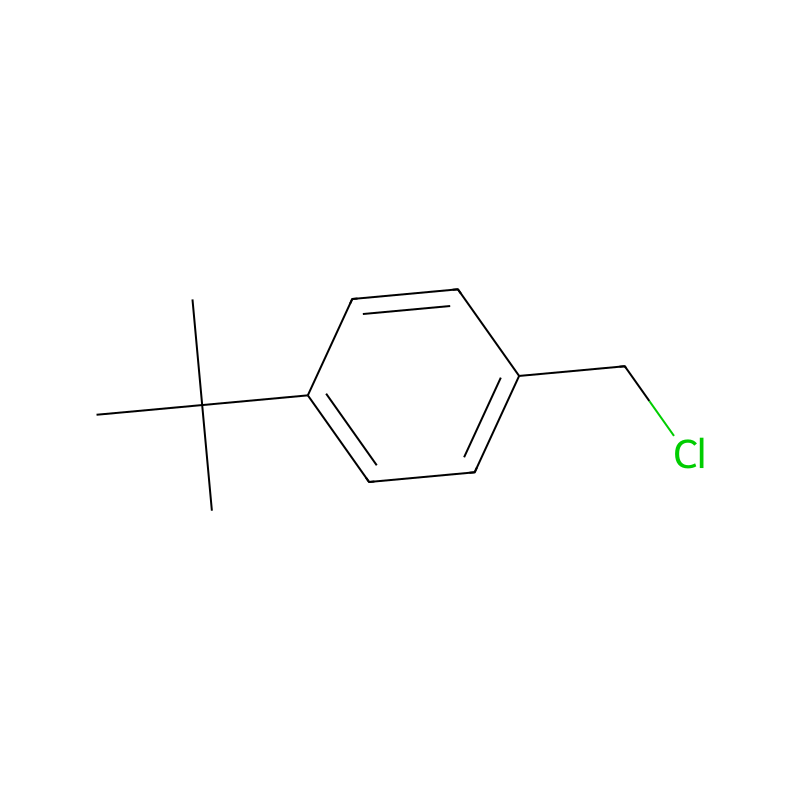
Identifiers & Physical Properties
| CAS No. | 19692-45-6 |
|---|---|
| Molecular formula | C11H15Cl |
| Average molar mass | 182.69 g/mol |
| Monoisotopic mass | 182.08622816 g/mol |
| SMILES | CC(C)(C)c1ccc(CCl)cc1 |
| InChIKey | WAXIFMGAKWIFDQ-UHFFFAOYSA-N |
| PubChem CID | 88198 |
| EC No. | 243-228-8 |
| DTXSID | DTXSID7066516 |
Chemical & Physical Properties
| XLogP | 4 |
|---|---|
| Topological polar surface area | 0 |
| Hydrogen bond donors | 0 |
| Hydrogen bond acceptors | 0 |
| Rotatable bonds | 2 |
| Heavy atoms | 12 |
| Formal charge | 0 |
| Complexity | 126 |
| SpringerMaterials Properties | Nuclear quadrupole resonance spectroscopy |
| Melting point | -18 °C |
| Boiling point | 101-105 °C7 mm Hg(lit.) |
| Density | 0.945 g/mL at 25 °C(lit.) |
| Refractive index | n20/D 1.521(lit.) |
| Flash point | 202 °F |
| Storage conditions | under inert gas (nitrogen or Argon) at 2-8°C |
| Physical state | Liquid |
| Color | Clear colorless to slightly yellow |
| Specific gravity | 0.945 |
| Solubility | Slightly soluble in water. |
| BRN | 471673 |
| InChI | 1S/C11H15Cl/c1-11(2,3)10-6-4-9(8-12)5-7-10/h4-7H,8H2,1-3H3 |
| InChIKey | WAXIFMGAKWIFDQ-UHFFFAOYSA-N |
| SMILES | CC(C)(C)c1ccc(CCl)cc1 |
| CAS DataBase Reference | 19692-45-6(CAS DataBase Reference) |
| NIST Chemistry Reference | Benzene, 1-(chloromethyl)-4-(1,1-dimethylethyl)-(19692-45-6) |
| EPA Substance Registry System | p-tert-Butylbenzyl chloride (19692-45-6) |
| UNSPSC Code | 12352100 |
| NACRES | NA.22 |
| GHS pictogram | GHS05,GHS07 |
| Signal word | Danger |
| GHS hazard statements | H314-H335 |
| GHS precautionary statements | P261-P271-P280-P303+P361+P353-P304+P340+P310-P305+P351+P338 |
| Target organs | Respiratory system |
| Personal protective equipment (PPE) | Faceshields, Gloves, Goggles, type ABEK (EN14387) respirator filter |
| Hazard symbols | C,Xi |
| Risk statements (R) | 34-36/37 |
| Safety statements (S) | 26-27-28-36/37/39-45 |
| UN transport number | UN 3265 8/PG 2 |
| Water hazard class (WGK) | 3 |
| F | 21 |
| Hazard Note | Irritant |
| TSCA inventory status | TSCA listed |
| Hazard class | 8Eye Dam. 1Skin Corr. 1BSTOT SE 3 |
| Packing group | III |
| Customs code | 29039990 |
| Storage class | 8A - Combustible corrosive hazardous materials |
| Limited quantities | 1.0 L (0.3 gallons) (liquid) or 1 Kg (2.2 lbs) (solid) |
| Excepted quantities | Max Inner Pack (30g or 30ml) and Max Outer Pack (500g or 500ml) |
Safety & Regulations
| GHS classification | DangerH314 (100%): Causes severe skin burns and eye damage [Danger Skin corrosion/irritation]P260, P261, P264, P264+P265, P271, P280, P301+P330+P331, P302+P361+P354, P304+P340, P305+P351+P338, P305+P354+P338, P316, P319, P321, P337+P317, P363, P403+P233, P405, and P501 (click each P-code to see the statement)Aggregated GHS information provided per 46 reports by companies from 6 notifications to the ECHA C&L Inventory. Each notification may be associated with multiple companies. |
|---|---|
| Regulatory information | Chemical: Benzene, 1-(chloromethyl)-4-(1,1-dimethylethyl)- |
| Hazard Classes and Categories | Skin Corr. 1B (100%) |
| F | 21 |
| Personal protective equipment (PPE) | Faceshields, Gloves, Goggles, type ABEK (EN14387) respirator filter |
| Water hazard class (WGK) | 3 |
| TSCA inventory status | TSCA listed |
| UN transport number | UN 3265 8/PG 2 |
| Customs code | 29039990 |
| Risk statements (R) | 34-36/37 |
| Signal word | Danger |
| GHS pictogram | GHS05,GHS07 |
| Hazard symbols | C,Xi |
| hazard_note | Irritant |
| Safety statements (S) | 26-27-28-36/37/39-45 |
| Hazard class | 8Eye Dam. 1Skin Corr. 1BSTOT SE 3 |
| Storage class | 8A - Combustible corrosive hazardous materials |
| Packing group | III |
| Target organs | Respiratory system |
| GHS hazard statements | H314-H335 |
| Limited quantities | 1.0 L (0.3 gallons) (liquid) or 1 Kg (2.2 lbs) (solid) |
| Excepted quantities | Max Inner Pack (30g or 30ml) and Max Outer Pack (500g or 500ml) |
| GHS precautionary statements | P261-P271-P280-P303+P361+P353-P304+P340+P310-P305+P351+P338 |
Applications & Uses
Uses
4-tert-Butylbenzyl chloride has been used to control molecular weight and prevent microgel formation during polymerization reaction.