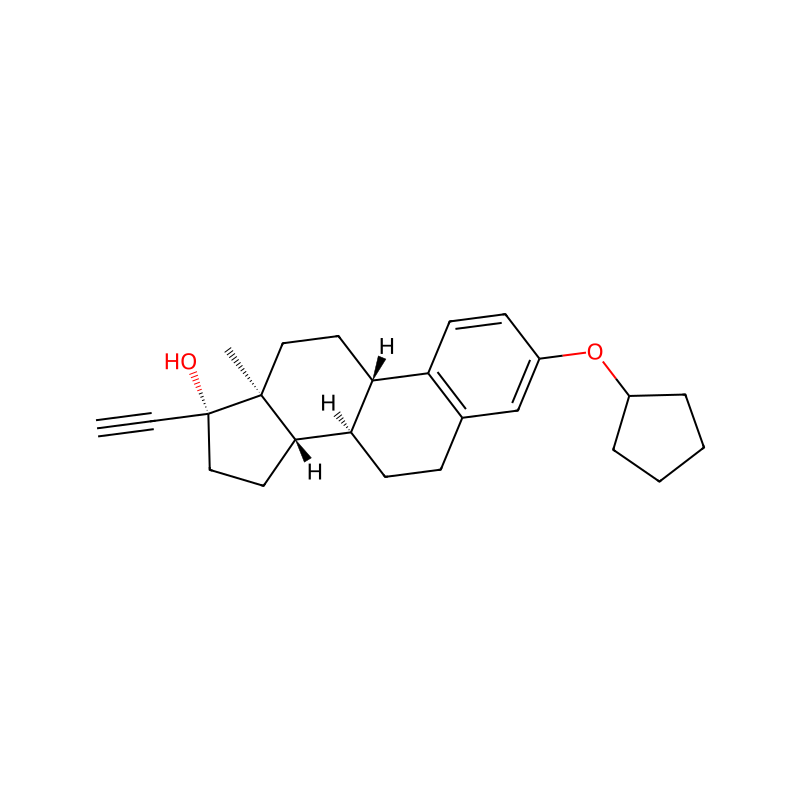
Identifiers & Physical Properties
| CAS No. | 152-43-2 |
|---|
| Molecular formula | C25H32O2 |
|---|
| Average molar mass | 364.5 g/mol |
|---|
| Monoisotopic mass | 364.24023026 g/mol |
|---|
| SMILES | C#C[C@]1(O)CC[C@H]2[C@@H]3CCc4cc(OC5CCCC5)ccc4[C@H]3CC[C@@]21C |
|---|
| InChIKey | PWZUUYSISTUNDW-VAFBSOEGSA-N |
|---|
| PubChem CID | 9046 |
|---|
| ChEMBL | CHEMBL1201165 |
|---|
| ChEBI | CHEBI:8716 |
|---|
| EC No. | 205-803-1 |
|---|
| DTXSID | DTXSID6046553 |
|---|
Chemical & Physical Properties
| XLogP | 5.3 |
|---|
| Topological polar surface area | 29.5 |
|---|
| Hydrogen bond donors | 1 |
|---|
| Hydrogen bond acceptors | 2 |
|---|
| Rotatable bonds | 3 |
|---|
| Heavy atoms | 27 |
|---|
| Formal charge | 0 |
|---|
| Complexity | 613 |
|---|
| Drugs | Pharmaceuticals -> Listed in ZINC15 |
|---|
| Lipids | Lipids -> Sterol Lipids [ST] -> Steroids [ST02] -> C18 steroids (estrogens) and derivatives [ST0201] |
|---|
| Solubility | 1.57e-03 g/L |
|---|
| Human Drugs | FDA approved drugs -> Active ingredient |
|---|
| Endocrine Disruptors | Potential endocrine disrupting compound |
|---|
| Melting point | 107.5 °C |
|---|
| Physical Description | Solid |
|---|
Safety & Regulations
| GHS classification | DangerH302 (60.9%): Harmful if swallowed [Warning Acute toxicity, oral]P203, P260, P261, P263, P264, P270, P271, P280, P301+P317, P302+P352, P304+P340, P317, P318, P321, P330, P362+P364, P405, and P501 (click each P-code to see the statement)Aggregated GHS information provided per 64 reports by companies from 4 notifications to the ECHA C&L Inventory. Each notification may be associated with multiple companies. |
|---|
| Hazard Classes and Categories | Acute Tox. 4 (60.9%) |
|---|
| Health effects | Side effects include liver and kidney dysfunction, high blood pressure, heart disease, degeneration of the testicles, premature baldness, and acne. |
|---|
| Exposure routes | Absorbed following oral administration. |
|---|
| Toxicity summary | Estrogens diffuse into their target cells and interact with a protein receptor (the estrogen receptor). Estrogen interacts with a target cell receptor. When the estrogen receptor has bound its ligand it can enter the nucleus of the target cell, and regulate gene transcription which leads to formation of messenger RNA. The mRNA interacts with ribosomes to produce specific proteins that express the effect of estradiol upon the target cell. Estrogens increase the hepatic synthesis of sex hormone binding globulin (SHBG), thyroid-binding globulin (TBG), and other serum proteins and suppress follicle-stimulating hormone (FSH) from the anterior pituitary. Target cells include the female reproductive tract, the mammary gland, the hypothalamus, and the pituitary. Estrogens increase the hepatic synthesis of sex hormone binding globulin (SHBG), thyroid-binding globulin (TBG), and other serum proteins and suppress follicle-stimulating hormone (FSH) from the anterior pituitary. The combination of an estrogen with a progestin suppresses the hypothalamic-pituitary system, decreasing the secretion of gonadotropin-releasing hormone (GnRH). |
|---|
| Signs and Symptoms | Symptoms of overdose include nausea and vomiting, and withdrawal bleeding may occur in females. |
|---|
| Carcinogen Classification | No indication of carcinogenicity to humans (not listed by IARC). |
|---|