HuagongsheHuagongshe Chemistry Print Report · For research reference only
C.I. Pigment Yellow 14
BENZIDINE YELLOW · Yellow 12 · Permanent Yellow G · c.i. 21095 · CIPIGMENT YELLOW 12 · Yellow 14 · C.I.P.Y14 · aaotyellow
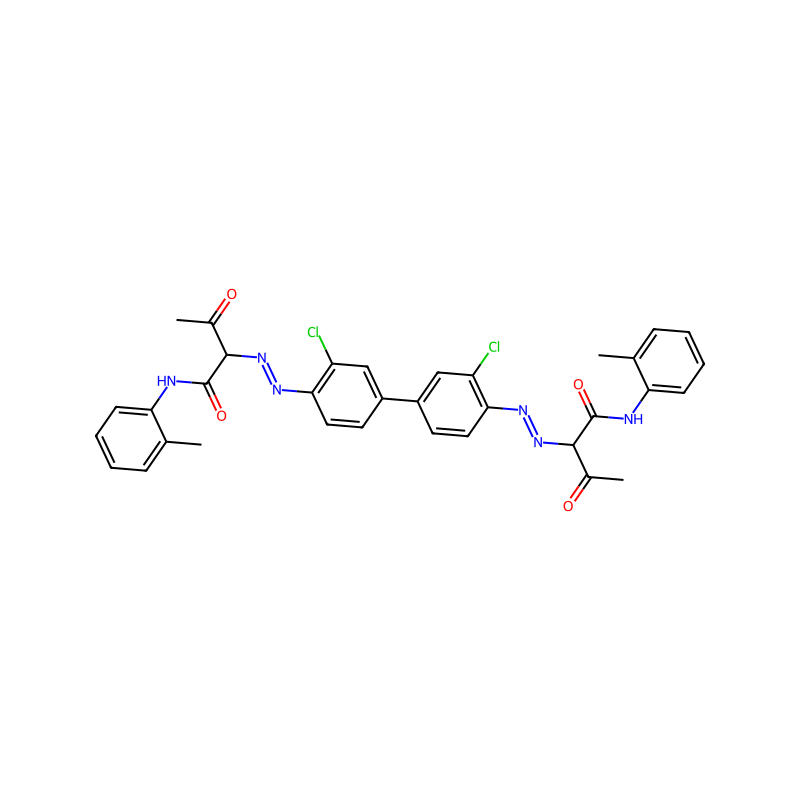
Identifiers & Physical Properties
| CAS No. | 5468-75-7 |
|---|---|
| Molecular formula | C34H30Cl2N6O4 |
| Average molar mass | 657.5 g/mol |
| Monoisotopic mass | 656.1705588 g/mol |
| SMILES | CC(=O)C(N=Nc1ccc(-c2ccc(N=NC(C(C)=O)C(=O)Nc3ccccc3C)c(Cl)c2)cc1Cl)C(=O)Nc1ccccc1C |
| InChIKey | LQZFGPJGXVFSTR-UHFFFAOYSA-N |
| PubChem CID | 93006 |
| EC No. | 226-789-3 |
| DTXSID | DTXSID9027601 |
Chemical & Physical Properties
| XLogP | 8.8 |
|---|---|
| Topological polar surface area | 142 |
| Hydrogen bond donors | 2 |
| Hydrogen bond acceptors | 8 |
| Rotatable bonds | 11 |
| Heavy atoms | 46 |
| Formal charge | 0 |
| Complexity | 1,050 |
| Physical Description | Dry PowderWet SolidCBILiquidOther Solid[EPA ChAMP: Hazard Characterization: C.I. Pigment Yellow 14 - 2010] Yellow odorless powder[BASF MSDS] |
| Boiling point | 793.4±60.0 °C(Predicted) |
| Density | 1.4203 (rough estimate) |
| Refractive index | 1.7350 (estimate) |
| Colour Index | 21095 |
| pKa (acidity coefficient) | 0.99±0.59(Predicted) |
| Physical state | Solid:nanomaterial |
| Color | Yellow to orange |
| Stability | Light Sensitive |
| LogP (partition coefficient) | 0.5 at 24℃ and pH7 |
| CAS DataBase Reference | 5468-75-7(CAS DataBase Reference) |
| FDA UNII | 586X0864EC |
| EPA Substance Registry System | C.I. Pigment Yellow 14 (5468-75-7) |
| GHS pictogram | GHS07 |
| Signal word | Warning |
| GHS hazard statements | H315-H335-H319 |
| GHS precautionary statements | P264-P280-P302+P352-P321-P332+P313-P362-P264-P280-P305+P351+P338-P337+P313P |
| Risk statements (R) | 36/37/38 |
| Safety statements (S) | 26-36/37/39 |
| RTECS number | EJ3512500 |
| TSCA inventory status | TSCA listed |
| REACH registrations | Active |
Safety & Regulations
| GHS classification | This chemical does not meet GHS hazard criteria for 96.8% (489 of 505) of all reports.Not ClassifiedReported as not meeting GHS hazard criteria by 489 of 505 companies (only 3.2% companies provided GHS information). For more detailed information, please visit ECHA C&L website.Aggregated GHS information provided per 505 reports by companies from 5 notifications to the ECHA C&L Inventory.Reported as not meeting GHS hazard criteria per 489 of 505 reports by companies.There are 3 notifications provided by 16 of 505 reports by companies with hazard statement code(s).Information may vary between notifications depending on impurities, additives, and other factors. The percentage value in parenthesis indicates the notified classification ratio from companies that provide hazard codes. Only hazard codes with percentage values above 10% are shown. For more detailed information, please visit ECHA C&L website. |
|---|---|
| Regulatory information | Chemical: Butanamide, 2,2'-[(3,3'-dichloro[1,1'-biphenyl]-4,4'-diyl)bis(azo)]bis[N-(2-methylphenyl)-3-oxo-Butanamide, 2,2'-[(3,3'-dichloro[1,1'-biphenyl]-4,4'-diyl)bis(2,1-diazenediyl)]bis[N-(2-methylphenyl)-3-oxo- is listed on the EPA's Chemical Data Reporting (CDR) system. Manufacturers and importers of Butanamide, 2,2'-[(3,3'-dichloro[1,1'-biphenyl]-4,4'-diyl)bis(2,1-diazenediyl)]bis[N-(2-methylphenyl)-3-oxo- are required to report information about their production and use of this chemical to the EPA under the Toxic Substances Control Act (TSCA). (40 eCFR Part 711)Status: Active Update: 21-02-2023 https://echa.europa.eu/registration-dossier/-/registered-dossier/15898Butanamide, 2,2'-[(3,3'-dichloro[1,1'-biphenyl]-4,4'-diyl)bis(azo)]bis[N-(2-methylphenyl)-3-oxo-: Does not have an individual approval but may be used under an appropriate group standard |
| Other safety information | IMAP assessments - Butanamide, 2,2'-[(3,3'-dichloro[1,1'-biphenyl]-4,4'-diyl)bis(azo)]bis[N-(2-methylphenyl)-3-oxo-: Environment tier I assessmentIMAP assessments - Selected benzidine-congener-based pigments: Human health tier II assessment |
| Hazards summary | Not irritating to skin or eyes in rabbits[IUCLID] Supporting chemicals demonstrate mild irritation or irritation to rabbit skin and eyesNo evidence of skin sensitization in guinea pigsNo systemic toxicity in repeated-dose inhalation and oral studies of rats (doses up to 410 mg/m3 and 2,500 mg/kg/day)No systemic, reproductive, or developmental toxicity in a combined study of rats at doses up to 1,000 mg/kg/dayNo evidence of carcinogenicity in rats or mice[EPA ChAMP: Hazard Characterization: C.I. Pigment Yellow 14 - 2010] Not expected to cause irritation or other adverse health effects if handled properly[BASF MSDS] See Benzidine. |
| Hazard Classes and Categories | Not Classified |
| Protective Action Criteria (PAC) | 15 [mg/m3]170 [mg/m3]990 [mg/m3] |
| TSCA inventory status | TSCA listed |
| RTECS number | EJ3512500 |
| Risk statements (R) | 36/37/38 |
| Signal word | Warning |
| GHS pictogram | GHS07 |
| Safety statements (S) | 26-36/37/39 |
| GHS hazard statements | H315-H335-H319 |
| REACH registrations | Active |
| GHS precautionary statements | P264-P280-P302+P352-P321-P332+P313-P362-P264-P280-P305+P351+P338-P337+P313P |
Applications & Uses
Uses
Pigment Yellow 14 is an organic azo dye used in the textile and printing industries. Pigment Yellow 14 is also used in composite coatings applied to PVC.