HuagongsheHuagongshe Chemistry Print Report · For research reference only
2,3-Diaminopyridine
PYRIDINE-2,3-DIAMINE · 2,3-pyridinediamine · 3-DiaMinopyridine · 2,3-diamino-pyridin · 2,3-DIAMINOPYRIDINE · TIMTEC-BB SBB004339 · Pyridin-2,3-diaMine · Pyridine, 2,3-diamino-
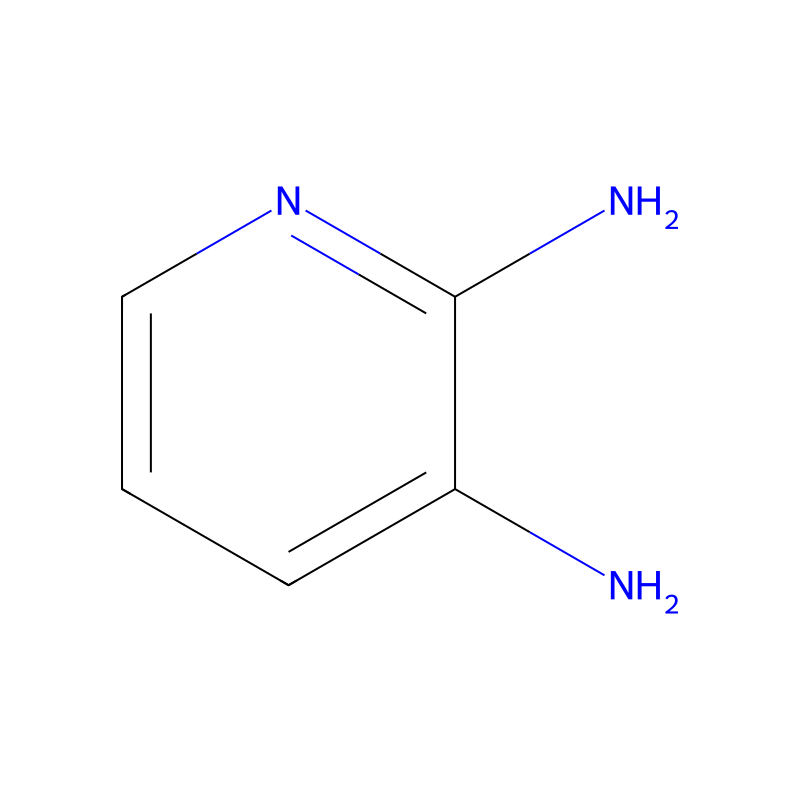
Identifiers & Physical Properties
| CAS No. | 452-58-4 |
|---|---|
| Molecular formula | C5H7N3 |
| Average molar mass | 109.13 g/mol |
| Monoisotopic mass | 109.06399722 g/mol |
| SMILES | Nc1cccnc1N |
| InChIKey | ZZYXNRREDYWPLN-UHFFFAOYSA-N |
| PubChem CID | 9956 |
| ChEBI | CHEBI:195591 |
| EC No. | 207-200-9 |
| DTXSID | DTXSID0051493 |
Chemical & Physical Properties
| XLogP | -0.2 |
|---|---|
| Topological polar surface area | 64.9 |
| Hydrogen bond donors | 2 |
| Hydrogen bond acceptors | 3 |
| Rotatable bonds | 0 |
| Heavy atoms | 8 |
| Formal charge | 0 |
| Complexity | 74.1 |
| Collision Cross Section | 118.5 Ų [M+H]+ [CCS Type: DTBuffer gas: N2Ionization: ESI+Dataset: TOXCASTSource Identifier: DTXSID0051493] |
| Melting point | 110-115 °C (lit.) |
| Boiling point | 195°C 55mm |
| Density | 1.1118 (rough estimate) |
| Refractive index | 1.5340 (estimate) |
| Flash point | 205 °C |
| Storage conditions | Keep in dark place,Sealed in dry,Room Temperature |
| Solubility | H2O: soluble50mg/mL, opaque (brown to very dark brown)100 g/L (20 ºC) |
| Physical state | Solid |
| pKa (acidity coefficient) | 6.78±0.36(Predicted) |
| Color | Very Dark Brown |
| Sensitivity | Air Sensitive |
| BRN | 109869 |
| InChI | 1S/C5H7N3/c6-4-2-1-3-8-5(4)7/h1-3H,6H2,(H2,7,8) |
| InChIKey | ZZYXNRREDYWPLN-UHFFFAOYSA-N |
| SMILES | Nc1cccnc1N |
| CAS DataBase Reference | 452-58-4(CAS DataBase Reference) |
| EWG's Food Scores | 1 |
| FDA UNII | CBX394737H |
| NIST Chemistry Reference | 2,3-Pyridinediamine(452-58-4) |
| UNSPSC Code | 12352116 |
| NACRES | NA.22 |
| GHS pictogram | GHS07 |
| Signal word | Warning |
| GHS hazard statements | H315-H319-H335 |
| GHS precautionary statements | P261-P264-P271-P280-P302+P352-P305+P351+P338 |
| Target organs | Respiratory system |
| Personal protective equipment (PPE) | dust mask type N95 (US), Eyeshields, Faceshields, Gloves |
| Hazard symbols | Xn,Xi,T |
| Risk statements (R) | 22-36/37/38-25 |
| Safety statements (S) | 26-36/37-45-37/39-28A-36 |
| UN transport number | UN 2811 |
| Water hazard class (WGK) | 3 |
| RTECS number | US7548000 |
| F | 9 |
| Hazard Note | Irritant |
| Hazard class | 6.1Eye Irrit. 2Skin Irrit. 2STOT SE 3 |
| Packing group | II |
| Customs code | 29333999 |
| Storage class | 11 - Combustible Solids |
Safety & Regulations
| GHS classification | DangerH301 (15.2%): Toxic if swallowed [Danger Acute toxicity, oral]P261, P264, P264+P265, P270, P271, P280, P301+P316, P301+P317, P302+P352, P304+P340, P305+P351+P338, P317, P319, P321, P330, P332+P317, P337+P317, P362+P364, P403+P233, P405, and P501 (click each P-code to see the statement)Aggregated GHS information provided per 46 reports by companies from 6 notifications to the ECHA C&L Inventory. Each notification may be associated with multiple companies. |
|---|---|
| Hazard Classes and Categories | Acute Tox. 3 (15.2%) |
| F | 9 |
| Personal protective equipment (PPE) | dust mask type N95 (US), Eyeshields, Faceshields, Gloves |
| Water hazard class (WGK) | 3 |
| RTECS number | US7548000 |
| UN transport number | UN 2811 |
| Customs code | 29333999 |
| Risk statements (R) | 22-36/37/38-25 |
| Signal word | Warning |
| GHS pictogram | GHS07 |
| Hazard symbols | Xn,Xi,T |
| hazard_note | Irritant |
| Safety statements (S) | 26-36/37-45-37/39-28A-36 |
| Hazard class | 6.1Eye Irrit. 2Skin Irrit. 2STOT SE 3 |
| Storage class | 11 - Combustible Solids |
| Packing group | II |
| Target organs | Respiratory system |
| GHS hazard statements | H315-H319-H335 |
| GHS precautionary statements | P261-P264-P271-P280-P302+P352-P305+P351+P338 |
Applications & Uses
Uses
2,3-Diaminopyridine was used in the synthesis of 2,3-diaminopyridinium-4-hydroxybenzoate1. It was used as internal standard in analysis of poly(amidoamine)dendrimers having different terminal functionalities by capillary electrophoresis. It was used as reagent in synthesis of imidazopyridines and organometallic complexes.
General Description
2,3-Diaminopyridine forms the bis-condensed Schiff base with salicylaldehyde. It forms charge transfer complex with tetrachloro-p-benzoquinone and tetracyanoethylene.