Participants
| Role | Name | HCID | Charge |
|---|
| Reactant | Hydroxylamine | HCID 787 | — |
| Reactant | Potassium Hydroxide | HCID 14797 | — |
| Reactant | Carbodiimide | HCID 160435 | — |
| Reactant | Hydroxyamine hydrochloride | HCID 443297 | — |
| Reactant | 1-Methyl-3-phenylthiourea | HCID 698294 | — |
| Solvent | Methanol | HCID 887 | — |
| Solvent | Diethyl Ether | HCID 3283 | — |
| Product | HCID 178485196 | HCID 178485196 | 19.7% |
Reaction Steps
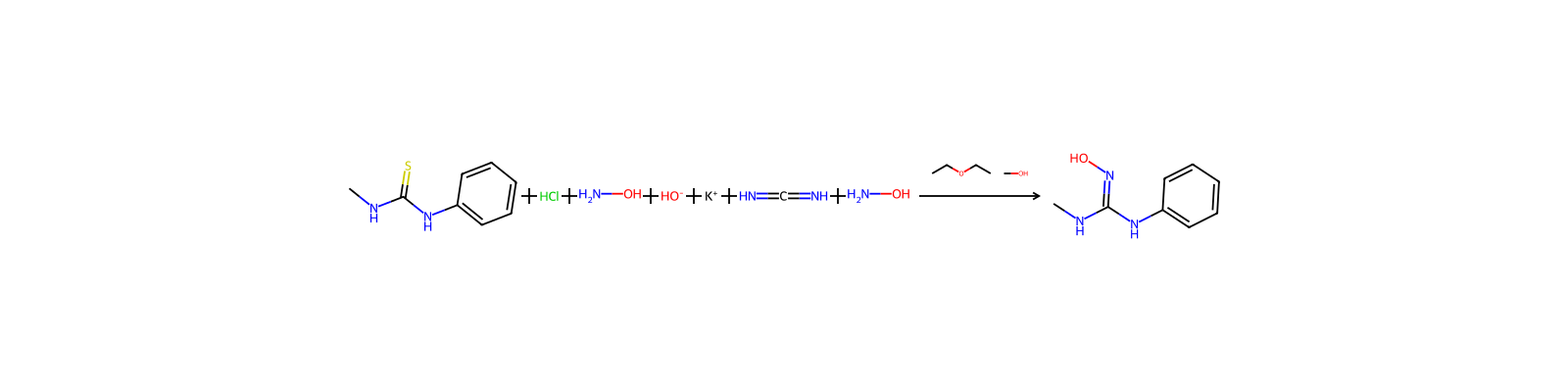
A mixture of 6.6 g (0.04 mole) of 1-phenyl-3-methylthiourea and 17.3 g (0.08 mole) of yellow mercuric oxide in 50 ml of ether was stirred vigorously at room temperature for 0.5 hour. The thick slurry was diluted with additional ether and filtered. To the filtrate was added all at once a solution of hydroxylamine prepared by treating 3.5 g (0.05 mole) of hydroxylamine hydrochloride in 50 ml of methanol at 0° with 2.8 g (0.05 mole) of potassium hydroxide (filtered after 0.5 hour to remove potassium chloride). The ether-methanol solution of the carbodiimide and hydroxylamine was stirred for 0.5 hour, then the solvent was removed at reduced pressure. The residue was dissolved in dilute hydrochloric acid and extracted with methylene chloride to remove neutral impurities. The aqueous layer was then made basic with sodium hydroxide. Extraction with methylene chloride and removal of the solvent gave the crude product. It was recrystallized from methylene chloride/hexane to give 1.3 g of white 1-phenyl-3-methyl-2-hydroxyguanidine, mp 95°-6°; nmr (CDCl3): δ 2.7 (s, 3); 6.9-7.4 (m, 5); 4-7 (very broad, 3). IR (chloroform solution): both OH and NH present. In the antitetrabenazine test, this compound gave a ptosis ED50 of 12.2 mg/kg and exploratory ED50 of > 81 mg/kg.
Provenance & Evidence
| DOI | 10.6084/m9.figshare.5104873.v1 |
|---|
| Patent number | US03954995 |
|---|
| Source dataset | uspto-grants-1976_05 |
|---|
| ORD ID | ord-364d7cb98b944ca4908db868e5719fbc |
|---|
| Source note | uspto-grants-1976_05 |
|---|