Reaction equation
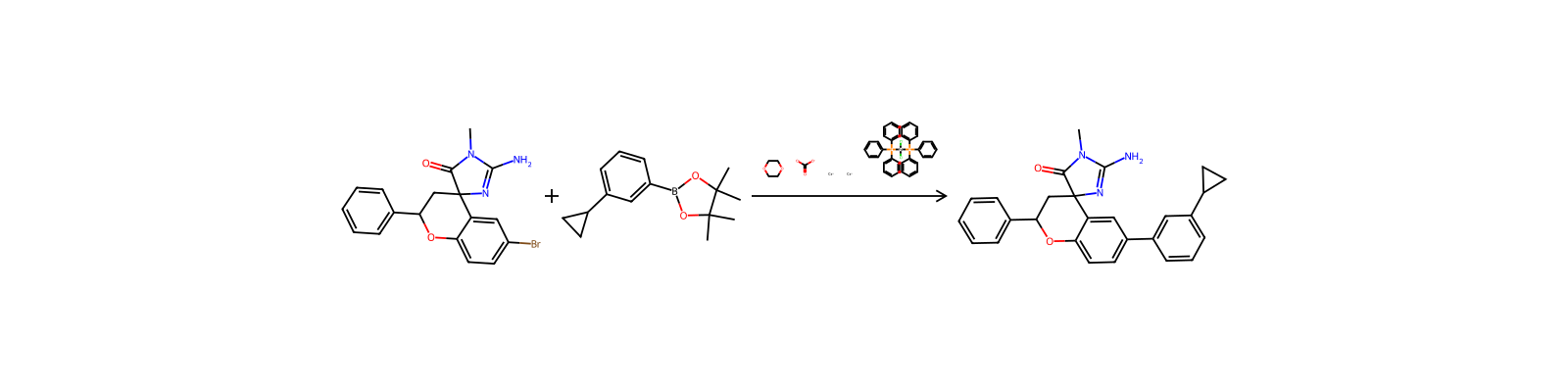
[NH2:1][C:2]1[N:3]([CH3:24])[C:4](=[O:23])[C:5]2([C:15]3[C:10](=[CH:11][CH:12]=[C:13](Br)[CH:14]=3)[O:9][CH:8]([C:17]3[CH:22]=[CH:21][CH:20]=[CH:19][CH:18]=3)[CH2:7]2)[N:6]=1.[CH:25]1([C:28]2[CH:29]=[C:30](B3OC(C)(C)C(C)(C)O3)[CH:31]=[CH:32][CH:33]=2)[CH2:27][CH2:26]1>O1CCOCC1.C([O-])([O-])=O.[Cs+].[Cs+].Cl[Pd](Cl)([P](C1C=CC=CC=1)(C1C=CC=CC=1)C1C=CC=CC=1)[P](C1C=CC=CC=1)(C1C=CC=CC=1)C1C=CC=CC=1>[NH2:1][C:2]1[N:3]([CH3:24])[C:4](=[O:23])[C:5]2([C:15]3[C:10](=[CH:11][CH:12]=[C:13]([C:32]4[CH:31]=[CH:30][CH:29]=[C:28]([CH:25]5[CH2:27][CH2:26]5)[CH:33]=4)[CH:14]=3)[O:9][CH:8]([C:17]3[CH:22]=[CH:21][CH:20]=[CH:19][CH:18]=3)[CH2:7]2)[N:6]=1Participants
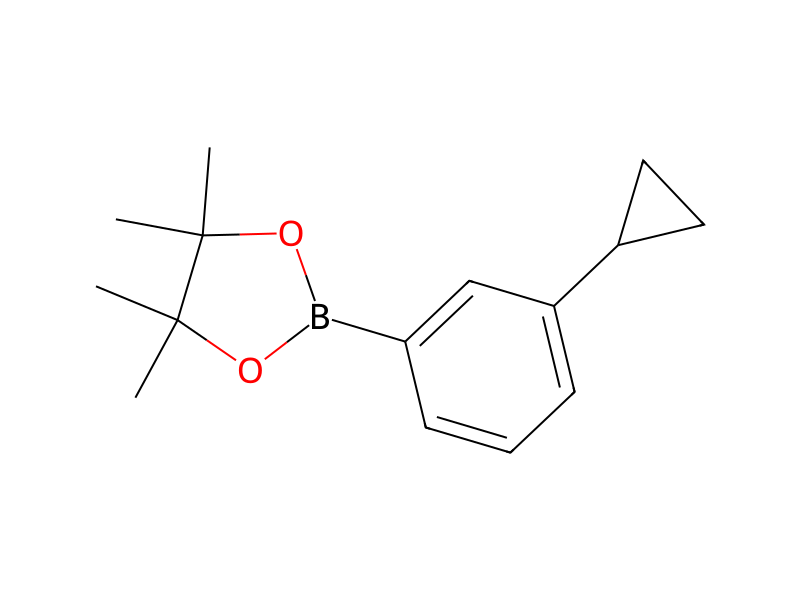
Reactant 2
Product 1

Reagents, catalysts & solvents 3



Procedure
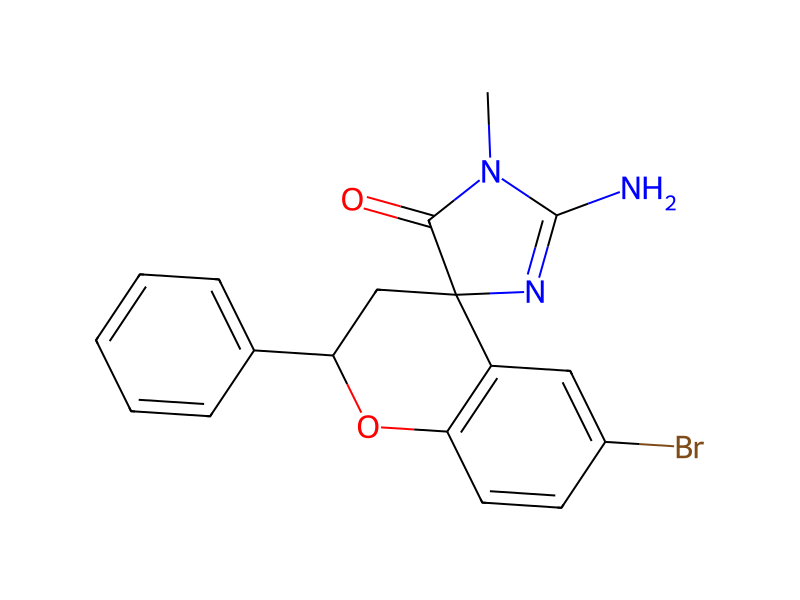
Pd(PPh3)2Cl2 (5 mg, 0.01 mmol) in a 10 mL of flask under Ar was treated sequentially with 2′-amino-6-bromo-1′-methyl-2-phenylspiro[chroman-4,4′-imidazol]-5′(1′H)-one (110 mg, 0.29 mmol) in 1,4-dioxane (5.0 mL), Cs2CO3 (2 N, 1 mL) and 2-(3-cyclopropylphenyl)-4,4,5,5-tetramethyl-1,3,2-dioxaborolane (70 mg, 0.29 mmol) The mixture was refluxed for 2 hour. The reaction mixture was concentrated in vacuo to give the residue, which was purified by preparative TLC and HPLC to give 2′-amino-6-(3-cyclopropylphenyl)-1′-methyl-2-phenylspiro[chroman-4,4′-imidazol]-5′(1′H)-one (3.6 mg, 3%). 1H-NMR (MeOD): 0.71 (m, 1H), 0.98 (m, 1H), 1.97 (m, 1H), 2.31 (m, 1H), 2.65 (m, 0.8H), 2.75 (m, 0.2H), 3.32 (m, 3H), 5.24 (m, 0.2H), 5.86 (m, 0.8H), 6.99 (m, 1H), 7.12 (m, 2H), 7.23 (m, 2H), 7.28 (m, 2H), 7.46 (m, 6H).
Workup
- temperaturewas refluxed for 2 hour
- concentrationThe reaction mixture was concentrated in vacuo
- customto give the residue, which
- customwas purified by preparative TLC and HPLC
Sources & evidence
- ORD record
- ord-b6e78b507ba946399d2c90832eb028e6
- Source dataset
- uspto-grants-2014_12
- Patent number
- US08921359B2
Linked notes
Loading…