Reaction equation

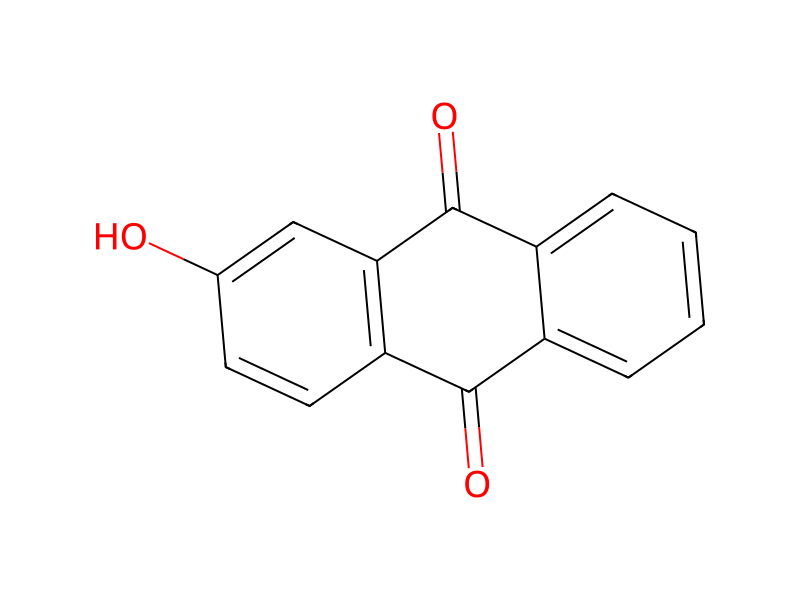
[O:1]([C:8]1[CH:21]=[CH:20][C:19]2[C:18](=[O:22])[C:17]3[C:12](=[CH:13][CH:14]=[CH:15][CH:16]=3)[C:11](=[O:23])[C:10]=2[CH:9]=1)C1C=CC=CC=1.O(C1C=CC(C(C2C=CC=CC=2C(O)=O)=O)=CC=1)C1C=CC=CC=1.O(C1(S([O-])(=O)=O)C=CC2C(=O)C3C(=CC=CC=3)C(=O)C=2C1S([O-])(=O)=O)C1C=CC=CC=1.[Na+].[Na+]>>[OH:1][C:8]1[CH:21]=[CH:20][C:19]2[C:18](=[O:22])[C:17]3[C:12](=[CH:13][CH:14]=[CH:15][CH:16]=3)[C:11](=[O:23])[C:10]=2[CH:9]=1Participants


Procedure
2-phenoxyanthraquinonedisulfonic acid formed as an intermediate product in the course of preparing 2-phenoxyanthraquinonepolysulfonic acid from 2-phenoxyanthraquinone or 2-(p-phenoxybenzoyl) benzoic acid was confirmed, by way of a proton-NMR-absorption spectrum thereof, as having such a structure that the two sulfonic acid groups are bonded, as shown in the reaction formulas (1), to o- and p-positions of the phenoxy group in the 2-phenoxyanthraquinone. FIG. 3 shows a proton-NMR-absorption spectrum (solvent: dimethylacetamide; measuring temp.: room temperature) of sodium 2-phenoxyanthraquinonedisulfonate. This spectrum shows that in the compound of the formula (VII): ##STR11## absorption of proton f is detected in 8.44 ppm (1H), absorption of protons c, h in 8.04-8.3 ppm (3H), absorption of protons e, g in 7.83-8.02 ppm (3H), absorption of proton a in 7.61 ppm (1H), absorption of proton b in 7.42 ppm (1H) and absorption of proton d in 7.1 ppm (1H). It is confirmed therefore that 2-phenoxyanthraquinonedisulfonic acid has the structure shown by the formula (VII). The structure of the formula (VII) is supported also by the fact that when this 2-phenoxyanthraquinonedisulfonic acid is treated under heating with a 5% aqueous solution of sodium hydroxide, the phenoxy group of this compound is split off to afford 2-hydroxyanthraquinone.
Workup
- custom##STR11## absorption of proton f
- customis detected in 8.44 ppm (1H), absorption of protons c, h in 8.04-8.3 ppm (3H), absorption of protons e
- customg in 7.83-8.02 ppm (3H), absorption of proton a
- customin 7.61 ppm (1H), absorption of proton b
- customin 7.42 ppm (1H) and absorption of proton
- additionis treated
- temperatureunder heating with a 5% aqueous solution of sodium hydroxide
- customthe phenoxy group of this compound is split off
Sources & evidence
- ORD record
- ord-da0b7d225b3b46e0bc4af53c0d40354d
- Source dataset
- uspto-grants-1981_06
- Patent number
- US04276187
Linked notes
Loading…