HuagongsheHuagongshe Chemistry Print Report · For research reference only
HRID 1753698Generated: October 24, 2026
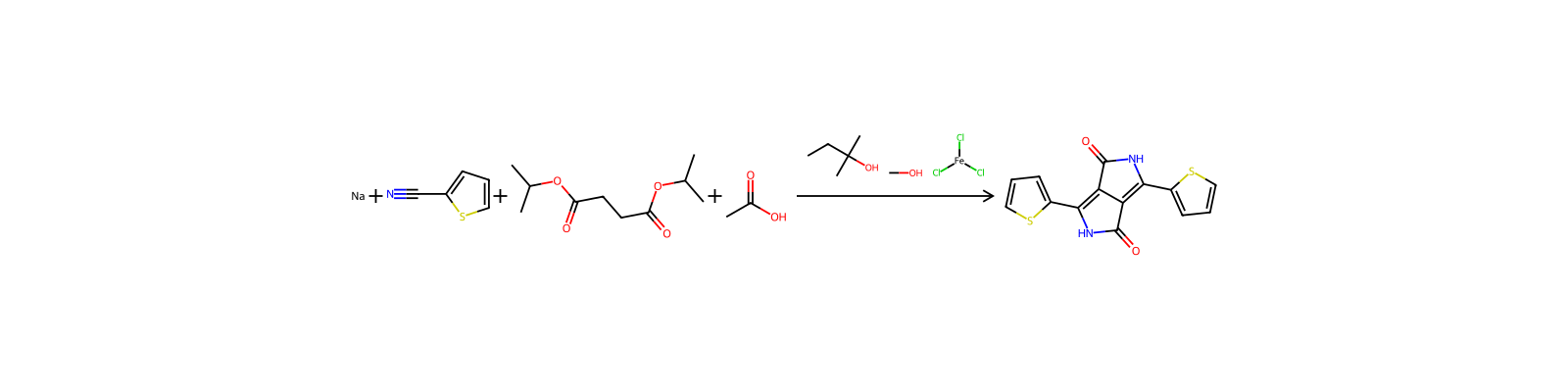
Acetic Acid → 1,4-dithiophen-2-yl-2,5-dihydropyrrolo[3,4-c]pyrrole-3,6-dione
https://huagongshe.com/en/reaction/1753698
Participants
| Role | Name | HCID | Charge |
|---|
| Reactant | Acetic Acid | HCID 176 | — |
| Reactant | 2-Thiophenecarbonitrile | HCID 66087 | — |
| Reactant | Diisopropyl succinate | HCID 70213 | — |
| Reactant | Sodium | HCID 5360545 | — |
| Catalyst | Iron chloride (FeCl3) | HCID 24380 | — |
| Solvent | Methanol | HCID 887 | — |
| Solvent | 2-Methyl-2-butanol | HCID 6405 | — |
| Product | 1,4-dithiophen-2-yl-2,5-dihydropyrrolo[3,4-c]pyrrole-3,6-dione | HCID 178517529 | — |
Reaction Steps
Fine pieces of sodium metal (6.90 g, 0.30 mol) were added to 100 mL t-amyl alcohol and a small amount of iron (iii) chloride (100 mg) was added. The mixture was stirred vigorously for 2 hr at 105° C. until sodium disappeared. The solution was cooled at 85° C. 2-Thiophenecarbonitrile (22.0 g, 0.2 mol) was added to the resultant solution. Then diisopropyl succinate (16.6 g, 0.08 mol) was dissolved in 10 mL of t-amyl alcohol and added drop wise over 1 hr at 85° C. Reaction was stirred at this temperature for 12 hrs. The reaction mixture was then cooled to 50° C., diluted with 100 mL of methanol, and then slowly neutralized with 30 ml of glacial acetic acid and refluxed briefly, and the reaction mixture was filtered. After the residue was washed several times with hot methanol and water, the resultant solid was dried in vacuum oven at 50° C. A dark red colored powder was obtained which was used further without purification (20 g, 83%).
Provenance & Evidence
| DOI | 10.6084/m9.figshare.5104873.v1 |
|---|
| Patent number | US09166167B2 |
|---|
| Source dataset | uspto-grants-2015_10 |
|---|
| ORD ID | ord-91c2c12475a44be8a7aa62493dace166 |
|---|
| Source note | uspto-grants-2015_10 |
|---|