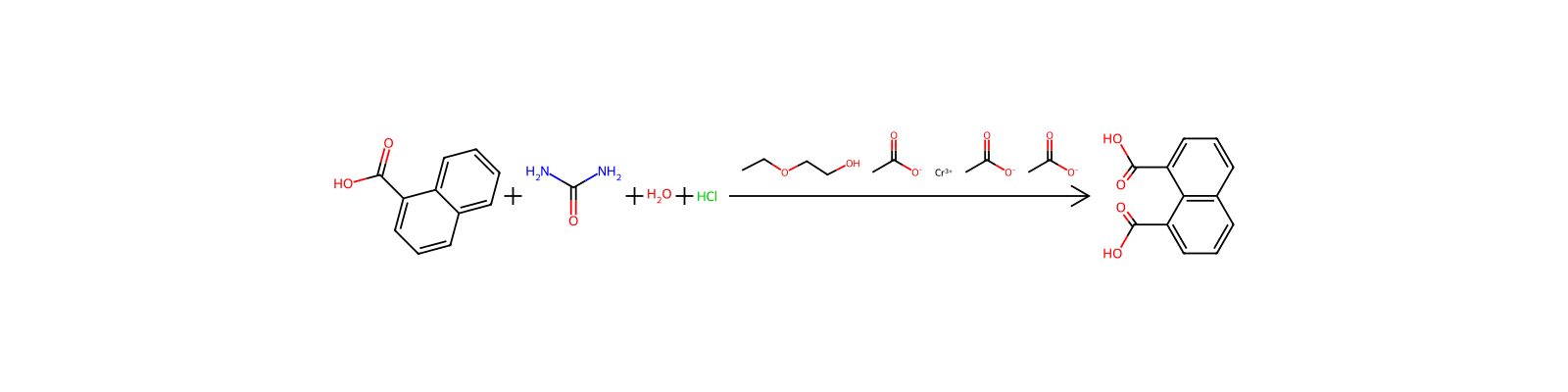
Participants
| Role | Name | HCID | Charge |
|---|
| Reactant | Hydrochloric Acid | HCID 313 | — |
| Reactant | Water | HCID 962 | — |
| Reactant | Urea | HCID 1176 | — |
| Reactant | 1-Naphthoic acid | HCID 6847 | — |
| Catalyst | Chromium(III) acetate | HCID 14012 | — |
| Solvent | Glycol monoethyl ether | HCID 8076 | — |
| Product | Naphthalic acid | HCID 68204 | — |
Reaction Steps
A 86.5 g quantity of naphthalic acid (i.e., 1,8-naphthalic acid or 1,8-naphthalene dicarboxylic acid) was dissolved in 300 g of ethyl cellosolve, and chromium acetate (0.2 equivalent calculated as atomic weight of Cr) and 30 g of urea were added to the solution. The mixture was stirred at 100° to 115° C. for 2 hours. The reaction mixture was in the form of a bluish green supernatent liquid. The mixture was cooled to 30° C. and placed into 1 liter of water containing 60 g of 35% hydrochloric acid, whereby a pale bluish green precipitate was formed. The precipitate was filtered off and washed with water until the pH thereof became 6 to 7. The precipitate was dried to give 95 g of Cr complex compound of 1,8-naphthalic acid (hereinafter referred to as "Complex Compound 2"). Complex Compound 2 was found to have good thermal stability (as tested at temperatures of below 350° C. in the same manner as described in Example 1).
Provenance & Evidence
| DOI | 10.6084/m9.figshare.5104873.v1 |
|---|
| Patent number | US04403027 |
|---|
| Source dataset | uspto-grants-1983_09 |
|---|
| ORD ID | ord-5083c59b4b06484f9bada5f99b3dfa63 |
|---|
| Source note | uspto-grants-1983_09 |
|---|