Participants
| Role | Name | HCID | Charge |
|---|
| Reactant | Hydrochloric Acid | HCID 313 | — |
| Reactant | Aniline | HCID 6115 | — |
| Reactant | 4-Bromoaniline | HCID 7807 | — |
| Reactant | Ammonium Sulfite | HCID 25041 | — |
| Reactant | Sodium Nitrite | HCID 23668193 | — |
| Solvent | Water | HCID 962 | — |
| Product | 4-Bromophenylhydrazine | HCID 12158 | 67.2% |
Reaction Steps
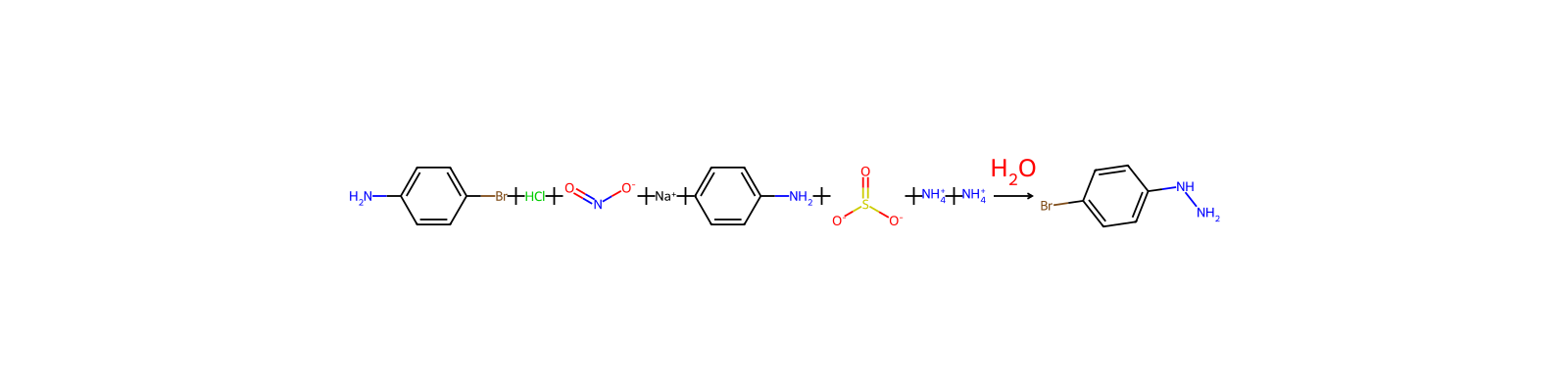
To a 1 L flask were added finely powdered p-bromoaniline (69 g, 0.4 mol), water (200 mL) and conc. HCl (100 mL, 1.2 mol). The mixture was cooled in an ice bath to less than 5° C. A solution of sodium nitrite (30 g, 0.43 mol) in water (90 mL) was added dropwise to the aniline suspension over approx. 1 h, while maintaining the temperature at less than 5° C. The mixture was stirred for a further 30 min and then was gravity filtered through a No. 1 paper into a chilled flask. The solution was added in small portions to a solution of 92% ammonium sulfite (118 g, 0.8 mol) in water (250 mL), which had been chilled to 0° C., at a rate such that the temperature remained at less than 5° C. (approx. 1 h). During the addition a yellow solid formed in the mixture. After the addition was completed, stirring was continued for 1 h at 0° C. and the mixture was then allowed to warm to rt. The solid was filtered off and the filtrate was treated with conc. HCl (120 mL). The solution was heated to reflux during which time a solid formed and then mostly dissolved. The hot solution was filtered and then allowed to cool to rt before chilling in a refrigerator overnight. The crystals were filtered off and were washed with 1 M HCl (60 mL). The solid was added to a mixture of DCM (1 L) and 1N sodium hydroxide (600 mL) and the suspension was shaken until the solid dissolved. The layers were separated and the aqueous phase was washed again with DCM (2×400 mL). The combined organic solutions were dried (MgSO4), filtered and the solvent was evaporated in vacuo to afford p-bromophenylhydrazine (50.3 g, 67%).
Provenance & Evidence
| DOI | 10.6084/m9.figshare.5104873.v1 |
|---|
| Patent number | US07868157B2 |
|---|
| Source dataset | uspto-grants-2011_01 |
|---|
| ORD ID | ord-8bf1d2d52cde4519b4752fdf53c88c68 |
|---|
| Source note | uspto-grants-2011_01 |
|---|