HuagongsheHuagongshe Chemistry Print Report · For research reference only
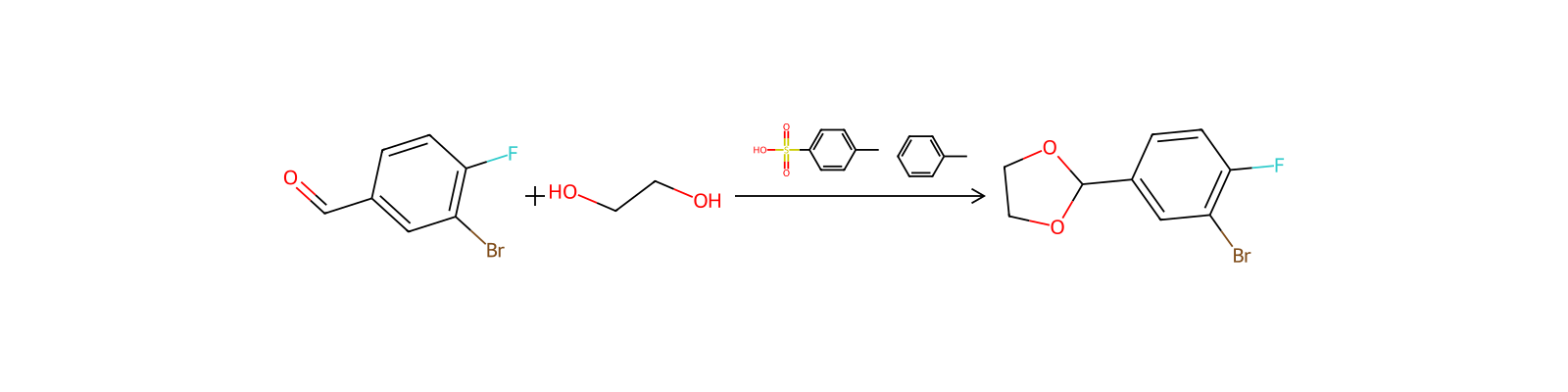
Ethylene Glycol → 1,3-Dioxolane, 2-(3-bromo-4-fluorophenyl)-
Participants
| Role | Name | HCID | Charge |
|---|---|---|---|
| Reactant | Ethylene Glycol | HCID 174 | — |
| Reactant | 3-Bromo-4-fluorobenzaldehyde | HCID 173604 | — |
| Catalyst | p-Toluenesulfonic acid | HCID 6101 | — |
| Solvent | Toluene | HCID 1140 | — |
| Product | 1,3-Dioxolane, 2-(3-bromo-4-fluorophenyl)- | HCID 10977765 | 78.3% |
Reaction Steps
A mixture of 3-bromo-4-fluorobenzaldehyde (45.7 g), ethylene glycol (27.39 g), p-toluenesulphonic acid (0.225 g) and dry toluene (110 cm3) was heated at the reflux temperature under a Dean and Stark trap. After 4.5 hours, approximately 12 cm3 of water had collected in the trap, and analysis of the reaction mixture by gas liquid chromatography indicated that no starting aldehyde was present. The mixture was washed with sodium bicarbonate solution and brine, and dried over anhydrous magnesium sulphate. Evaporation of the solvent under reduced pressure gave a yellow oil, which was purified by distillation under reduced pressure to give 2-(3-bromo-4-fluorophenyl)-1,3-dioxolane (43.56 g), boiling point 68°-106° C. at 0.04 mmHg.
Provenance & Evidence
| DOI | 10.6084/m9.figshare.5104873.v1 |
|---|---|
| Patent number | US04762835 |
| Source dataset | uspto-grants-1988_08 |
| ORD ID | ord-c060ac6cc12e4d48b786ab94b72b761c |
| Source note | uspto-grants-1988_08 |