HuagongsheHuagongshe Chemistry Print Report · For research reference only
HRID 445136Generated: October 24, 2026
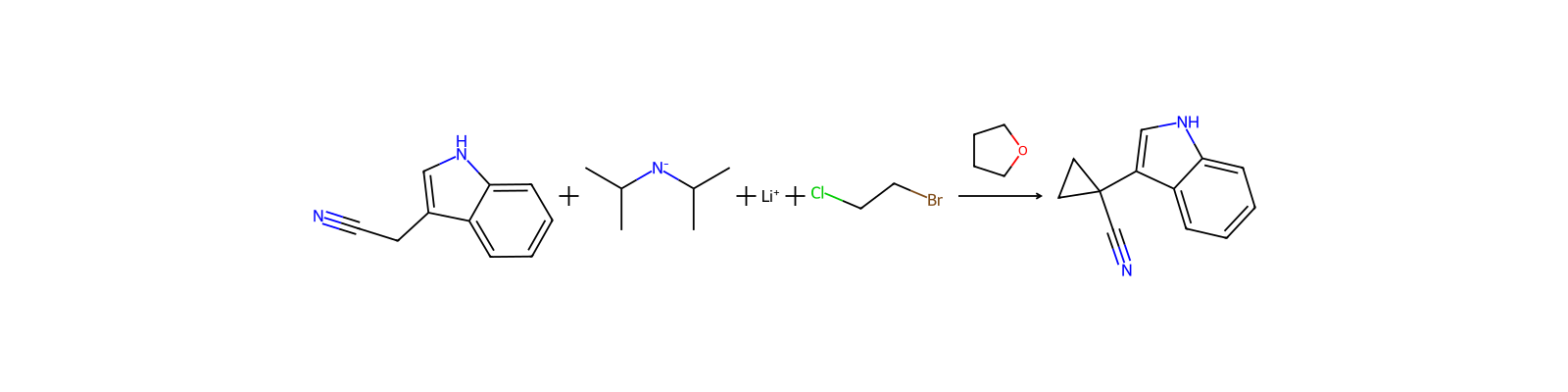
1-Bromo-2-Chloroethane → 1-(1H-Indol-3-yl)cyclopropanecarbonitrile
https://huagongshe.com/en/reaction/445136
Participants
| Role | Name | HCID | Charge |
|---|
| Reactant | 1-Bromo-2-Chloroethane | HCID 7849 | — |
| Reactant | Indole-3-acetonitrile | HCID 351795 | — |
| Reactant | Lithium diisopropylamide | HCID 2724682 | — |
| Solvent | Tetrahydrofuran | HCID 8028 | — |
| Product | 1-(1H-Indol-3-yl)cyclopropanecarbonitrile | HCID 15378324 | — |
Reaction Steps
1H-indole-3-ylacetonitrile (18.7 g) was dissolved in tetrahydrofuran (240 mL) and, after cooling to −30° C., lithium diisopropylamide (2.0M heptane/tetrahydrofuran/ethylbenzene solution, 240 mL) was added dropwise, followed by stirring at −5° C. for 30 minutes. The reaction mixture was cooled to −30° C. and 1-bromo-2-chloroethane (11.0 mL) was added dropwise, followed by stirring for 2 hours while heating to 0° C. The reaction mixture was poured into ice/hydrochloric acid (2N, 360 mL) and extracted with ethyl acetate. The organic layer was washed in turn with water, an aqueous saturated sodium hydrogen carbonate solution and saturated saline, dried over anhydrous magnesium sulfate and then concentrated. The residue was purified by silica gel column chromatography (hexane:ethyl acetate=3:1) to obtain a compound and the compound was recrystallized from (hexane:ethyl acetate=1:1) to obtain the titled compound having the following physical properties (8.67 g).
Provenance & Evidence
| DOI | 10.6084/m9.figshare.5104873.v1 |
|---|
| Patent number | US08476293B2 |
|---|
| Source dataset | uspto-grants-2013_07 |
|---|
| ORD ID | ord-f08f170c81f44a6eb2665abafbddf2c2 |
|---|
| Source note | uspto-grants-2013_07 |
|---|