HuagongsheHuagongshe Chemistry Print Report · For research reference only
HRID 53907Generated: October 23, 2026
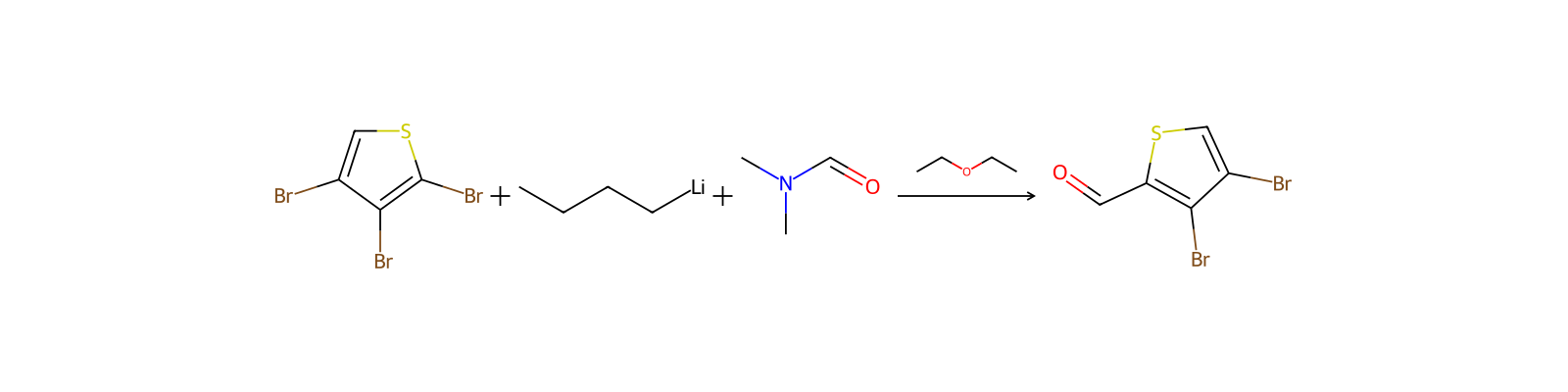
Dimethylformamide → 3,4-Dibromothiophene-2-carbaldehyde
https://huagongshe.com/en/reaction/53907
Participants
| Role | Name | HCID | Charge |
|---|
| Reactant | Dimethylformamide | HCID 6228 | — |
| Reactant | 2,3,4-Tribromothiophene | HCID 76593 | — |
| Reactant | Butyllithium | HCID 178418339 | — |
| Solvent | Diethyl Ether | HCID 3283 | — |
| Product | 3,4-Dibromothiophene-2-carbaldehyde | HCID 12559528 | 50.9% |
Reaction Steps
A solution of 2,3,4-tribromothiophene (2.56 g, 0.0080 mol) in 20 mL of diethyl ether was cooled to -78° C. and then n-butyllithium (5.0 mL, 1.6M) in hexanes was added slowly from an addition funnel. When the addition was complete, the reaction mixture was stirred for 15 minutes. Then DMF (0.88 g, 1.2 mol) was added in one portion. The reaction mixture was gradually warmed to room temperature and was left to stir overnight. The reaction was quenched with aqueous ammonium chloride solution and extracted twice with diethyl ether. The organic extracts were combined, washed with two small portions of water and then brine and dried (MgSO4). The solution was filtered and concentrated, and the residue was purified on flash silica gel with 2.5% diethyl ether-hexanes to provide 1.1 g of 3,4-dibromothiophene-2-carboxaldehyde as an off-white solid. The above sequence was repeated as above except that the n-butyllithium was cooled to -78° C. and then was added to the thiophene solution by cannulation. The reaction mixture was stirred for 2 h before DMF was added. The reaction was worked up as before and the crude product was recrystallized from ether to give 0.9 g of product. A third preparation was also done. A solution of 2,3,4-tribromothiophene (4.8 g, 0.015 mol) in 20 mL of diethyl ether was cooled to -78° C. and then n-butyllithium (10.0 mL, 1.6M) was added slowly from an addition funnel. When the addition was complete, the reaction mixture was stirred for 15 minutes. Then DMF (1.82 g, 0.025 mol) was added in one portion. The reaction mixture was gradually warmed to room temperature, and was left to stir overnight. The reaction was quenched with aqueous ammonium chloride solution and extracted twice with diethyl ether. The organic extracts were combined, washed with two small portions of water and then brine and dried (MgSO4). The solution was filtered and concentrated, and the residue was purified on flash silica gel with 2.5% diethyl ether-hexanes. The product was combined with the previous batches of 3,4-dibromothiophene-2-carboxaldehyde and recrystallized from diethylether to give 3.7 g of 3,4-dibromothiophene-2-carboxaldehyde, A8, whose NMR in CDCl3 supported the desired product structure. ##STR48##
Provenance & Evidence
| DOI | 10.6084/m9.figshare.5104873.v1 |
|---|
| Patent number | US05621113 |
|---|
| Source dataset | uspto-grants-1997_04 |
|---|
| ORD ID | ord-73836d3431ae495e8fc4af6ef768649b |
|---|
| Source note | uspto-grants-1997_04 |
|---|