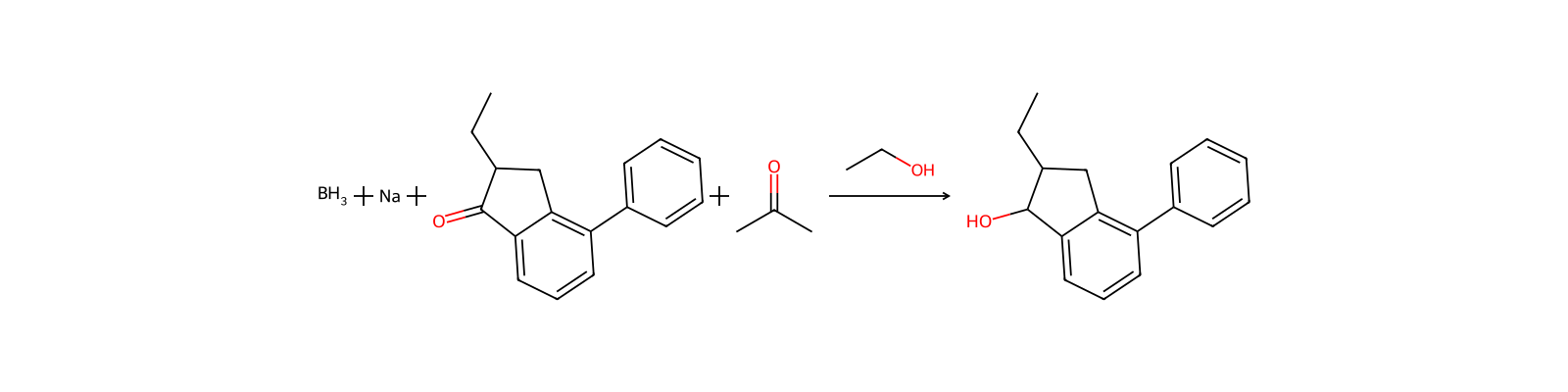
Participants
| Role | Name | HCID | Charge |
|---|
| Reactant | Acetone | HCID 180 | — |
| Reactant | 2-Ethyl-4-phenyl-1-indanone | HCID 22173218 | — |
| Reactant | HCID 178418435 | HCID 178418435 | — |
| Solvent | Ethanol | HCID 702 | — |
| Product | 2-Ethyl-1-hydroxy-4-phenylindan | HCID 22340215 | 99.3% |
Reaction Steps
To a 200-ml three-necked round flask (equipped with a stirrer tip, a Dimroth condenser, a dropping funnel and a thermometer) were introduced 0.85 g (22.6 mmol) of sodium boron hydride and 28 ml of ethanol, and then in a nitrogen atmosphere at room temperature, a solution of 10.6 g (45.1 mmol) of 2-ethyl-4-phenyl-1-indanone in 20 ml of ethanol was dropwise added. After the dropwise addition was completed, the temperature was elevated to 50° C. to perform reaction for further 3.5 hours. After the reaction, the mixture was cooled, and acetone was dropwise added to decompose the unreacted sodium boron hydride. Then, the reaction mixture was concentrated under reduced pressure and extracted with 50 ml of water and 50 ml of ether. The organic phase was separated, and the aqueous phase was extracted twice with 50 ml of ether. The combined organic phases were washed with 100 ml of a saturated saline solution and dried over anhydrous Na2SO4. Then, the solvent was distilled off under reduced pressure to obtain 10.67 g of the aimed product (a mixture of two isomers) as a viscous, light yellow liquid (yield: 99%). The properties of the product thus obtained are described below.
Provenance & Evidence
| DOI | 10.6084/m9.figshare.5104873.v1 |
|---|
| Patent number | US05998039 |
|---|
| Source dataset | uspto-grants-1999_12 |
|---|
| ORD ID | ord-26d728dca65e4327955dcc14f90f46d3 |
|---|
| Source note | uspto-grants-1999_12 |
|---|