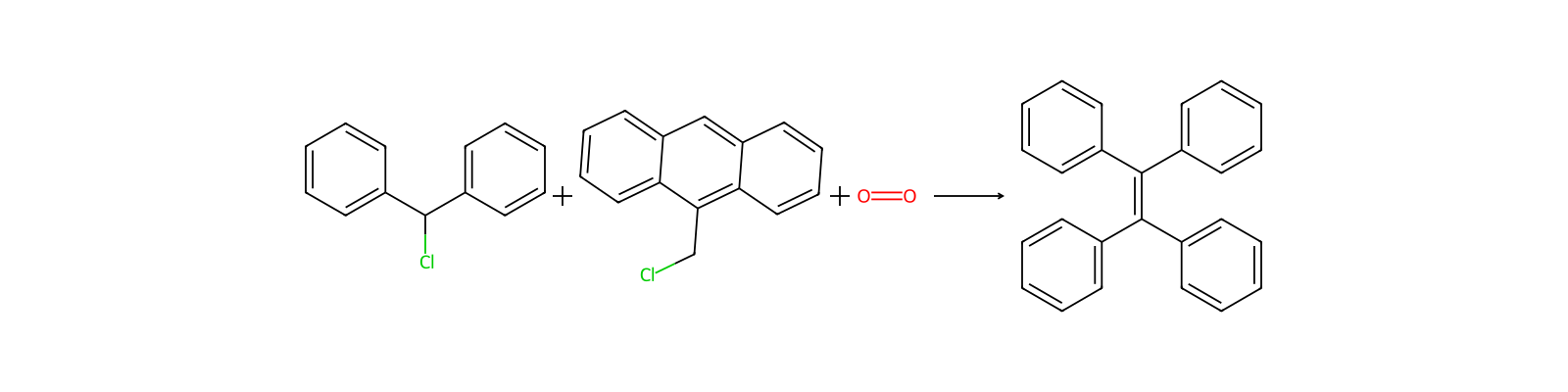
Participants
| Role | Name | HCID | Charge |
|---|
| Reactant | Oxygen | HCID 977 | — |
| Reactant | Chlorodiphenylmethane | HCID 7035 | — |
| Reactant | 9-(Chloromethyl)anthracene | HCID 32385 | — |
| Product | Tetraphenylethylene | HCID 69437 | — |
Reaction Steps
N,N'-Bisbenzyl spirodiamide 11 was obtained by diethyl ether extraction from the brine-DMSO reaction mixture in 80-93% yield. Bulkier derivatives N,N'-bis(diphenylmethyl)-spirodiamide 12 and N,N'-bis(9-anthracenylmethyl)-spirodiamide 13 have also been synthesized from diphenymethyl chloride and 9-anthracenylmethyl chloride, respectively. N,N'-bis(9-anthracenylmethyl)spirodiamide 13 was synthesized using the same method as bisbenzyl derivative 11 and isolated by column chromatography in 35% yield. The anthracenyl group in 13 is sensitive to oxygen, so analytically pure crystalline product was collected directly from fractions by cooling the chromatography fractions in a refrigerator under nitrogen. Diphenylmethyl chloride itself reacted with the basic equilibrium mixture of sodium methylsulfinylcarbanion and spirodiamide dianion in DMSO to produce a fluorescent product, tetraphenylethene. By employing a 100% excess of diphenylmethyl chloride, N,N'-bis(diphenylmethyl)-spirodiamide 12 was isolated by column chromatography in 22% yield.
Provenance & Evidence
| DOI | 10.6084/m9.figshare.5104873.v1 |
|---|
| Patent number | US05128466 |
|---|
| Source dataset | uspto-grants-1992_07 |
|---|
| ORD ID | ord-e1d2da41bdb046d9bb5aa1a16b2dd3e5 |
|---|
| Source note | uspto-grants-1992_07 |
|---|