Participants
| Role | Name | HCID | Charge |
|---|
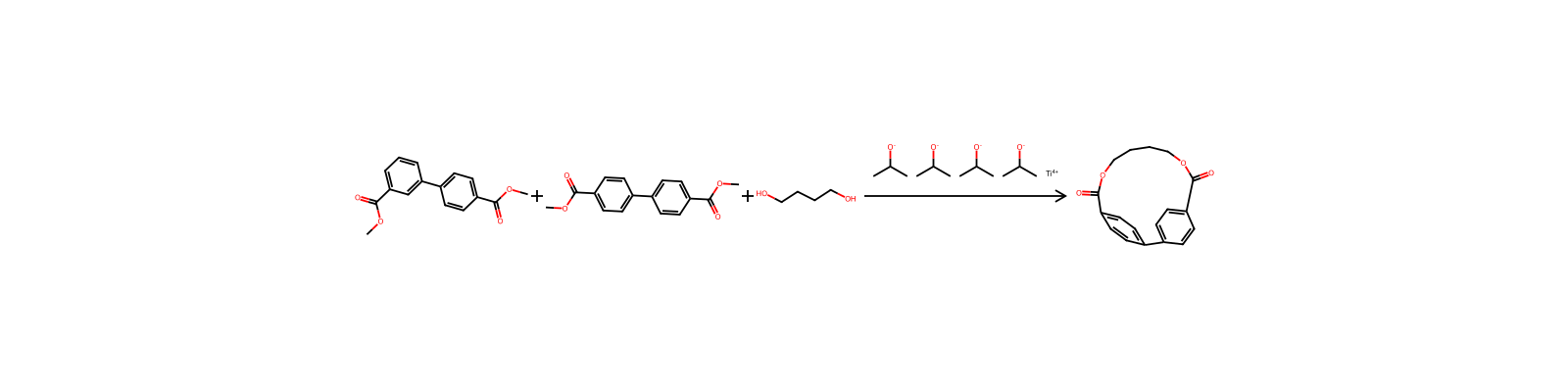
| Reactant | 1,4-Butanediol | HCID 8064 | — |
| Reactant | Dimethyl 4,4'-biphenyldicarboxylate | HCID 13099 | — |
| Reactant | (1,1'-Biphenyl)-3,4'-dicarboxylic acid, 3,4'-dimethyl ester | HCID 108747 | — |
| Catalyst | Titanium isopropoxide | HCID 11026 | — |
| Product | Butylene 4,4'-biphenyldicarboxylate | HCID 86746069 | — |
Reaction Steps
Dimethyl 3,4'-biphenyldicarboxylate (5.41 g, 0.0200 mole), 21.62 g (0.0800 mole) of dimethyl 4,4'-biphenyldicarboxylate, 18.24 g (0.200 mole) of 1,4-butanediol and 20 μL of titanium tetraisopropoxide are added to a 100-mL round bottom flask equipped with a paddle stirrer, 15-cm heated Vigreux column, distillation head, condenser and graduated receiver. The apparatus is evacuated and refilled with nitrogen three times. A molten salt bath preheated to 220° C. is raised around the flask and after the monomers have melted, the stirrer is started. Methanol begins to distill and after 20 minutes, 7.0 mL is collected. During the next 27 minutes, the temperature is increased to 281° C. then the pressure is slowly reduced to 1 mm Hg. The excess 1,4-butanediol distills and viscosity of the reaction mass slowly increases. After an additional 8 minutes, the clear colorless polymer melt becomes very viscous and the polymerization is stopped. As it cools, the polymer melt quickly crystallizes to an opaque white solid which is then ground to a course powder. The polymer's inherent viscosity is 1.16 dL/g and its peak melting point is 266° C.
Provenance & Evidence
| DOI | 10.6084/m9.figshare.5104873.v1 |
|---|
| Patent number | US05138022 |
|---|
| Source dataset | uspto-grants-1992_08 |
|---|
| ORD ID | ord-71a0f1c9aef04ff1aa2bc04c45d3dc3c |
|---|
| Source note | uspto-grants-1992_08 |
|---|