Reaction equation
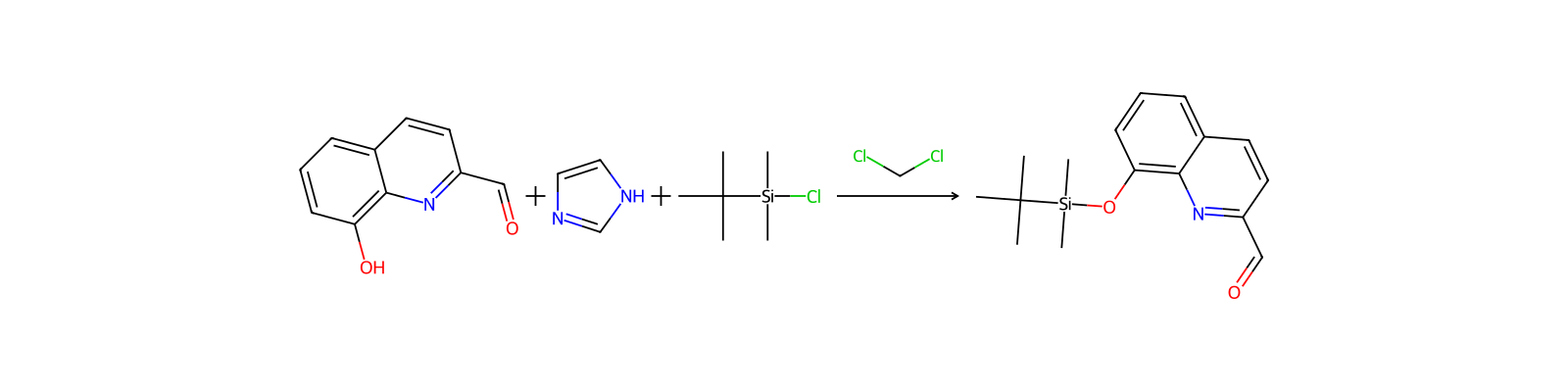
[OH:1][C:2]1[CH:3]=[CH:4][CH:5]=[C:6]2[C:11]=1[N:10]=[C:9]([CH:12]=[O:13])[CH:8]=[CH:7]2.N1C=CN=C1.[C:19]([Si:23](Cl)([CH3:25])[CH3:24])([CH3:22])([CH3:21])[CH3:20]>C(Cl)Cl>[Si:23]([O:1][C:2]1[CH:3]=[CH:4][CH:5]=[C:6]2[C:11]=1[N:10]=[C:9]([CH:12]=[O:13])[CH:8]=[CH:7]2)([C:19]([CH3:22])([CH3:21])[CH3:20])([CH3:25])[CH3:24]Participants
5




Conditions
- Temperature
- 0 °C
Procedure
8-Hydroxyquinoline-2-carbaldehyde (5.00 g, 28.9 mmol) and imidazole (4.32 g, 63.5 mmol) were dissolved in DCM (50 mL) under N2. The reaction mixture was cooled to 0° C., followed by addition of tert-butylchlorodimethylsilane (4.94 g, 31.8 mmol). After stirring for 16 hours at ambient temperature the reaction mixture was partitioned between DCM and H2O. The organic layer was washed with H2O and aqueous saturated NaHCO3, dried over Na2SO4, filtered and concentrated under reduced pressure to afford an orange oil. The residue was purified by flash column chromatography (10:1 Hexanes/EtOAc) to provide 6.85 g (83%) of desired product as a yellow/orange oil.
Workup
- customwas partitioned between DCM and H2O
- washThe organic layer was washed with H2O and aqueous saturated NaHCO3
- dry with materialdried over Na2SO4
- filtrationfiltered
- concentrationconcentrated under reduced pressure
- customto afford an orange oil
- customThe residue was purified by flash column chromatography (10:1 Hexanes/EtOAc)
Sources & evidence
- ORD record
- ord-a4b6dd338c934e2d88337b6f40bda95d
- Source dataset
- uspto-grants-2015_03
- Patent number
- US08987251B2
Linked notes
Loading…