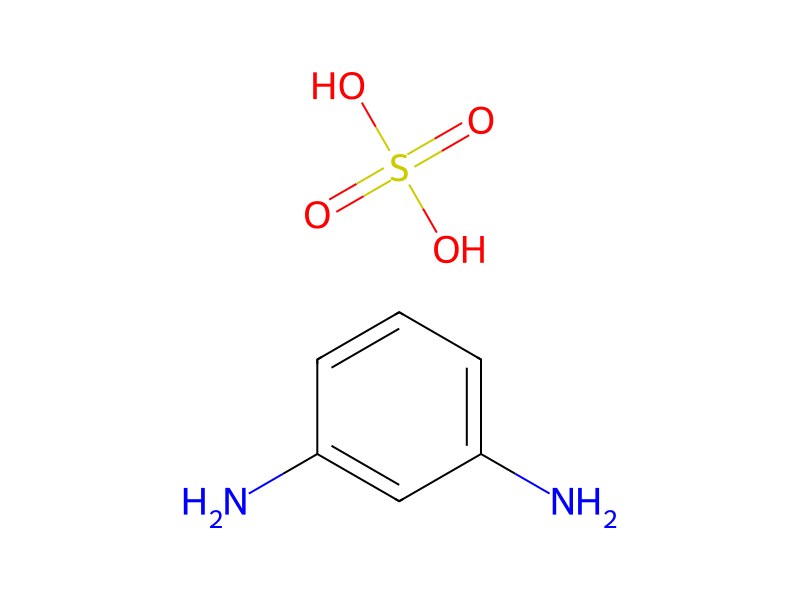
基本情報
- 標準SMILES
Nc1cccc(N)c1.O=S(=O)(O)O- InChIKey
LDXYDHGRKFMULJ-UHFFFAOYSA-N- 分子式
- C6H8N2.H2O4S
- 平均分子量
- 206.22 g/mol
- 単同位体質量
- 206.0361278
概要
On the basis of the animal and clinical data included in this report, the CIR Expert Panel concludes that m-Phenylenediamine and m-Phenylenediamine Sulfate are safe for use in hair dyes at concentrations of up to 10%.
名称と識別子
- 優先名称
- 1,3-Benzenediamine, sulfate (1:1)
- IUPAC
- benzene-1,3-diamine;sulfuric acid
- 現地名
- 硫酸 m-フェニレンジアミン
- 英語名
- 1,3-Phenylenediamine sulfate
- 分子式
- C6H10N2O4S
- 分子量
- 206.22
名称と別名
名称をさらに表示
データベース識別子
- CAS
541-70-8- PubChem CID
- 10942
- DTXSID
DTXSID7060251- UNII
- O7CFS23KOR
- EC Number
- 208-791-6
物性
構造計算による物性
- 極性表面積
- 135 Ų
- 水素結合供与体数
- 4
- 水素結合受容体数
- 6
- 回転可能結合数
- 0
- 重原子数
- 13
- 形式電荷
- 0
- 複雑度
- 146
実験および物理化学的性質
物理化学的性質
- 水溶解度
- Soluble in water
- 外見
- powder to crystal
- 色
- White to Light yellow to Purple
- 化粧品成分の機能
- ヘアカラーリング
- CAS データベース
- 541 · 541-70-8(CAS DataBase Reference)
- EPAの化学物質情報
- 1 · 1,3-Benzenediamine, sulfate (1:1) (541-70-8)
安全と法規制
GHS分類
GHS Classification
Danger
H301 (87.5%): Toxic if swallowed [Danger Acute toxicity, oral]
P261, P262, P264, P264+P265, P270, P271, P272, P273, P280, P301+P316, P301+P317, P302+P352, P304+P340, P305+P351+P338, P316, P317, P321, P330, P333+P317, P337+P317, P361+P364, P362+P364, P391, P403+P233, P405, and P501 (click each P-code to see the statement)
Aggregated GHS information provided per 8 reports by companies from 3 notifications to the ECHA C&L Inventory. Each notification may be associated with multiple companies.
Danger
H301: Toxic if swallowed [Danger Acute toxicity, oral]
危険有害性情報
Regulatory Information
Chemical: 1,3-Benzenediamine, sulfate (1:1)
1,3-Benzenediamine, sulfate (1:1): Does not have an individual approval but may be used as a component in a product covered by a group standard. It is not approved for use as a chemical in its own right.
Hazards Summary
Can potentially induce methemoglobinemia; Emergency treatment: Paraphenylenediamine; In sensitized individuals, paraphenylenediamine may cause allergic contact dermatitis following application as a hair dye and asthma following inhalation; Following ingestion, can cause angioneurotic edema, methemoglobinemia, acute tubular necrosis, and hepatotoxicity; An adult died after ingestion of 3 grams of p-phenylenediamine; Another adult who ingested 1800 mg developed angioneurotic edema and acute renal failure; [HSDB] See m-Phenylenediamine.
Special Reports
USEPA; Phenylenediamines; response to interagency testing committee; Fed Regist 47 (5): 973-83 (1982). Evidence is given supporting testing of the class of cmpd phenylenediamines for their toxic effects on human health and the environment. The results of toxicity testing of 22 cmpd are tabulated as are the effects for which testing is being considered for 13 cmpd, and the uses or potential uses of 47 phenylenediamines. The human exposure potential and environmental release are also to be considered.
Milman HA, Peterson C; Apparent correlation between structure and carcinogenicity of phenylenediamines and related compounds; Environmental Health Perspectives 56: 261-73 (1984). The carcinogenicity of 23 phenylenediamines and related compounds was reviewed.
Hazard Classes and Categories
Acute Tox. 3 (87.5%)
Acute toxicity (ingestion) - category 3
安全と保護具
Disposal Methods
SRP: At the time of review, criteria for land treatment or burial (sanitary landfill) disposal practices are subject to significant revision. Prior to implementing land disposal of waste residue (including waste sludge), consult with environmental regulatory agencies for guidance on acceptable disposal practices.
毒性情報
Toxicity Summary
On the basis of the animal and clinical data included in this report, the CIR Expert Panel concludes that m-Phenylenediamine and m-Phenylenediamine Sulfate are safe for use in hair dyes at concentrations of up to 10%.
Safe for use in cosmetics, with qualifications
Antidote and Emergency Treatment
For immediate first aid: Ensure that adequate decontamination has been carried out. If victim is not breathing, start artificial respiration, preferably with a demand-valve resuscitator, bag-valve-mask device, or pocket mask as trained. Perform CPR if necessary. Immediately flush contaminated eyes with gently flowing water. Do not induce vomiting. If vomiting occurs, lean patient forward or place on left side (head-down position, if possible) to maintain an open airway and prevent aspiration. Keep victim quiet and maintain normal body temperature. Obtain medical attention. /Organic bases, amines, and related compounds/
For basic treatment: Establish a patent airway. Suction if necessary. Watch for signs of respiratory insufficiency and assist ventilations if necessary. Administer oxygen by nonrebreather mask at 10 to 15 L/min. Monitor for pulmonary edema and treat if necessary ... Monitor for shock and treat if necessary ... Anticipate seizures and treat if necessary ... For eye contamination, flush eyes immediately with water. Irrigate each eye continuously with normal saline during transport ... Do not use emetics. For ingestion, rinse mouth and administer 5 mL/kg up to 200 mL of water for dilution if the patient can swallow, has a strong gag reflex, and does not drool. Administer activated charcoal ... Cover skin burns with sterile dressings after decontamination ... . /Organic bases, amines, and related compounds/
法規制情報
安全データ
- tsca
- TSCA listed
- ridadr
- 2811
- hs_code
- 2921.51.5000
- 化審法
- (3)-185
- hazard_class
- 6.1
- packing_group
- III
- 毒劇物取締法
- 劇物
- 有毒物質データの
- 541-70-8(Hazardous Substances Data)
化学と産業
用途と製造
Uses
CIR ingredient: m-Phenylenediamine Sulfate
Not commercially produced; [HSDB]
General Manufacturing Information
1,3-Benzenediamine, sulfate (1:1): ACTIVE
Not produced commercially.
サプライヤー50 社
関連反応
現在のフィルター条件では反応記録がありません。
関連ノート
読み込み中…