
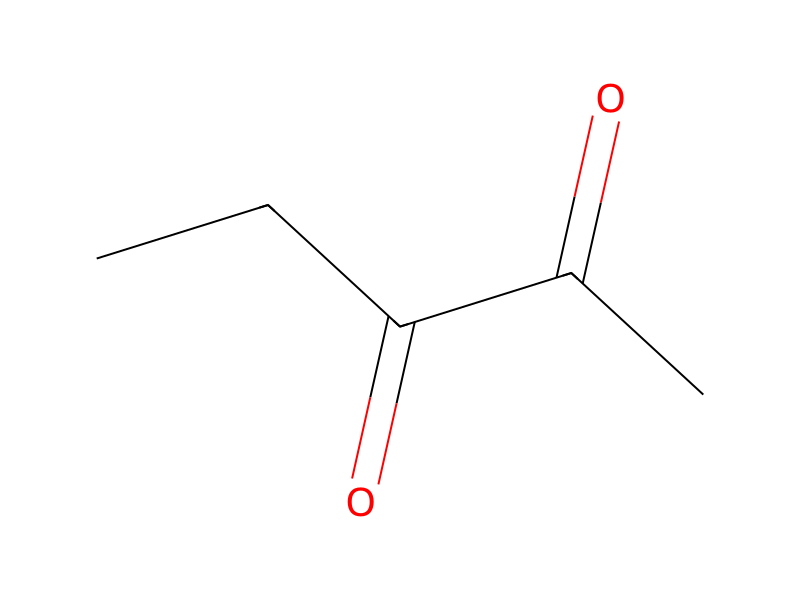
基本情報
- 標準SMILES
CCC(=O)C(C)=O- InChIKey
TZMFJUDUGYTVRY-UHFFFAOYSA-N- 分子式
- C5H8O2
- 平均分子量
- 100.12 g/mol
- 単同位体質量
- 100.0524295
概要
Pentane-2,3-dione is an alpha-diketone that is pentane substituted at the 2- and 3-positions by oxo groups. It has a role as a flavouring agent. It is a methyl ketone and an alpha-diketone. It derives from a hydride of a pentane.
名称と識別子
- 優先名称
- 2,3-Pentanedione
- IUPAC
- pentane-2,3-dione
- 現地名
- 2,3-ペンタンジオン
- 英語名
- 2,3-Pentanedione
- 分子式
- C5H8O2
- 分子量
- 100.12
名称と別名
2,3-PENTANEDIONEpentane-2,3-dione600-14-6AcetylpropionylAcetyl propionyl2,3-PentadioneFEMA No. 2841K4WBE45SCMDTXSID6051435NSC-7613CHEBI:52774RefChem:442619
名称をさらに表示
2,3-ペンタンジオンペンタン-2,3-ジオン3,4-ペンタンジオンアセチルプロピオニルエチルメチルジケトン2,3-ペンタジオン2,3‐ペンタンジオン3-Pentanedione2,3-PentandionAcethylpropionylACETYL PROPIONYL, NATURALPENTANDION-2,3CH3C(O)C(O)C2H52.6-Pentanedione
DTXCID5030036209-984-82,3-pentandioneethyl methyl diketoneAcetylpropionyl (VAN)Acetyl propionyl (natural)Pentan-2,3-dione2,3-pentane-dione
データベース識別子
- CAS
600-14-6- PubChem CID
- 11747
- DTXSID
DTXSID6051435- ChEMBL
CHEMBL192809- ChEBI
CHEBI:52774- UNII
- K4WBE45SCM
- EC Number
- 209-984-8
- Nikkaji
- J69.485A
物性
構造計算による物性
- XLogP
- 0.1
- 極性表面積
- 34.1 Ų
- 水素結合供与体数
- 0
- 水素結合受容体数
- 2
- 回転可能結合数
- 2
- 重原子数
- 7
- 形式電荷
- 0
- 複雑度
- 94.3
実験および物理化学的性質
Chemical ClassesOther Classes -> Aliphatic Ketones, Other
SpringerMaterials PropertiesAngular frequency
FragrancesFragrance Ingredient (Acetyl propionyl) -> IFRA transparency List
OdorSomewhat sweet odor similar to quinone ... Detection: 20 ppb. Aroma characteristics at 1.0%: buttery diacytl-like, fermented dairy and creamy, popcorn buttery
TastePenetrating buttery taste on dilution...Taste characteristics at 1 to 5 ppm: sweet buttery, creamy, cheesy, slightly toasted dairy, with a rich baked goods nuance and good mouth feel
Food AdditivesFLAVORING AGENT OR ADJUVANT -> FDA Substance added to food
Density0.979-0.985
Flavoring AgentsEU Flavoring substances
Color/Form
Yellow liquid
Yellow to yellow-green liquid
Solubility
In water, 6.67X10+4 at 15 °C
Miscible with ethanol, diethyl ether, and acetone
66.7 mg/mL at 15 °C
insoluble in glycerol and water; miscible with alcohol, propylene glycol, fixed oils
1 ml in 3 ml 50% alcohol (in ethanol)
Flash Point
19 °C (66 °F) - open cup
66 °F
Boiling Point
109.9 °C
108 °C
230-234 °F
物理化学的性質
- 融点
- -52 °C · -52 °C (lit.)
- 沸点
- 110 · 110-112 °C (lit.)
- 比重(密度)
- 0.957 g/mL · 0.957 g/mL at 25 °C (lit.)
- 蒸気圧
- 28.5 hPa · 28.5 hPa (20 °C)
- FEMA
- 2841 · 2841 | 2,3-PENTANEDIONE
- 屈折率
- 20 · n20/D 1.404(lit.)
- 闪点
- 66 °F · 66 °F
- 貯蔵温度
- 2 · 2-8°C
- 溶解性
- 60 g/リットル · 60g/リットル
- 外見
- 液体
- 色
- 非常に濃い緑黄色
- PH
- 4 · 4 (H2O)
- 臭い (Odor)
- 1 %。刺激的で甘いバター、クリーミーなキャラメル、ナッツのようなチーズ · ジプロピレングリコール中1.00%。刺激的で甘いバター、クリーミーなキャラメル、ナッツのようなチーズ
- においのタイプ
- バターっぽい
- 由来生物
- synthetic
- 爆発限界(explosive limit)
- 1.8 · 1.8-10.9%(V)
- 水溶解度
- 60 g/L · 60g/L(15℃)
- JECFA Number
- 410 · 410
- BRN
- 1699638 · 1699638
- Henry's Law Constant
- 1.3 · 1.3×10-1 mol/(m3Pa) at 25℃, Wu et al. (2022)
- 安定性
- 安定。可燃性が高い - 涼しい場所に保管してください。強酸化剤、還元剤、強塩基とは相容れない。
- 主な用途
- フレーバーそして香料
- InChI
- 1S/C5H8O2/c1-3-5(7)4(2)6/h3H2,1-2H3
- InChIKey
- TZMFJUDUGYTVRY-UHFFFAOYSA-N
- SMILES
- CCC(=O)C(C)=O
- LogP
- -0.85 · -0.85
- CAS データベース
- 600 · 600-14-6(CAS DataBase Reference)
- NISTの化学物質情報
- 2 · 2,3-Pentanedione(600-14-6)
- EPAの化学物質情報
- 2 · 2,3-Pentanedione (600-14-6)
化学的性質
化学的特性2,3-Pentanedione is a colourless or deep green-yellow colour liquid that has a somewhat sweet odor similar to quinone. This compound has a penetrating, buttery taste on dilution. It is used as flavoring agent or adjuvant.
安全と法規制
GHS分類
GHS Classification
Danger
H225 (98.6%): Highly Flammable liquid and vapor [Danger Flammable liquids]
P210, P233, P240, P241, P242, P243, P260, P261, P264+P265, P272, P280, P302+P352, P303+P361+P353, P305+P354+P338, P317, P319, P321, P333+P317, P362+P364, P370+P378, P403+P235, and P501 (click each P-code to see the statement)
Aggregated GHS information provided per 1656 reports by companies from 37 notifications to the ECHA C&L Inventory. Each notification may be associated with multiple companies.
Danger
H225: Highly Flammable liquid and vapor [Danger Flammable liquids]
危険有害性情報
Regulatory Information
Chemical: 2,3-Pentanedione
Regulation (EC) No 1831/2003 (amended)
2,3-Pentanedione is listed on the EPA's Chemical Data Reporting (CDR) system. Manufacturers and importers of 2,3-Pentanedione are required to report information about their production and use of this chemical to the EPA under the Toxic Substances Control Act (TSCA). (40 eCFR Part 711)
REACH registered substance: Pentane-2,3-dione (EC: 209-984-8)
2,3-Pentanedione: Does not have an individual approval but may be used under an appropriate group standard
Other Safety InformationEvaluation - Acetylpropionyl and diacetyl
Fire PotentialFlammable liquid
Hazards Summary
A moderate skin irritant; [RTECS] Safe when used as a flavoring agent in food; [JECFA] Due to structural similarities with diacetyl, there are concerns that occupational exposure may lead to a decline in pulmonary function; Airway epithelial damage demonstrated in rats is similar to that caused by diacetyl; [Reference #1] Danger of skin sensitization; [MAK] A skin and strong eye irritant; [Alfa Aesar MSDS] See Environmental characterization of a coffee processing workplace with obliterative bronchiolitis in former workers. [PMID 27105025] See Diacetyl. See 2,4-Pentanedione.
FDA Requirements
2,3-Pentanedione is a food additive permitted for direct addition to food for human consumption as a synthetic flavoring substance and adjuvant in accordance with the following conditions: a) they are used in the minimum quantity required to produce their intended effect, and otherwise in accordance with all the principles of good manufacturing practice, and b) they consist of one or more of the following, used alone or in combination with flavoring substances and adjuvants generally recognized as safe in food, prior-sanctioned for such use, or regulated by an appropriate section in this part.
Toxic Combustion ProductsSpecial hazards arising from the substance or mixture: Carbon oxides
Hazard Classes and Categories
Flam. Liq. 2 (98.6%)
Flammable liquids - Category 2
Skin, Eye, and Respiratory IrritationsA skin irritant.
Critical Temperature and Pressure0.955-0.959 (15/4 °C)
Hazardous Reactivities and IncompatibilitiesIncompatible materials: Oxidizing agents, reducing agents, strong bases.
安全と保護具
Exposure Control and Personal Protection0.02 [ppm]
Fire Fighting Procedures
Suitable extinguishing media: Use water spray, alcohol-resistant foam, dry chemical, or carbon dioxide.
Advice for firefighters: Wear self-contained breathing apparatus for firefighting if necessary.
Use water spray to cool unopened containers.
Storage Conditions
Keep container tightly closed in a dry and well-ventilated place. Containers which are opened must be carefully resealed and kept upright to prevent leakage. Recommended storage temperature 2 - 8 °C. Storage class (TRGS 510): Flammable liquids.
Cleanup Methods
ACCIDENTAL RELEASE MEASURES: Personal precautions, protective equipment, and emergency procedures: Use personal protective equipment. Avoid breathing vapors, mist, or gas. Ensure adequate ventilation. Remove all sources of ignition. Evacuate personnel to safe areas. Beware of vapors accumulating to form explosive concentrations. Vapors can accumulate in low areas. Environmental precautions: Prevent further leakage or spillage if safe to do so. Do not let product enter drains. Methods and materials for containment and cleaning up: Contain spillage, and then collect with an electrically protected vacuum cleaner or by wet-brushing and place in container for disposal according to local regulations.
Disposal Methods
SRP: Recycle any unused portion of the material for its approved use or return it to the manufacturer or supplier. Ultimate disposal of the chemical must consider: the material's impact on air quality; potential migration in air, soil or water; effects on animal, aquatic and plant life; and conformance with environmental and public health regulations. If it is possible or reasonable use an alternative chemical product with less inherent propensity for occupational harm/injury/toxicity or environmental contamination.
Product: Burn in a chemical incinerator equipped with an afterburner and scrubber but exert extra care in igniting as this material is highly flammable. Offer surplus and non-recyclable solutions to a licensed disposal company. Contact a licensed professional waste disposal service to dispose of this material; Contaminated packaging: Dispose of as unused product.
Preventive Measures
ACCIDENTAL RELEASE MEASURES: Personal precautions, protective equipment, and emergency procedures: Use personal protective equipment. Avoid breathing vapors, mist, or gas. Ensure adequate ventilation. Remove all sources of ignition. Evacuate personnel to safe areas. Beware of vapors accumulating to form explosive concentrations. Vapors can accumulate in low areas. Environmental precautions: Prevent further leakage or spillage if safe to do so. Do not let product enter drains.
Precautions for safe handling: Avoid contact with skin and eyes. Avoid inhalation of vapor or mist. Use explosion-proof equipment. Keep away from sources of ignition - No smoking. Take measures to prevent the build up of electrostatic charge.
Appropriate engineering controls: Handle in accordance with good industrial hygiene and safety practice. Wash hands before breaks and at the end of workday.
Gloves must be inspected prior to use. Use proper glove removal technique (without touching glove's outer surface) to avoid skin contact with this product. Dispose of contaminated gloves after use in accordance with applicable laws and good laboratory practices. Wash and dry hands.
SRP: The scientific literature for the use of contact lenses by industrial workers is inconsistent. The benefits or detrimental effects of wearing contact lenses depend not only upon the substance, but also on factors including the form of the substance, characteristics and duration of the exposure, the uses of other eye protection equipment, and the hygiene of the lenses. However, there may be individual substances whose irritating or corrosive properties are such that the wearing of contact lenses would be harmful to the eye. In those specific cases, contact lenses should not be worn. In any event, the usual eye protection equipment should be worn even when contact lenses are in place.
Recommended Exposure Limit (REL)
<9.3 ppb [as an 8-hr TWA]
31 ppb [15 minutes]
Personal Protective Equipment (PPE)
Eye/face protection: Face shield and safety glasses. Use equipment for eye protection tested and approved under appropriate government standards such as NIOSH (US) or EN 166(EU).
Skin protection: Handle with gloves.
Body Protection: Impervious clothing. Flame retardant antistatic protective clothing. The type of protective equipment must be selected according to the concentration and amount of the dangerous substance at the specific workplace.
Respiratory protection: Where risk assessment shows air-purifying respirators are appropriate use a full-face respirator with multipurpose combination (US) or type ABEK (EN 14387) respirator cartridges as a backup to engineering controls. If the respirator is the sole means of protection, use a full-face supplied air respirator. Use respirators and components tested and approved under appropriate government standards such as NIOSH (US) or CEN (EU).
毒性情報
Environmental Fate
TERRESTRIAL FATE: Based on a classification scheme(1), an estimated Koc value of 1(SRC), determined from a structure estimation method(2), indicates that 2,3-pentanedione is expected to have very high mobility in soil(SRC). Volatilization of 2,3-pentanedione from moist soil surfaces may be an important fate process(SRC) given its Henry's Law constant estimated as 3.95X10⁻⁵ atm-cu m/mole(2) based upon its vapor pressure, 20 mm Hg(3), and water solubility, 6.67X10+4 mg/L(2). 2,3-Pentanedione is expected to volatilize from dry soil surfaces(SRC) based upon a vapor pressure of 20 mm Hg at 20 °C(3). Biodegradation data in soil were not available(SRC, 2016). In a Warburg Repirometry test 2,3- pentanedione was toxic to the microogansims(4).
AQUATIC FATE: Based on a classification scheme(1), an estimated Koc value of 1(SRC), determined from a structure estimation method(2), indicates that 2,3-pentanedione is not expected to adsorb to suspended solids and sediment(SRC). Volatilization from water surfaces may be expected(3) based upon an estimated Henry's Law constant of 3.95X10⁻⁵ atm-cu m/mole(2), derived from its vapor pressure, 20 mm Hg(4), and water solubility, 6.67X10+4 mg/L(2). Using this Henry's Law constant and an estimation method(2), volatilization half-lives for a model river and model lake are 16 hours and 11 days, respectively(SRC). According to a classification scheme(5), an estimated BCF of 3(SRC), from an estimated log Kow of -0.85(2), suggests the potential for bioconcentration in aquatic organisms is low(SRC). Biodegradation data in water were not available(SRC, 2016). In a Warburg Repirometry test 2,3-pentanedione was toxic to the microogansims(6).
ATMOSPHERIC FATE: According to a model of gas/particle partitioning of semivolatile organic compounds in the atmosphere(1), 2,3-pentanedione, which has a vapor pressure of 20 mm Hg at 20 °C(2), is expected to exist solely as a vapor in the ambient atmosphere. Vapor-phase 2,3-pentanedione is degraded in the atmosphere by reaction with photochemically-produced hydroxyl radicals(SRC); the half-life for this reaction in air is estimated to be 12 days(SRC), calculated from its rate constant of 1.33X10⁻¹² cu cm/molecule-sec at 25 °C(3). 2,3-Pentanedione contains chromophores that absorb at wavelengths >290(4) and, therefore, is expected to be susceptible to direct photolysis by sunlight(SRC). The half-life for the direct photolysis of 2,3-pentanedione is 3 hours(5).
Food Survey Values
2,3-Pentanedione has been detected, not quantified in peach, wheat bread, cocoa, coffee, black tea, roasted filbert, roasted peanut, roasted almonds, pecans, soybean, malt, peated malt, chayote, peas, cooked potato, tomato, boiled egg, cooked chicken and fat, cooked beef and pork, beer, cognac, sweet corn, okra, mate and soursop(1). 2,3-Pentanedione has been identified, but not quantified, in pork liver(1), chicken, beef, and pork meat volatiles(2) and cooked beef(3).
2,3-Pentanedione has been reported as a coffee aroma constituent at concentrations ranging between 9.0 nmol - 0.9 mmol (1). 2,3-Pentanedione has been reported as a volatile compound of cooked sweet corn products with concentrations of 5 ppb in canned cream and canned kernel corn, and <2 ppb in frozen kernel and fresh kernel corn(2). 2,3-Pentanedione has been reported as a volatile compound of microwave popped corn kernels at concentrations ranging from 200 to 380 ug/kg(3). 2,3-Pentanedione has been reported as a volatile compound of commercial rice cakes at concentrations ranging from 91 to 250 ppb(4). 2,3-Pentanedione has been reported as an aroma constituent in raw and roasted earth almonds (Cyperus esculentus)(5). 2,3-Pentanedione was identified but not quantified in frankfurters(6).
Adverse EffectsSkin Sensitizer - An agent that can induce an allergic reaction in the skin.
Milk Concentrations2,3-Pentanedione has been identified in yogurt and butter (1).
Toxicity Summary
IDENTIFICATION AND USE: 2,3-Pentanedione is a yellow liquid. It is used as flavoring agent (butter flavoring) including many e-cigarette brands. HUMAN EXPOSURE AND TOXICITY: Inhalation of butter flavoring by workers in the microwave popcorn industry may result in "popcorn workers' lung." Cultured human bronchial/tracheal epithelial cells (NHBEs) were exposed for 6 hours to diacetyl or 2,3-pentanedione vapors (25 or >/= 60 ppm) and the effects on short circuit current and transepithelial resistance (Rt) were measured. Immediately after exposure to 25 ppm both flavorings reduced Na+ transport, without affecting Cl- transport or Na+,K+-pump activity. Concentrations (100-360 ppm) of diacetyl and 2,3-pentanedione reported to give rise in vivo to epithelial damage, and 60 ppm, caused death of NHBEs 0 hours post-exposure. The results indicate that ion transport is inhibited transiently in airway epithelial cells by lower concentrations of the flavorings than those that result in morphological changes of the cells in vivo or in vitro. ANIMAL STUDIES: Rats that inhaled air, 2,3-pentanedione (112, 241, 318, or 354 ppm) for 6 hours were sacrificed the following day. Rats inhaling 2,3-pentanedione developed necrotizing rhinitis, tracheitis, and bronchitis. To investigate delayed toxicity, additional rats inhaled 318 (range, 317.9-318.9) ppm 2,3-pentanedione for 6 hours and were sacrificed 0 to 2, 12 to 14, or 18 to 20 hours after exposure. Respiratory epithelial injury in the upper nose involved both apoptosis and necrosis, which progressed through 12 to 14 hours after exposure. Olfactory neuroepithelial injury included loss of olfactory neurons that showed reduced expression of the 2,3-pentanedione-metabolizing enzyme, dicarbonyl/L-xylulose reductase, relative to sustentacular cells. Caspase 3 activation occasionally involved olfactory nerve bundles that synapse in the olfactory bulb (OB). An additional group of rats inhaling 270 ppm 2,3-pentanedione for 6 hours 41 minutes showed increased expression of IL-6 and nitric oxide synthase-2 and decreased expression of vascular endothelial growth factor A in the OB, striatum, hippocampus, and cerebellum using real-time PCR. Claudin-1 expression increased in the OB and striatum. In other experiment, male and female rats and mice were exposed to 0, 50, 100, or 200 ppm 2,3-pentanedione 6 hr/d, 5 d/wk for up to 2 weeks. Bronchoalveolar lavage fluid (BALF) was collected after 1, 3, 5, and 10 exposures, and histopathology was evaluated after 12 exposures. MCP-1, MCP-3, CRP, FGF-9, fibrinogen, and OSM were increased 2- to 9-fold in BALF of rats exposed for 5 and 10 days to 200 ppm. In mice, only fibrinogen was increased after 5 exposures to 200 ppm. The epithelium lining the respiratory tract was the site of toxicity in all mice and rats exposed to 200 ppm. Significantly, 2,3-pentanedione also caused both intraluminal and intramural fibrotic airway lesions in rats. In third experiment, rats exposed to 150 or 200 ppm 2,3-pentanedione developed bronchial fibrosis. In mice, 2,3-pentanedione was not a dermal irritant when tested at concentrations up to 50%. However, concentration-dependent increases in lymphocyte proliferation were observed following exposure to 2,3-pentanedione in mice.
Plant Concentrations2,3-Pentanedione has been identified, but not quantified, as a volatile component of leaves of the plant Callicarap japonica(1) as well as a volatile compound of Kiwi fruit flowers(2).
Soil Adsorption/Mobility
Using a structure estimation method based on molecular connectivity indices(1), the Koc of 2,3-pentanedione can be estimated to be 1(SRC). According to a classification scheme(2), this estimated Koc value suggests that 2,3-pentanedione is expected to have very high mobility in soil.
Natural Pollution Sources2,3-Pentanedione was identified in essential oil of Finnish pine. It has been reported found in several fruits, vegetables, and nuts(1).
Atmospheric ConcentrationsURBAN/SUBURBAN: 2,3-Pentanedione has been detected in summer and winter ambient air samples at concentrations of 11.1 and 8.1 ng/cu m, respectively, collected in 2006/2007 near busy roadways in Roseville, CA(2).
Human Toxicity Excerpts
/ALTERNATIVE and IN VITRO TESTS/ Inhalation of butter flavoring by workers in the microwave popcorn industry may result in "popcorn workers' lung." In previous in vivo studies rats exposed for 6 hr to vapor from the flavoring agents, diacetyl and 2,3-pentanedione, acquired flavoring concentration-dependent damage of the upper airway epithelium and airway hyporeactivity to inhaled methacholine. Because ion transport is essential for lung fluid balance, we hypothesized that alterations in ion transport may be an early manifestation of butter flavoring-induced toxicity. We developed a system to expose cultured human bronchial/tracheal epithelial cells (NHBEs) to flavoring vapors. NHBEs were exposed for 6 hr to diacetyl or 2,3-pentanedione vapors (25 or >/= 60 ppm) and the effects on short circuit current and transepithelial resistance (Rt) were measured. Immediately after exposure to 25 ppm both flavorings reduced Na+ transport, without affecting Cl- transport or Na+,K+-pump activity. Rt was unaffected. Na+ transport recovered 18 hr after exposure. Concentrations (100-360 ppm) of diacetyl and 2,3-pentanedione reported earlier to give rise in vivo to epithelial damage, and 60 ppm, caused death of NHBEs 0 hr (immediately) post-exposure. Analysis of the basolateral medium indicated that NHBEs metabolize diacetyl and 2,3-pentanedione to acetoin and 2-hydroxy-3-pentanone, respectively. The results indicate that ion transport is inhibited transiently in airway epithelial cells by lower concentrations of the flavorings than those that result in morphological changes of the cells in vivo or in vitro.
/OTHER TOXICITY INFORMATION/ Over the last decade, concerns have been raised about potential respiratory health effects associated with occupational exposure to the flavoring additives diacetyl and 2,3-pentanedione. Both of these diketones are also natural components of many foods and beverages, including roasted coffee. To date, there are no published studies characterizing workplace exposures to these diketones during commercial roasting and grinding of unflavored coffee beans. In this study, we measured naturally occurring diacetyl, 2,3-pentanedione, and respirable dust at a facility that roasts and grinds coffee beans with no added flavoring agents. Sampling was conducted over the course of three roasting batches and three grinding batches at varying distances from a commercial roaster and grinder. The three batches consisted of lightly roasted soft beans, lightly roasted hard beans, and dark roasted hard beans. Roasting occurred for 37 to 41 min, and the grinding process took between 8 and 11 min. Diacetyl, 2,3-pentanedione, and respirable dust concentrations measured during roasting ranged from less than the limit of detection (<LOD) to 0.0039 ppm, <LOD to 0.018 ppm, and <LOD to 0.31 mg/cu m, respectively. During grinding, diacetyl, 2,3-pentanedione, and respirable dust concentrations ranged from 0.018 to 0.39 ppm, 0.0089 to 0.21 ppm, and <LOD to 1.7 mg/cu m, respectively. For any given bean/roast combination and sample location, diketone concentrations during grinding were higher than those measured during roasting. During grinding, concentrations decreased with increased distance from the source. Measured concentrations of both diketones were higher during grinding of soft beans than hard beans. The results indicate that airborne concentrations of naturally occurring diacetyl and 2,3-pentanedione associated with unflavored coffee processing: (1) are similar to the concentrations that have been measured in food flavoring facilities; (2) are likely to exceed some recommended short-term occupational exposure limits, but; (3) based on previous analyses of exposure response relationships in animal studies, are far below the concentrations that are expected to cause even minimal responses in the human respiratory tract.
/OTHER TOXICITY INFORMATION/ Diacetyl and 2,3-pentanedione inhalation have been suggested as causes of severe respiratory disease, including bronchiolitis obliterans, in food/flavoring manufacturing workers. Both compounds are present in many food items, tobacco, and other consumer products, but estimates of exposures associated with the use of these goods are scant. A study was conducted to characterize exposures to diacetyl and 2,3-pentanedione associated with cigarette smoking. The yields (ug/cigarette) of diacetyl and 2,3-pentanedione in mainstream (MS) cigarette smoke were evaluated for six tobacco products under three smoking regimens (ISO, Massachusetts Department of Public Health, and Health Canada Intense) using a standard smoking machine. Mean diacetyl concentrations in MS smoke ranged from 250 to 361 ppm for all tobacco products and smoking regimens, and mean cumulative exposures associated with 1 pack-year ranged from 1.1 to 1.9 ppm-years. Mean 2,3-pentanedione concentrations in MS smoke ranged from 32.2 to 50.1 ppm, and mean cumulative exposures associated with 1 pack-year ranged from 0.14 to 0.26 ppm-years. We found that diacetyl and 2,3-pentanedione exposures from cigarette smoking far exceed occupational exposures for most food/flavoring workers who smoke. This suggests that previous claims of a significant exposure-response relationship between diacetyl inhalation and respiratory disease in food/flavoring workers were confounded, because none of the investigations considered or quantified the non-occupational diacetyl exposure from cigarette smoke, yet all of the cohorts evaluated had considerable smoking histories. Further, because smoking has not been shown to be a risk factor for bronchiolitis obliterans, our findings are inconsistent with claims that diacetyl and/or 2,3-pentanedione exposure are risk factors for this disease.
Fish/Seafood Concentrations
Identified in fatty fish, shrimp, oyster, and clam(1). 2,3-Pentanedione has been reported as a volatile component of anchovy (Engraulis japonica) paste and big eyed herring (Harengula zunasi) paste at mean concentrations of 669 and 1450 ng/g(2). 2,3-Pentanedione has been identified as a volatile compound of leg, body, and carspace meat of edible crabs (Charybdis feriatus) at concentrations of 27.7, 29.6, and 74.2 ug/kg (dry weight), respectively(3). 2,3-Pentanedione has been identified, but not quantified, as a volatile component of cooked mussels (Mytilus edulis)(4) and fish oil enriched by milk(5).
Artificial Pollution Sources2,3-Pentanedione's production and use as a flavor agent(1) may result in its release to the environment through various waste streams(SRC).
法規制情報
FDA Requirements
2,3-Pentanedione is a food additive permitted for direct addition to food for human consumption as a synthetic flavoring substance and adjuvant in accordance with the following conditions: a) they are used in the minimum quantity required to produce their intended effect, and otherwise in accordance with all the principles of good manufacturing practice, and b) they consist of one or more of the following, used alone or in combination with flavoring substances and adjuvants generally recognized as safe in food, prior-sanctioned for such use, or regulated by an appropriate section in this part.
安全データ
- F
- 9-23
- wgk
- 1
- tsca
- TSCA listed
- rtecs
- SA1850000
- ridadr
- UN 1224 3/PG 2
- 毒性
- LD50 orally in Rabbit: 3000 mg/kg LD50 dermal Rabbit > 2500 mg/kg
- hs_code
- 29141990
- risk_code
- 11-36/37/38
- 化審法
- (2)-563, (2)-2474
- 消防法
- 危-4-1-II
- hazard_code
- F,Xi
- safety_code
- 16-26-36-37/39
- hazard_class
- 3
- packing_group
- II
- 自然発火温度
- 265 °C
- Hazard Classifications
- Flam. Liq. 2Skin Sens. 1BSTOT RE 2
- ストレージクラス
- 3 - Flammable liquids
- 有毒物質データの
- 600-14-6(Hazardous Substances Data)
化学と産業
薬理情報
Metabolism/Metabolites
We developed a system to expose cultured human bronchial/tracheal epithelial cells (NHBEs) to flavoring vapors. NHBEs were exposed for 6 hr to diacetyl or 2,3-pentanedione vapors (25 or >/= 60 ppm)... Analysis of the basolateral medium indicated that NHBEs metabolize diacetyl and 2,3-pentanedione to acetoin and 2-hydroxy-3-pentanone, respectively.
Cellular LocationsCytoplasm
用途と製造
Uses
Used as flavoring agent or adjuvant; [FDA] Used as a substitute for diacetyl in food flavoring and food production; [Reference #1]
Flavors of butterscotch and chocolate type
... used as aroma components in alcohol-free beverages and in baked goods.
2,3-Pentanedione and acetoin were detected in 23 and 46 of the 51 flavors /of e-cigarettes/ tested at concentrations up to 64 and 529 ug/e-cigarette, respectively.
Reported uses (ppm):
U.S. Production2021: 26 lb
Consumer UsesFragrance
Methods of Manufacturing
By oxidation of methyl propyl ketone with excess NaNO2 and diluted HCl in the presence of hydroxylamine hydrochloride under a nitrogen blanket.
Processes used include oxidation of the corresponding diols over a copper or silver catalyst, or selective oxidation of the methylene group in the corresponding methyl alkyl ketones with oxygen in the presence of catalysts such as nickel.
Formulations/PreparationsGrade: 99%
Use Classification
Fragrance Ingredients
Flavouring Agent -> FLAVOURING_AGENT -> JECFA Functional Classes
Flavoring Agents -> JECFA Flavorings Index
Flavouring Agent -> FLAVOURING_AGENT -> JECFA Functional Classes
General Manufacturing Information2,3-Pentanedione: ACTIVE
応用分野
天然物の起源2,3-Pentanedione occurs in butter, bread, milk, yogurt, chicken, meat, cocoa, coffee, potato chips, roasted almonds, pecans, beer, red and white wine, rum and whiskey. The organoleptic profile can be described as creamy, penetrating, cheesy, oily, sweet, buttery, almondlike, brown roasted, and somewhat caramellic, with a fruity nuance.
使用2,3-Pentanedione may be used as a reference standard in the determination of 2,3-pentanedione in beer samples using headspace-gas chromatographic technique (HS-GC).
一般的な説明2,3-Pentanedione (acetylpropionyl) is one of the aroma active compounds of cereal coffee brew.
調製方法
製造方法By oxidation of methyl propyl ketone with excess NaNO2 and diluted HCl in the presence of hydroxylamine hydrochloride under a nitrogen blanket.
上流・下流製品情報
上流原料
下流製品
サプライヤー50 社
国药集团化学试剂有限公司86-21-63210123 · [email protected]
梯希爱(上海)化成工业发展有限公司021-67121386 · [email protected]
上海阿拉丁生化科技股份有限公司400-6206333 13167063860 · [email protected]
巨野众悦香料有限公司0530-8599699 13701896116 · [email protected]
河北创海生物科技有限公司+86-86-13131129325 · [email protected]
Baoji Guokang Healthchem co.,ltd+8615604608665 15604608665 · [email protected]
Dayang Chem (Hangzhou) Co.,Ltd.+86-0571-88938639 17705817739 · [email protected]
Hebei Yanxi Chemical Co., Ltd.+86-17531190177 · [email protected]
Syntechem Co.,Ltd[email protected]
上海迈瑞尔生化科技有限公司4006356688 18621169109 · [email protected]
阿法埃莎(中国)化学有限公司400-6106006 · [email protected]
安耐吉化学&3A(安徽泽升科技股份有限公司)400-0056266 · [email protected]
上海瀚鸿科技股份有限公司021-54306202 13764082696 · [email protected]
山东洛克化工有限公司17653113209 13065062079 · [email protected]
上海钰康生物科技有限公司+86-18930848214 +86-021-56762820 · [email protected]
吉良化学21-62165282 · [email protected]
上海景颜化工科技有限公司13817811078 · [email protected]
嘉兴市艾森化工有限公司0573-85285100 18627885956 · [email protected]
上海隆盛化工有限公司58099637 13585536065 · [email protected]
合肥天健化工有限公司551-65418679 15856988503;15837135945 · [email protected]
山东西亚化学有限公司13355009207 13355009207 · [email protected]
玛雅试剂+86 (573) 82222445 (0)18006601000 452520369 · [email protected]
四川库利南科技有限公司400-1166-196 18981987031 · [email protected]
河南蔚源生物科技有限公司0371-27990887 13703782753 · [email protected]
天津希恩思生化科技有限公司400 638 7771 · [email protected]
艾科试剂4008-755-333 18080918076 · [email protected]
青岛保税区鲁联国际贸易有限公司0532-83893697 18561902820 · [email protected]
上海思域化工科技有限公司86-21-34053660 · [email protected]
赛默飞世尔科技(中国)有限公司800-810-5118 · [email protected]
上海遐瑞医药科技有限公司+86 21 61551611
TCI AMERICA800-4238616 · [email protected]
TOKYO CHEMICAL INDUSTRY CO., LTD.03-36680489 · [email protected]
TCI Europe320-37350700 · [email protected]
上海贤鼎生物科技有限公司4009209199 · [email protected]
上海倍卓生物科技有限公司021-61119791,13386096464 · [email protected]
上海将来实业股份有限公司021-61552785 · [email protected]
成都零六生物科技有限公司400-1166-196 13458535857 · [email protected]
上海寰川实业有限公司021-61478794 · [email protected]
江苏艾康生物医药研发有限公司025-66028182 17714375163 · [email protected]
上海兴鲁化工科技有限公司02120970332 · [email protected]
成都润泽本土化工有限公司13096311329 028-88469284 616445927 · [email protected]
湖北巨胜科技有限公司027-59599241 18871490274 · [email protected]
池州凯隆进出口贸易有限公司[email protected]
Sigma-Aldrich西格玛奥德里奇(上海)贸易有限公司021-61415566 800-8193336 · [email protected]
AN PharmaTech Co Ltd86(21)68097365 · [email protected]
桦特昇生物科技(武汉)有限公司027-59207879 1972026995 18140587686 · [email protected]
TargetMol中国(陶术生物)021-021-33632979 15002134094 · [email protected]
上海陶术生物科技股份有限公司+1-781-999-5354; +1-00000000000 · [email protected]
成都瑞欧克科技有限公司028-64353063 · [email protected]
山东智尚新材料有限公司+8617653113209 · [email protected]
補足説明
定義ChEBI: 2,3-Pentanedione is an alpha-diketone that is pentane substituted at the 2- and 3-positions by oxo groups. It has a role as a flavouring agent. It is an alpha-diketone and a methyl ketone. It derives from a hydride of a pentane.
関連反応
3 件


関連ノート
読み込み中…