1-アリル-2-チオ尿素
1-アリル-2-チオ尿素 · アミノシン · アリルチオカルバミド · N-(2-プロペニル)チオ尿素 · チオシナミン · アリルチオ尿素 · 2-プロペニルチオ尿素 · 1-アリルチオ尿素
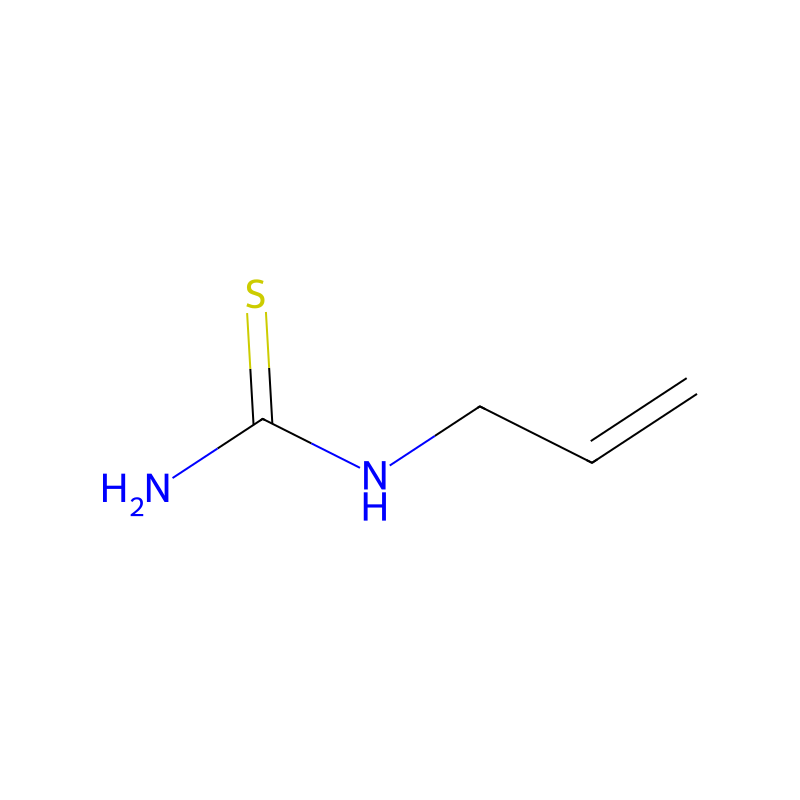
識別子と物理属性
| CAS No. | 109-57-9 |
|---|---|
| 分子式 | C4H8N2S |
| 平均分子量 | 116.19 g/mol |
| 単同位体質量 | 116.04081926 g/mol |
| SMILES | C=CCNC(N)=S |
| InChIKey | HTKFORQRBXIQHD-UHFFFAOYSA-N |
| PubChem CID | 1549517 |
| ChEMBL | CHEMBL1451910 |
| ChEBI | CHEBI:74079 |
| EC No. | 203-683-5 |
| DTXSID | DTXSID3024449 |
| 現地名 | 1-アリル-2-チオ尿素 |
化学・物理的性質
| XLogP | 0.2 |
|---|---|
| 極性表面積 | 70.1 |
| 水素結合供与体数 | 2 |
| 水素結合受容体数 | 1 |
| 回転可能結合数 | 2 |
| 重原子数 | 7 |
| 形式電荷 | 0 |
| 複雑度 | 79.8 |
| SpringerMaterials Properties | Crystal structure |
| 密度 | 1.11 to 1.22 (NTP, 1992)1.11 g/mL at 25 °C(lit.) |
| 溶解度 | 10 to 50 mg/mL at 67.1 °F (NTP, 1992)>17.4 [ug/mL] (The mean of the results at pH 7.4)H2O:ソリュブル30部67g/L(20℃) |
| 融点 | 158 to 172 °F (NTP, 1992)70-72 °C(lit.) |
| Physical Description | Allylthiourea is a white crystalline solid with a slight garlic odor. (NTP, 1992) |
| 沸点 | 191.3±33.0 °C(Predicted) |
| 屈折率 | 1.5936 (estimate) |
| 貯蔵条件 | Store below +30°C. |
| 外観・状態 | 粉末、結晶、顆粒またはチャンク |
| pKa(酸解離定数) | 14.57±0.70(Predicted) |
| 比重 | 1.111.219 (20/20℃) |
| 色 | ホワイトからライトベージュ |
| Merck | 14,9362 |
| BRN | 1071470 |
| 安定性 | 安定。強力な酸化剤とは相容れない。 |
| InChI | 1S/C4H8N2S/c1-2-3-6-4(5)7/h2H,1,3H2,(H3,5,6,7) |
| InChIKey | HTKFORQRBXIQHD-UHFFFAOYSA-N |
| SMILES | NC(=S)NCC=C |
| CAS データベース | 109-57-9(CAS DataBase Reference) |
| NISTの化学物質情報 | Allylthiourea(109-57-9) |
| EPAの化学物質情報 | Allylthiourea (109-57-9) |
化学的特性
white crystals or powder. Melting point 76~78.5 ℃, relative density is 1.110, soluble in water and ethanol, slightly soluble in ethanol, insoluble in benzene, with a garlic odor. It is used as an additive for cyanide-free copper plating to increase the brightness and corrosion resistance of plated products.
安全性と法規制
| GHS 分類 | DangerH301 (99.5%): Toxic if swallowed [Danger Acute toxicity, oral]P264, P270, P301+P316, P321, P330, P405, and P501 (click each P-code to see the statement)Aggregated GHS information provided per 197 reports by companies from 6 notifications to the ECHA C&L Inventory. |
|---|---|
| 規制情報 | Chemical: Thiourea, 2-propenyl-Allylthiourea: Does not have an individual approval but may be used under an appropriate group standard |
| 輸送ラベル(DOT) | Poison |
| 火災危険 | Flash point data are not available for this chemical, but it is probably combustible. (NTP, 1992) |
| 健康有害性 | SYMPTOMS: Contact eczema due to sensitization in humans has been reported. (NTP, 1992) |
| 反応性グループ | Amides and Imides |
| Reactivity Profile | ALLYLTHIOUREA may react vigorously with strong oxidizing agents. Can react exothermically with reducing agents (such as alkali metals and hydrides) to release gaseous hydrogen. May react exothermically with both acids and bases. May generate flammable gases in combination with aldehydes, nitrides, and hydrides. Incompatible with peroxides and acid halides. |
| Air and Water Reactions | Soluble in water. |
| Hazard Classes and Categories | Acute Tox. 3 (99.5%) |
| 消火 | Fires involving this compound should be controlled using a dry chemical, carbon dioxide or Halon extinguisher. (NTP, 1992) |
| 応急処置 | EYES: First check the victim for contact lenses and remove if present. Flush victim's eyes with water or normal saline solution for 20 to 30 minutes while simultaneously calling a hospital or poison control center. Do not put any ointments, oils, or medication in the victim's eyes without specific instructions from a physician. IMMEDIATELY transport the victim after flushing eyes to a hospital even if no symptoms (such as redness or irritation) develop. |
| 非火災時の漏出対応 | SMALL SPILLS AND LEAKAGE: If you spill this chemical, you should dampen the solid spill material with water, then transfer the dampened material to a suitable container. Use absorbent paper dampened with water to pick up any remaining material. Seal your contaminated clothing and the absorbent paper in a vapor-tight plastic bag for eventual disposal. Wash all contaminated surfaces with a soap and water solution. Do not reenter the contaminated area until the Safety Officer (or other responsible person) has verified that the area has been properly cleaned. |
| Isolation and Evacuation | Excerpt from ERG Guide 154 [Substances - Toxic and/or Corrosive (Non-Combustible)]: |
| Personal Protective Equipment (PPE) | RECOMMENDED RESPIRATOR: Where the neat test chemical is weighed and diluted, wear a NIOSH-approved half face respirator equipped with an organic vapor/acid gas cartridge (specific for organic vapors, HCl, acid gas and SO2) with a dust/mist filter. (NTP, 1992) |
| 水環境危害等級(WGK) | 2 |
| TSCA 収載状態 | TSCA listed |
| RTECS 番号 | YR8050000 |
| 輸送番号(UN) | UN 2811 6.1/PG 3 |
| 毒性 | LD50 orally in rats: 200 mg/kg (Dieke) |
| 税関コード | 29309070 |
| 危険文句(R) | 25 |
| 危険表示 | T |
| 安全措置(S) | 45-24/25 |
| 危険等級 | 6.1Acute Tox. 3 Oral |
| 包装等級 | III |
| 貯蔵分類 | 6.1C - Combustible acute toxic Cat.3toxic compounds or compounds which causing chronic effects |
用途
用途
有機合成原料、生化学研究用。
使用
N-Allylthiourea is a nitrification inhibitor used in the study on the transformation of diclofenac, naproxen and bisoprolol under aerobic and anaerobic conditions. It is also used in medicine to minimize scar tissue in order to fight against a type of dermatitis. Further, it inhibits the growth of transplanted tumors in mice. It acts as a chelating agent. In addition, it is used in cosmetics, preservative and in organic synthesis.
一般的な説明
White crystalline solid with a slight garlic odor.
製法・合成法
製造方法
In the presence of potassium iodide, in ethanol solution, chloropropene is reacted with sodium thiocyanide to form allyl isothiocyanate, which is then ammoniated in ammonium hydroxide solution, concentrated, cooled and crystallized, filtered, washed, and recrystallized in ethanol or water to produce Allylthiourea.
純化方法
Recrystallise it from H2O. It is soluble in 30 parts of cold H2O, and it is soluble in EtOH but insoluble in *C6H6. It has also been recrystallised from acetone, EtOH or ethyl acetate, after decolorising with charcoal. The white crystals have a bitter taste with a slight garlic odour and are TOXIC. An unstable crystalline form is obtained by recrystallising from the melt. [McCrone et al. Anal Chem 21 421 1949, Beilstein 4 IV 1072.]