グラモキソン
1,1'-ジメチル-4,4'-ビピリジニウムジクロリド · 1,1'-ジメチル-4,4'-ビピリジニウムジクロリド水和物 · 1,1'-ジメチル-4,4'-ビピリジニウム·ジクロリド · メチルビオローゲン · 1,1'-ジメチル-4,4'-ビピリジニウム·2クロリド · パラコートジクロリド · グラモキシン · メチルビオロゲンジクロリド
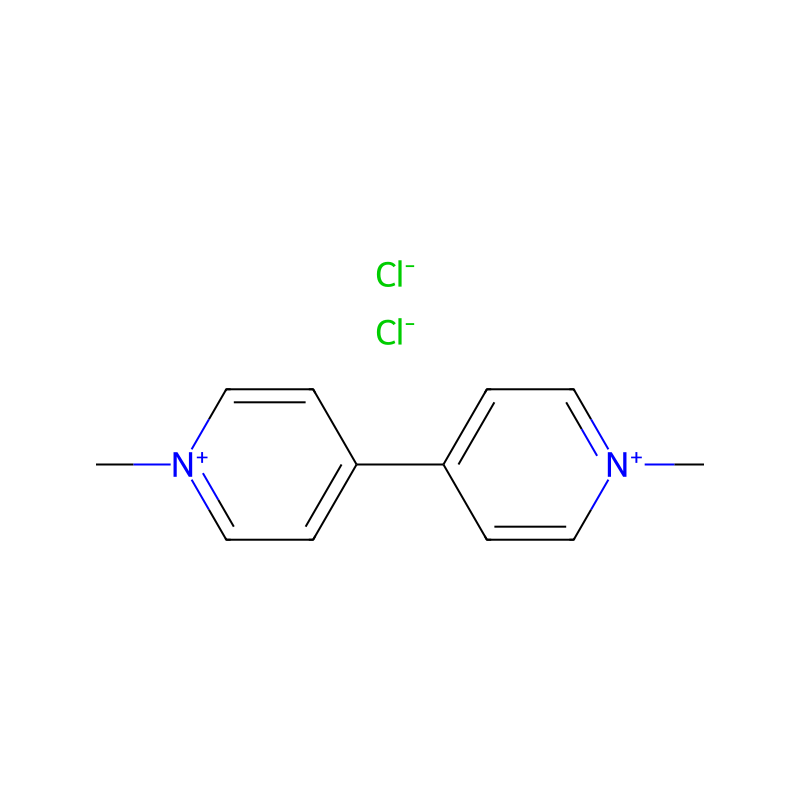
識別子と物理属性
| CAS No. | 1910-42-5 |
|---|---|
| 分子式 | C12H14Cl2N2 |
| 平均分子量 | 257.16 g/mol |
| 単同位体質量 | 256.0534038 g/mol |
| SMILES | C[n+]1ccc(-c2cc[n+](C)cc2)cc1.[Cl-].[Cl-] |
| InChIKey | FIKAKWIAUPDISJ-UHFFFAOYSA-L |
| PubChem CID | 15938 |
| ChEMBL | CHEMBL458019 |
| ChEBI | CHEBI:28786 |
| EC No. | 217-615-7 |
| DTXSID | DTXSID7024243 |
| 現地名 | グラモキソン |
化学・物理的性質
| 極性表面積 | 7.8 |
|---|---|
| 水素結合供与体数 | 0 |
| 水素結合受容体数 | 2 |
| 回転可能結合数 | 1 |
| 重原子数 | 16 |
| 形式電荷 | 0 |
| 複雑度 | 145 |
| LogP(分配係数) | -4.5 |
| 密度 | 1.24 to 1.26 at 68 °F (NTP, 1992)1.24 g/cm³1.25 |
| 溶解度 | greater than or equal to 100 mg/mL at 66 °F (NTP, 1992)Solubility in water, g/100ml at 20 °C: 62MiscibleMethanol (Sligthly)溶ける |
| 沸点 | Decomposes (NIOSH, 2024)403.89°C (rough estimate) |
| Decomposition | 300 °C |
| 融点 | Decomposes 572 °F (EPA, 1998)572 °F (decomposes)>300 °C(lit.) |
| 蒸気圧 | Approximately 0 (EPA, 1998)0.0000001 [mmHg]Vapor pressure, Pa at 25 °C:<0.0000001 mmHg0Pa at 25℃ |
| Physical Description | Paraquat dichloride is a colorless to yellow crystalline solid. Used as a contact herbicide and desiccant. (EPA, 1998)Yellow solid with a faint, ammonia-like odor. [herbicide] [Note: Paraquat may also be found commercially as a methyl sulfate salt C12H14N2+2CH3SO4.][NIOSH]COLOURLESS HYGROSCOPIC CRYSTALS.[herbicide] [Note: Paraquat may also be found commercially as a methyl sulfateYellow solid with a faint, ammonia-like odor. [herbicide] [Note: Paraquat may also be found commercially as a methyl sulfate salt C12H14N2 2CH3SO4.] |
| 屈折率 | 1.6400 (estimate) |
| 貯蔵条件 | Inert atmosphere,Room Temperature |
| 外観・状態 | 結晶または結晶性粉末 |
| 色 | ベージュまたはピンクからブラウン |
| Merck | 7031 |
| 安定性 | 安定。強力な酸化剤とは相容れない。 |
| LogP(分配係数) | -4.5 at 20℃ |
| CAS データベース | 1910-42-5(CAS DataBase Reference) |
| EPAの化学物質情報 | Paraquat dichloride (1910-42-5) |
化学的特性
off-white powder
安全性と法規制
| GHS 分類 | DangerH301: Toxic if swallowed [Danger Acute toxicity, oral]H311: Toxic in contact with skin [Danger Acute toxicity, dermal]H315: Causes skin irritation [Warning Skin corrosion/irritation]H319: Causes serious eye irritation [Warning Serious eye damage/eye irritation]H330: Fatal if inhaled [Danger Acute toxicity, inhalation]H335: May cause respiratory irritation [Warning Specific target organ toxicity, single exposureRespiratory tract irritation]H372 **: Causes damage to organs through prolonged or repeated exposure [Danger Specific target organ toxicity, repeated exposure]H400: Very toxic to aquatic life [Warning Hazardous to the aquatic environment, acute hazard]H410: Very toxic to aquatic life with long lasting effects [Warning Hazardous to the aquatic environment, long-term hazard]P260, P261, P262, P264, P264+P265, P270, P271, P273, P280, P284, P301+P316, P302+P352, P304+P340, P305+P351+P338, P316, P319, P320, P321, P330, P332+P317, P337+P317, P361+P364, P362+P364, P391, P403+P233, P405, and P501 (click each P-code to see the statement) |
|---|---|
| 規制情報 | Hazard Traits - Hazard Trait UndefinedAuthoritative List - CECBP - Priority ChemicalsReport - if used as a fragrance or flavor ingredientParaquat dichloride is listed in the dataset of EPA Human Health Benchmarks for Pesticides under the Safe Drinking Water Act (40 eCFR 141)Status: Active Update: 26-01-2023 https://echa.europa.eu/registration-dossier/-/registered-dossier/29834Paraquat dichloride: Does not have an individual approval but may be used as a component in a product covered by a group standard. It is not approved for use as a chemical in its own right.The New Jersey Worker and Community Right to Know Act requires public and private employers to provide information about hazardous substances at their workplaces. (N.J.S.A. 34:5A-1 et. seq.) |
| その他の安全情報 | IMAP assessments - 4,4'-Bipyridinium, 1,1'-dimethyl-, dichloride: Human health tier I assessmentIMAP assessments - 4,4'-Bipyridinium, 1,1'-dimethyl-, dichloride: Environment tier I assessment |
| 輸送ラベル(DOT) | Poison |
| 火災危険 | Avoid strong oxidizers. (EPA, 1998)Not combustible. Gives off irritating or toxic fumes (or gases) in a fire. |
| 健康有害性 | Can cause death due to severe injury to the lungs. The lowest lethal oral dose reported in humans is 43 mg/kg. (EPA, 1998) |
| 有害性の概要 | Contact injuries in workers include skin rashes, burns, eye damage from splashes, nail damage, and nasal bleeding. Parquat absorption through the skin can contribute to systemic toxicity, especially when contacting damaged skin or sensitive areas like the buttocks and genitalia. Toxic ingestion: low doses (<20 mg/kg) cause local irritation to oral and GI mucosamoderate doses (20-40 mg/kg) cause renal, liver and lung damage with respiratory failure within 2-3 weekshigh doses (>40 mg/kg) cause pulmonary fibroplasia, respiratory failure, and death within 1-7 days. [ACGIH] Classified as highly toxic, paraquat may be used only by certified applicators. [EXTOXNET] Prolonged contact will cause blistering of skin. Poisoning usually occurs after toxic ingestion, e.g., attempted suicide. [EPA Pesticides] Phototoxic contact dermatitis reported in farmworkers[Kanerva, p. 1823] A multigenerational study in rats given 100 ppm or 300 ppm dietary paraquat showed no effects on fertility or neonatal morbidity and mortality. In mice, maternal feeding with 125 ppm paraquat caused increased mortality in pups that was related to lung injury. [ACGIH] Among the many herbicides in use, only the bipyridyl compounds have appeared to produce hepatic injury in humans. Even these agents have produced hepatic injury only as the result of ingestion of large amounts, not because of environmental contamination and questionably as the result of occupational exposures. [Zimmerman, p. 415] Paraquat has a chemical structure similar to MPTP, but animal studies have failed to show that paraquat causes parkinsonism. [Rosenstock, p. 1111] See Paraquat. |
| 反応性グループ | Quaternary Ammonium and Phosphonium Salts |
| EC 分類 | Symbol: T+, NR: 24/25-26-36/37/38-48/25-50/53S: (1/2)-22-28-36/37/39-45-60-61 |
| UN 分類 | UN Hazard Class: 6.1UN Pack Group: I |
| Reactivity Profile | PARAQUAT DICHLORIDE is stable in acidic media, but unstable in alkaline media. It is photochemically decomposed by UV irradiation in aqueous solutions and is rapidly inactivated by soil. The neat chemical may be sensitive to light. This compound is corrosive to metal and it can react with strong acids, bases, and oxidizing agents. It is hydrolyzed by alkali compounds and it is inactivated by inert clays and anionic surfactants. (NTP, 1992) |
| Chemical Dangers | Decomposes above 300 °C . This produces toxic fumes including nitrogen oxides and hydrogen chloride. Attacks metals. |
| Flammable Limits | Noncombustible Solid |
| 消火 | This material is a bipyridilium compound. Procedures for bipyridilium pesticides are as follows. Small fires: dry chemical, carbon dioxide, water spray, or foam. Large fires: water spray, fog, or foam. Move container from fire area if you can do so without risk. Fight fire from maximum distance. Dike fire control water for later disposaldo not scatter the material. (EPA, 1998)In case of fire in the surroundings, use appropriate extinguishing media. |
| 応急処置措置 | Fresh air, rest. Refer immediately for medical attention.Remove contaminated clothes. Rinse and then wash skin with water and soap.Rinse with plenty of water for several minutes (remove contact lenses if easily possible). Refer immediately for medical attention.Rinse mouth. Give one or two glasses of water to drink. Give a slurry of activated charcoal in water to drink. Refer immediately for medical attention. |
| 応急処置 | Warning: Effects occur in two stages, immediate and delayed. Caution is advised. Exposure to paraquat may be fatalthere is no effective antidote.Signs and Symptoms of Acute Paraquat Exposure: Signs and symptoms of acute exposure to paraquat may be severe and include nausea, vomiting, diarrhea, and abdominal pain. A burning sensation of the mouth and esophagus with possible ulceration may occur following ingestion. Eye exposure may result in corneal opacification (cloudiness). Dermatitis and nail atrophy may occur following dermal contact. Delayed effects include transient reversible liver injury, acute renal failure, and progressive pulmonary fibrosis with associated dyspnea (shortness of breath) and pulmonary edema.Emergency Life-Support Procedures: Acute exposure to paraquat may require decontamination and life support for the victims. Emergency personnel should wear protective clothing appropriate to the type and degree of contamination. Air-purifying or supplied-air respiratory equipment should also be worn, as necessary. Rescue vehicles should carry supplies such as plastic sheeting and disposable plastic bags to assist in preventing spread of contamination.Inhalation Exposure:1. Move victims to fresh air. Emergency personnel should avoid self-exposure to paraquat.2. Evaluate vital signs including pulse and respiratory rate, and note any trauma. If no pulse is detected, provide CPR. If not breathing, provide artificial respiration. If breathing is labored, administer oxygen or other respiratory support.3. Obtain authorization and/or further instructions from the local hospital for performance of other invasive procedures.4. RUSH to a health care facility.Dermal/Eye Exposure:1. Remove victims from exposure. Emergency personnel should avoid self- exposure to paraquat.3. Remove contaminated clothing as soon as possible.4. If eye exposure has occurred, eyes must be flushed with lukewarm water for at least 15 minutes.5. Wash exposed skin areas three times with soap and water.6. Obtain authorization and/or further instructions from the local hospital for performance of other invasive procedures.7. RUSH to a health care facility.Ingestion Exposure:1. Evaluate vital signs including pulse and respiratory rate, and note any trauma. If no pulse is detected, provide CPR. If not breathing, provide artificial respiration. If breathing is labored, administer oxygen or other respiratory support.2. Obtain authorization and/or further instructions from the local hospital for performance of other invasive procedures.3. Vomiting may be induced with syrup of Ipecac. If elapsed time since ingestion of paraquat is unknown or suspected to be greater than 30 minutes, do not induce vomiting and proceed to Step(General first aid procedures)Eye: Irrigate immediately - If this chemical contacts the eyes, immediately wash (irrigate) the eyes with large amounts of water, occasionally lifting the lower and upper lids. Get medical attention immediately.Skin: Water flush immediately - If this chemical contacts the skin, immediately flush the contaminated skin with water. If this chemical penetrates the clothing, immediately remove the clothing and flush the skin with water. Get medical attention promptly.Breathing: Respiratory supportSwallow: Medical attention immediately - If this chemical has been swallowed, get medical attention immediately. |
| 安全保管 | Keep in a well-ventilated room. Well closed. Separated from food and feedstuffs. Provision to contain effluent from fire extinguishing. Store in an area without drain or sewer access. |
| 暴露管理・個人防護 | 0.1 [mg/m3], inhalable fraction[German Research Foundation (DFG)] |
| 非火災時の漏出対応 | (Non-Specific -- Bipyridilium Pesticide) Keep unnecessary people awayisolate hazard area and deny entry. Stay upwindkeep out of low areas. Ventilate closed spaces before entering them. Remove and isolate contaminated clothing at the site. If water pollution occurs, notify appropriate authorities. Do not touch spilled materialstop leak if you can do so without risk. Use water spray to reduce vapors.Small spills: absorb with sand or other noncombustible absorbent material and place into containers for later disposal.Small dry spills: with clean shovel place material into clean, dry container and covermove containers from spill area.Large spills: dike far ahead of spill for later disposal. (EPA, 1998) |
| 漏出処分 | Consult an expert! Personal protection: chemical protection suit including self-contained breathing apparatus. Do NOT let this chemical enter the environment. Collect leaking and spilled liquid in sealable containers as far as possible. Absorb remaining liquid in sand or inert absorbent. Then store and dispose of according to local regulations. Sweep spilled substance into covered sealable containers. If appropriate, moisten first to prevent dusting. Carefully collect remainder. Then store and dispose of according to local regulations. |
| Isolation and Evacuation | Excerpt from ERG Guide 151 [Substances - Toxic (Non-Combustible)]:IMMEDIATE PRECAUTIONARY MEASURE: Isolate spill or leak area in all directions for at least 50 meters (150 feet) for liquids and at least 25 meters (75 feet) for solids.SPILL: Increase the immediate precautionary measure distance, in the downwind direction, as necessary.FIRE: If tank, rail tank car or highway tank is involved in a fire, ISOLATE for 800 meters (1/2 mile) in all directionsalso, consider initial evacuation for 800 meters (1/2 mile) in all directions. (ERG, 2024) |
| Eye Prevention | Wear face shield or eye protection in combination with breathing protection if powder. |
| Inhalation Risk | Evaporation at 20 °C is negligiblea harmful concentration of airborne particles can, however, be reached quickly on spraying or when dispersed, especially if powdered. |
| Skin Prevention | Protective gloves. Protective clothing. |
| Exposure Prevention | PREVENT DISPERSION OF DUST! STRICT HYGIENE! |
| Treatment | In case of oral exposure, administer charcoal as a slurry. Consider after ingestion of a potentially life-threatening amount of poison if it can be performed soon after ingestion. The treatment is symptomatic and supportive. In case of eye exposure, irrigate exposed eyes with copious amounts of room temperature water for at least 15 minutes. In case of dermal exposure, remove contaminated clothing and jewellery. Wash the skin, including hair and nails, vigorouslydo repeated soap washings. Discard contaminated clothing. (T36) |
| 標的器官 | RespiratoryEyes, skin, respiratory system, heart, liver, kidneys, gastrointestinal tract |
| 健康影響 | It can cause temporary damage to nails and if swalloed, may cause nose bleeding. Long term exposures to paraquat would most likely cause lung and eye damage. Some suspect a possible link to a greater incidence of Parkinson's disease. Pancreatitis may develop in some cases of acute. Paraquat is caustic to the oral, esophageal, and gastric mucosa (T36, A545, L421). |
| 有害作用 | Occupational hepatotoxin - Secondary hepatotoxins: the potential for toxic effect in the occupational setting is based on cases of poisoning by human ingestion or animal experimentation.Nephrotoxin - The chemical is potentially toxic to the kidneys in the occupational setting.Dermatotoxin - Skin burns.Toxic Pneumonitis - Inflammation of the lungs induced by inhalation of metal fumes or toxic gases and vapors.Fibrogenic - Inducing tissue injury and fibrosis (scarring).ACGIH Carcinogen - Not Classifiable. |
| 暴露経路 | The substance can be absorbed into the body by inhalation of its aerosol, through the skin and by ingestion.inhalation, skin absorption, ingestion, skin and/or eye contactInhalation (T44)oral (T44)eye contat (T44)dermal (T44) |
| 毒性の概要 | The mechanisms of the toxic effects of paraquat are largely the result of a metabolically catalyzed single electron oxidation reduction reaction, resulting in depletion of cellular NADPH and the generation of potentially toxic forms of oxygen such as the superoxide radical (A607). Recent studies have demonstrated paraquat cytotoxicity occurs in the mitochondria and particularly in mitochondrial-rich tissues. The mitochondrial NADH-dependent PQ reductase containing a voltage-dependent anion channel 1 (VDAC1) appears to be largely responsible for paraquat cytotoxicity. When mitochondria are incubated with NADH and paraquat, the superoxide anion is produced, and the mitochondria rupture. Ruptured mitochondria lead to rapid cell death (A3102). |
| Signs and Symptoms | Cough. Sore throat. Headache. Nosebleeds.Redness.Redness. Burning sensation. Pain.Sore throat. Abdominal pain. Nausea. Vomiting. Diarrhoea.irritation eyes, skin, nose, throat, respiratory systemepistaxis (nosebleed)dermatitisfingernail damageirritation gastrointestinal tractheart, liver, kidney damageEye or skin irritationhypotension may develop after large ingestionepistaxis and sore throat may develop after inhalation. Nausea, vomiting, diarrhea, and abdominal pain are common (T36). |
| Acute Toxicity Link | Chemical: PARAQUAT |
| ICSC Environmental Data | The substance is very toxic to aquatic organisms. The substance may cause long-term effects in the aquatic environment. This substance does enter the environment under normal use. Great care, however, should be taken to avoid any additional release, for example through inappropriate disposal. |
| EPA IRIS Information | ParaquatRespiratory4.5 x 10 ^-3 mg/kg-day |
| Carcinogen Classification | No indication of carcinogenicity to humans (not listed by IARC). |
| Toxicity Data | LCLo (rat) = 1 mg/m3/6H for respirable dustLD50: 150 mg/kg (Oral, Rat) (L1008) LD50: >480 mg/kg (Dermal, Rabbit) (L1008) |
| 職業暴露区分(OEB) | D |
| 職業暴露限界(OEL) | TWA: 0.1 mg/m3 (resp) [skin] |
| 水環境危害等級(WGK) | 3 |
| 生命健康即時危険濃度 | 1 mg/m3 |
| RTECS 番号 | DW2275000 |
| 輸送番号(UN) | UN 2811 6.1/PG 1 |
| 毒性 | LD50 orally in rats: 125 mg/kg (Conning) |
| PRTR法 | 第一種指定化学物質 |
| 税関コード | 29333990 |
| 危険文句(R) | 24/25-26-36/37/38-48/25-50/53 |
| 化審法 | (5)-3722 |
| 安衛法 | 57,57-2 |
| 危険表示 | T+,N |
| 安全措置(S) | 22-28-36/37/39-45-60-61-28A |
| 危険等級 | 6.1(a) |
| 包装等級 | II |
| 毒劇物取締法 | 毒物 |
用途
解説
パラコート,無色の結晶.分解点340 ℃.水溶解度620 g L-1(20 ℃).光化学系Ⅰから電子を受けとり,酸素分子を還元して超酸化物を発生させ,細胞膜を損傷する非選択性除草剤.
用途
パラコート,白色結晶で水に溶ける。茎葉に処理することによって植物体内で活性酸素を生成し,ほとんどすべての雑草を枯死させる。土壌中では速やかに分解される。
用途
酸化還元酵素又は酵素系の水素(電子)受容体、供与体、中間電子伝達体。
用途
ビピリジニウム系除草剤の商品名で,一般名としてパラコートが用いられる。イギリスのICI社が,同系列の除草剤,ジクワットにひきつづいて,1950年代に開発した除草剤である。非選択的,非ホルモン系除草剤で,茎葉散布により接触的に殺草作用を示す。土壌表面で容易に吸着,不活性化するので,果樹園の下草の除草,非農地の除草に適し,水稲刈取り後のミズガヤツリ,マツバイの除草にも用いられる。パラコート, この薬剤は,光合成の明反応系から生ずる励起電子により還元を受け,さらに空気中の酸素により酸化されてもとの構造にもどる際に,生体内に過酸化物が生じ,これが殺草作用の原因となる。
説明
Paraquat dichloride is a dark blue liquid, non-combustible, stable herbicide chemical. It is incompatible with strong oxidising agents. On contact with fire paraquat decomposes gives off irritating or toxic fumes (or gases), nitrogen oxides, and hydrogen chloride. Paraquat dichloride contact and storage destroys metal. Paraquat dichloride hydrolyses in alkaline media and reacts with aluminium to produce hydrogen gas. Paraquat (N,N′-dimethyl-4,4′-bipyridinium dichloride) is one of the most widely used herbicides in the world. Paraquat dichloride is a herbicide currently registered to control weeds and grasses in many agricultural and non-agricultural areas. It is used preplant or preemergence on vegetables, grains, cotton, grasses, sugar cane, peanuts, potatoes, and tree plantation areas; post-emergence around fruit crops, vegetables, trees, vines, grains, soybeans, and sugar cane. It is also used on non-crop areas such as public airports, electric transformer stations, and around commercial buildings to control weeds. It has been reported that about seven pesticide products are registered which contain the active ingredient paraquat dichloride and classified as restricted use pesticides (RUPs). Paraquat dichloride and the products are primarily intended for ‘Occupational Use’. In the United States, Paraquat is classified as ‘restricted commercial use’, and people must obtain a license to use the product.
一般的な説明
Colorless to yellow crystalline solid. Used as a contact herbicide and desiccant.
製法・合成法
純化方法
Recrystallise the dichloride from MeOH/acetone mixture. It has also been recrystallised three times from absolute EtOH [Bancroft et al. Anal Chem 53 1390 1981]. Dry it at 80o in a vacuum. [Beilstein 23/8 V 30.]